
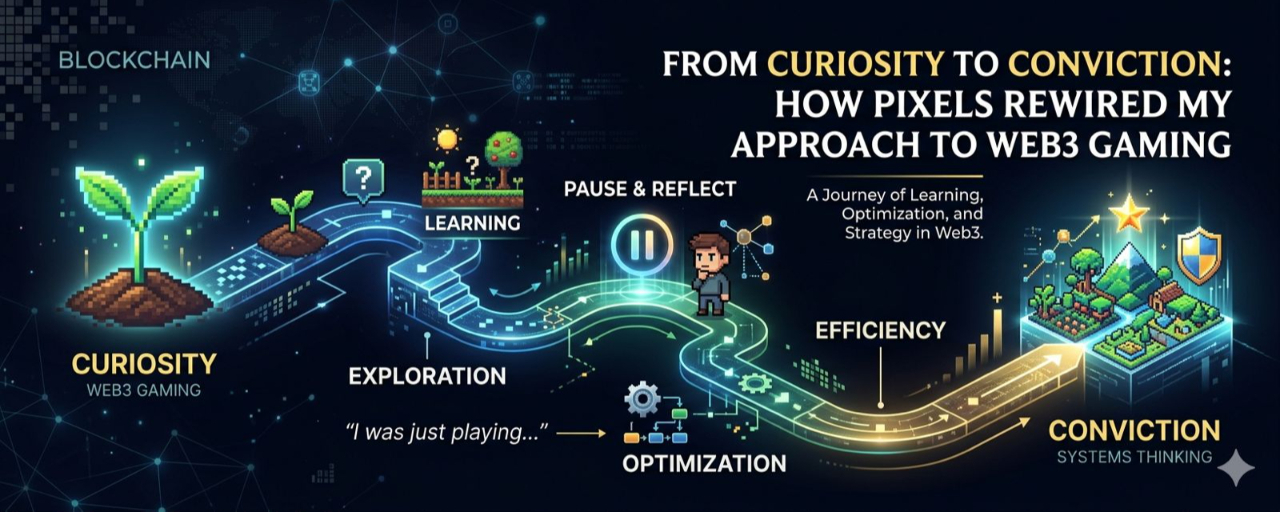

I didn’t start my journey with Pixels because I believed in it.
In fact, it was the opposite.
At that time, I had already explored several Web3 games, and to be honest, most of them left me disappointed. They either felt too complex, too technical, or simply not enjoyable. I was looking for something different... something that didn’t feel like I was forcing myself to understand it.
That’s when I stumbled upon Pixels.
At first glance, it looked simple. Almost too simple. A farming game in a Web3 environment? It didn’t sound revolutionary. But something about it made me stay a little longer than usual.
And that “little longer” turned into something much bigger.
I started casually — planting crops, harvesting, exploring the map. There was no pressure, no complicated onboarding, no overwhelming mechanics. It felt natural. And that’s exactly what caught me off guard.
For the first time, I wasn’t trying to “figure out” a blockchain game. I was just playing.
But slowly, things began to shift.
As I spent more time in Pixels, I started noticing subtle layers beneath the surface. Players weren’t just farming randomly... they were optimizing. They were making decisions. They were thinking ahead.
That’s when my mindset changed.
I moved from playing casually to playing consciously.
Instead of randomly planting crops, I started observing patterns. Which crops were more efficient? What timing worked best? How could I maximize output without increasing effort?
And that’s when I realized something powerful:
Pixels rewards thinking, not just playing.
But it wasn’t all smooth progress.
There were moments when I felt stuck. Times when my growth slowed down, and I couldn’t figure out why. At one point, I even questioned whether I was wasting my time.
But instead of quitting, I did something different.
I paused.
I analyzed my gameplay.
I realized that I was still operating with a short-term mindset. I was chasing quick results instead of building a system. That was my biggest mistake.
So I changed my approach completely.
I started thinking in cycles instead of actions. I focused on efficiency instead of speed. I stopped reacting and started planning.
And slowly, everything began to improve.
What surprised me the most wasn’t just the in-game progress... it was how this mindset started affecting other areas of my life. I became more patient, more strategic, and more aware of how small decisions compound over time.
Pixels wasn’t just a game anymore.
It became a learning environment.
A system where effort, patience, and smart decisions actually mattered.
Today, when I log into Pixels, I don’t see it as just another Web3 project. I see it as something that quietly reshaped how I approach opportunities... not just in gaming, but in general.
And the crazy part?
It all started with curiosity.