
Understanding the Bitcoin Halving Cycle: The Machine of Scarcity Behind Decentralized Digital Assets
Amid the ever-evolving landscape of global finance, Bitcoin remains both a star and an anomaly. Unlike fiat currencies that can be printed by central banks as needed for the economy, Bitcoin operates under strict monetary rules embedded in code—a digital economic constitution that cannot be altered by any government or institution.
The core of the Bitcoin monetary system is an event that occurs every four years: the Bitcoin Halving. For some, this is merely a technical routine. However, for astute market participants, the halving is the fundamental heartbeat that determines scarcity, network security, and historically, the price cycle of the world's largest cryptocurrency.
The Mechanism Behind Scarcity: Understanding Halving
Technically, Bitcoin Halving is a programmed event that automatically cuts the rewards (block reward) received by miners by 50%. This halving occurs every 210,000 blocks (approximately every four years) and will continue until the total maximum supply of 21 million BTC is fully mined—expected to occur in 2140.
Let's look at the trajectory of this reward reduction:
· 2009 (Genesis Block): 50 BTC per block
· 2012 (1st Halving): 25 BTC per block
· 2016 (2nd Halving): 12.5 BTC per block
· 2020 (3rd Halving): 6.25 BTC per block
· 2024 (4th Halving): 3.125 BTC per block
This mechanism creates a continuously declining inflation rate (disinflationary). If in the early years Bitcoin experienced double-digit supply inflation, post-halving 2024, Bitcoin’s annual inflation rate has plummeted below 1%, much lower than gold or modern fiat currencies. In this context, the term "Digital Gold" is not just marketing jargon; it is an economic blueprint deliberately crafted by its creator, Satoshi Nakamoto, to counter unlimited money printing.
Why is Halving So Important? More Than Just Numbers
Reducing the supply of new coins entering the market may sound simple, but the implications are vast and touch on three main pillars of the Bitcoin ecosystem:
1. Economic Fundamentals: Supply Shock Dynamics
Imagine a rare commodity, such as gold, where the annual production suddenly gets cut in half while global demand remains stable or increases. In theory, prices should adjust upwards. This is the basic premise behind the Bitcoin supply shock narrative.
With the decreasing supply from miners, the natural sell pressure from the mining industry diminishes. If capital inflows to products like Bitcoin Spot ETFs continue to rise, the imbalance between limited supply and high demand has historically formed the foundation for price appreciation cycles.
2. Network Security and Survival of the Fittest
Halving is a double-edged sword for miners. When revenue in BTC terms is cut in half, only miners with the highest operational efficiency (cheap electricity costs, modern ASIC hardware) can survive.
This process often triggers concerns about "miner capitulation." However, the Bitcoin protocol has an automatic adjustment mechanism: Difficulty Adjustment. If many inefficient miners exit and the network's hash rate drops, the difficulty level of mining will decrease. This makes it easier for the remaining miners to find blocks, keeping transaction confirmation times stable at around 10 minutes. This is a form of intelligent homeostasis that ensures the network remains healthy and resilient post-shock.
3. Business Diversification in Modern Mining Era
Interestingly, the post-halving era of 2024 shows a shift in strategy among large mining corporations. Instead of merely surviving the reduced BTC rewards, many companies like TeraWulf and Core Scientific are starting to shift their excess electricity capacity and data center infrastructure to the Artificial Intelligence (AI) and cloud computing sectors.
This transformation is a testament to the maturity of the industry: modern Bitcoin miners are no longer just collectors of digital coins, but rather providers of large-capacity energy and computing infrastructure looking for more stable revenue sources to complement crypto income volatility.
Reading Historical Cycles: Will History Rhyme Again?
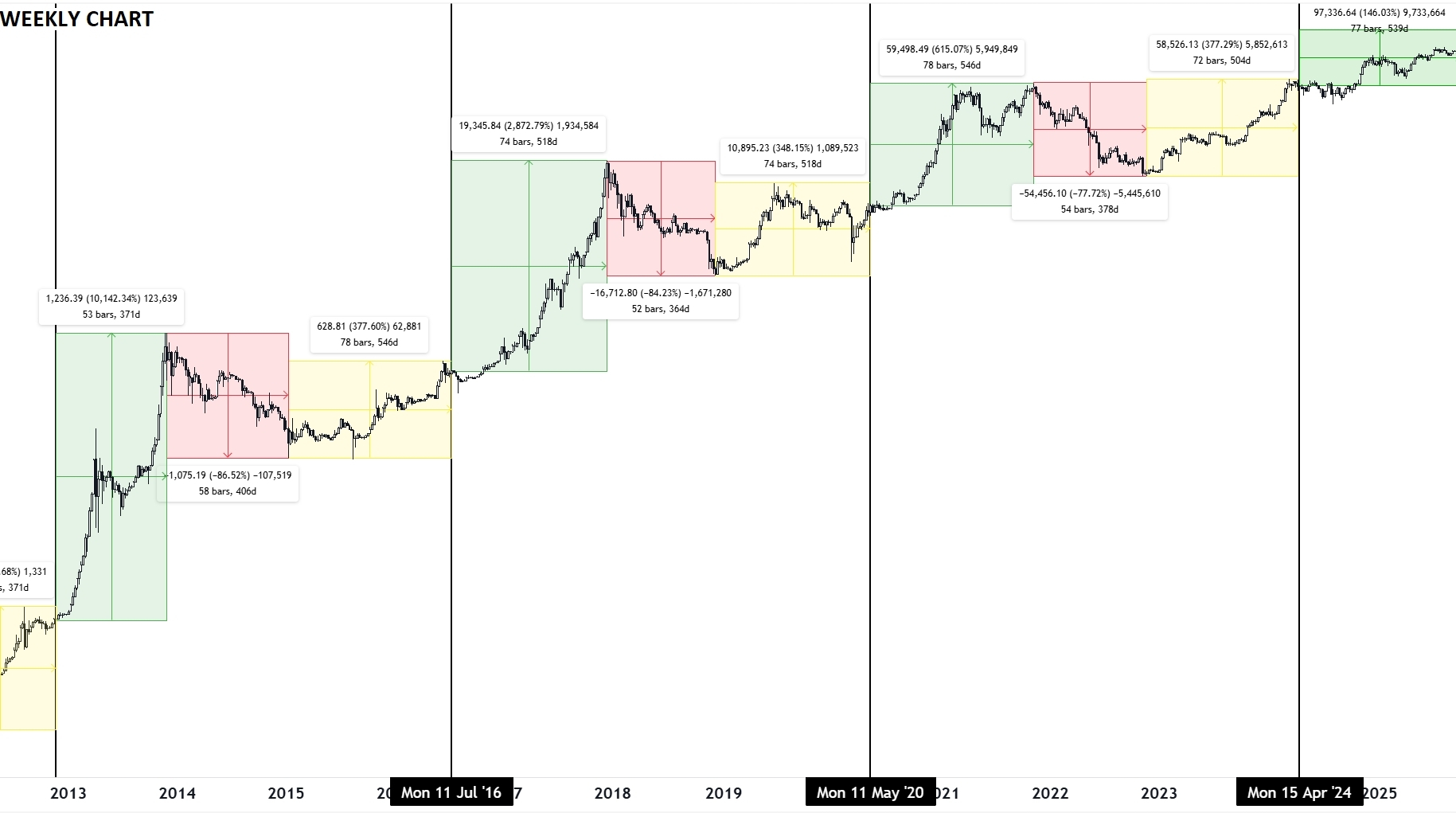
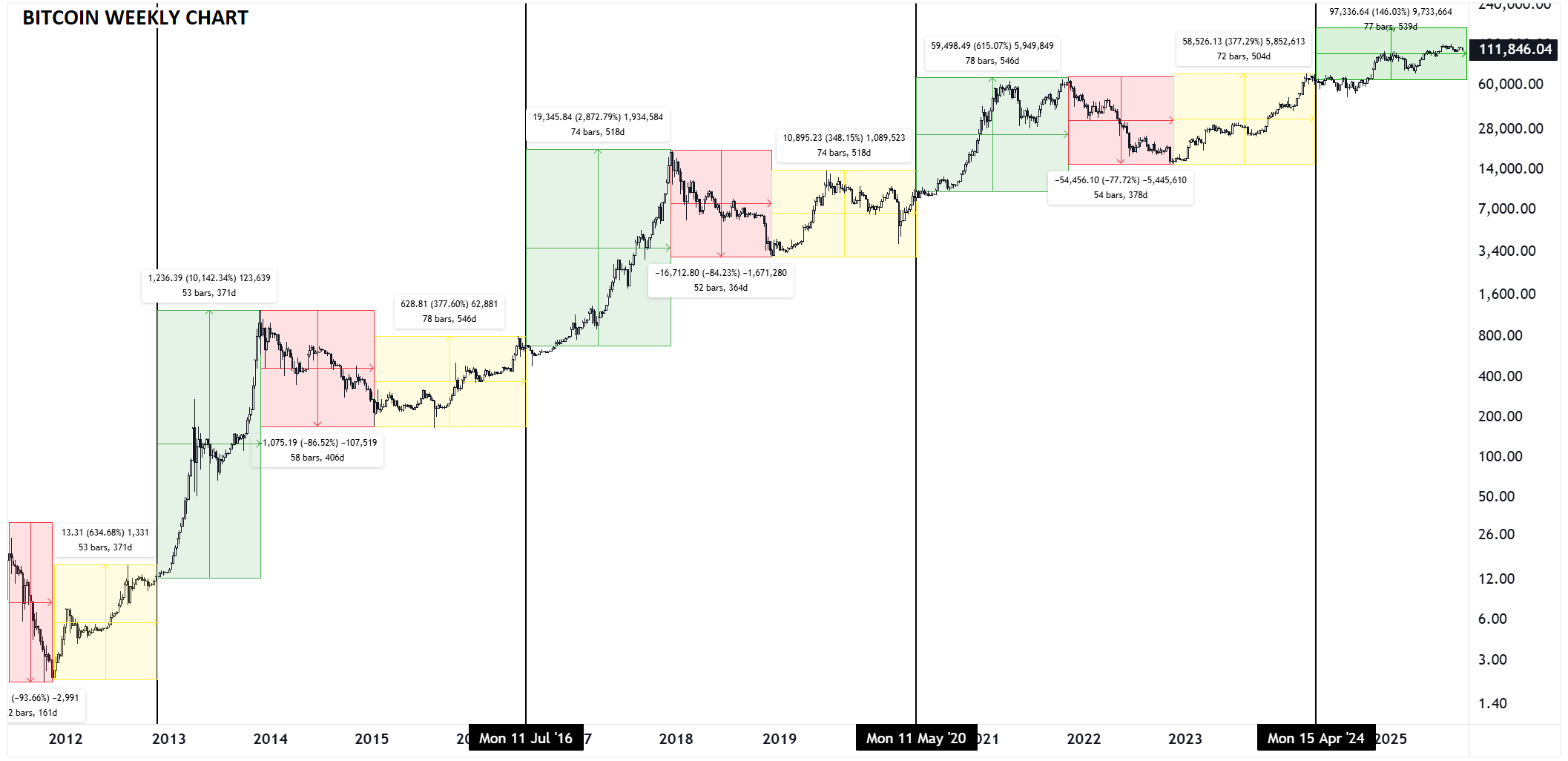
Analyzing historical data from the three previous halving cycles provides a near-poetic pattern. Consistently, new all-time high prices are reached around 12 to 18 months after the halving event.
· 2012 Cycle: Extraordinary increase of over 7,000% in the year post-halving.
· 2016 Cycle: Appreciation of around 291% in the same period.
· 2020 (3rd Halving): 541% surge, pushing Bitcoin to $69,000.
However, it's important to note that the percentage gains are decreasing as Bitcoin's market capitalization grows. Moving a trillion-dollar market capitalization requires much larger liquidity injections compared to a decade ago. As a result, volatility may also subside as institutional adoption increases.
Post-halving April 2024, the market witnessed a new dynamic: For the first time, Bitcoin managed to breach its previous all-time high before the halving occurred, driven by the approval of Bitcoin Spot ETFs in the U.S. This indicates that the halving narrative has now become a consensus trade calculated by mainstream financial markets, no longer a secret among the crypto community alone.
Impact on Traders and Investors: Navigating the 2024-2028 Cycle
Currently, Bitcoin has entered the second half of the fourth halving cycle towards the next event in 2028 (expected to occur at block 1,050,000, with the reward dropping to 1.5625 BTC). For those looking to capitalize on this cycle on platforms like Binance, here are some key narratives to pay attention to:
1. Shift from "4-Year Cycle" to Macro Cycle: Although halving remains foundational, Bitcoin's price movements are increasingly tied to global macroeconomic conditions—such as the Fed's interest rate policies and global liquidity. Institutional capital flows through ETFs may potentially dampen sharp downturns that typically occur in the second year of the cycle.
2. Accumulation Amidst Volatility: Historical data shows that the period around 12 months after halving is often characterized by price consolidation. This has historically been an accumulation phase for long-term investors before the next potential significant movement.
3. Impact of Derivatives and Liquidity: The Bitcoin derivatives market is now much more liquid. Large short position liquidations can trigger a short squeeze that accelerates price increases in the short term, as seen in the rapid movement towards the $76,000 level in 2025.

Conclusion: Understanding Code, Understanding Value
Bitcoin Halving is a real testament that monetary systems can operate under clear, transparent, and anti-inflationary rules—a stark contrast to the uncertainties of traditional monetary policy. As we move towards the 2028 halving, Bitcoin's scarcity will become increasingly felt.
For the Binance community, understanding halving doesn’t mean trying to precisely guess the highest or lowest price points. Rather, it’s about understanding why this asset is designed to be scarce, and how that programmed scarcity could potentially affect market equilibrium in the long term. Whether you are a short-term trader leveraging volatility or a long-term holder who believes in the digital gold narrative, halving is a fundamental reminder that in the world of Bitcoin, code is law.
Disclaimer: This content is informational and educational, not financial advice. Always do your own research (DYOR) before making investment decisions.
