
Most people still read Pixels like a familiar Web3 game story: launch a token, distribute rewards, grow users, and hope the economy survives the extraction cycle. But the new PIXEL design points to a more unusual idea. In the staking section of its whitepaper, Pixels says, “One token. Many ‘validators.’ The validator is the game,” and explains that games replace traditional validators while stakers help decide which games receive ecosystem resources and incentives.
That changes what staking actually does.
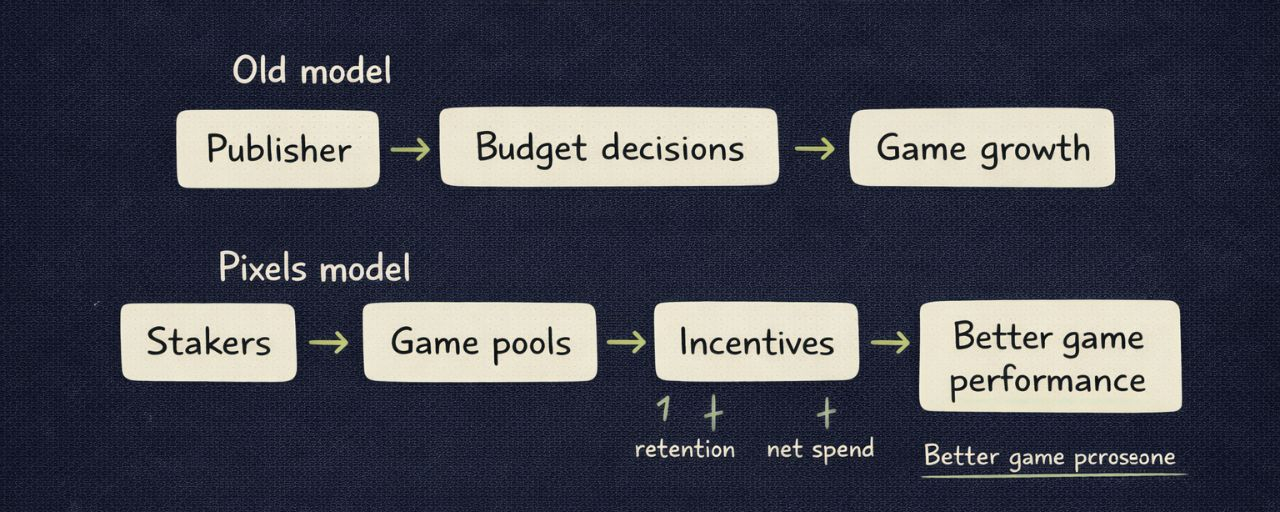
In a normal network, validators secure block production. In Pixels, staking is framed less as infrastructure security and more as ecosystem capital allocation. Users stake into individual game pools, and the whitepaper says the amount staked into each game affects that game’s future share of emissions and incentives. Pixels also says games compete for that stake by showing strong retention, high net in-game spending, and effective use of ecosystem tools.
This is why the phrase “games as validators” matters.
It does not mean games validate blocks in the technical sense. It means games are being evaluated as destinations for capital, incentives, and future support. That starts to look a lot like publishing, except with a different decision-maker. Instead of a publisher allocating budget entirely from the top down, Pixels is building a model where community stake becomes part of the allocation logic. That is my inference from the way the whitepaper links game pools, future incentives, and community signals on game quality.
The broader point becomes clearer when you connect staking to the flywheel.
Pixels describes a circular system where PIXEL staking becomes UA credits, those credits fund targeted in-game rewards, player spend creates revenue share, stakers receive rewards, and the resulting activity generates richer data and smarter targeting. The whitepaper also says a game’s staking pool converts into an on-chain UA budget that studios can use instead of buying ads on platforms like Facebook or TikTok.
That makes the publishing angle more serious than it first appears.
Traditional publishing usually controls three things: distribution, incentive budgets, and performance feedback. Pixels is trying to put all three inside one loop. Stake helps determine where growth capital goes. Rewards are used as targeted acquisition spend. Data from purchases, quests, trades, and withdrawals feeds back into the system to improve future targeting. The whitepaper says these events are logged through the Pixels Events API and that models retrain nightly to improve retention, ARPDAU, and RORS.
This also helps explain why the redesign came after a reset.
In its revised-vision section, Pixels says 2024 exposed three problems: token inflation, sell pressure, and mis-targeted rewards. In response, it says it shifted toward data-backed incentives, liquidity fees, and a new publishing model where players influence and benefit from the success of individual games. The same section says the project’s longer-term ambition is to become a decentralized AppsFlyer or AppLovin for both Web3 and Web2 games.
So when I look at Pixels, I do not think the main question is whether PIXEL is simply a good gaming token.
I think the more interesting question is whether Pixels can turn staking into a publishing market, where games compete for capital by proving better economics, better retention, and better contribution to the ecosystem. If that model works, “the validator is the game” will matter not as a slogan, but as a new way of deciding which games deserve to grow. That conclusion is an inference from Pixels’ staking, publishing, flywheel, and revised-vision sections taken together.
