
I’ve been thinking about this for a long time…
when a game slowly turns into an economic system, is that actually progress or are we quietly losing the fun that made games worth playing?
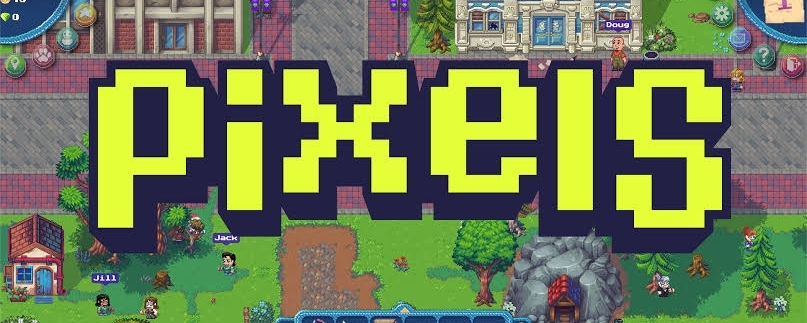
This question keeps coming back whenever I look at Pixels.
From the outside, it looks like a clear success.
More players, more activity, more hype.
But when I look a bit deeper, things don’t feel that simple.
That’s where the real discussion begins for me.
I remember when Pixels was on Polygon.
It felt like a straightforward farming-style onchain game.
Simple, easy to get into, not overly complex.
Then the shift to Ronin happened.
And honestly, that changed everything.
Ronin is built for gaming low fees, fast transactions, and an existing player base.
So naturally, growth followed.
But I keep wondering…
was that growth because the game improved,
or because the environment made it easier for people to join?
Because I’ve seen this before growth doesn’t always mean real engagement.
Sometimes it’s just reduced friction.
And those two are often hard to separate.
When I look at the core design, Pixels seems to revolve around three things:
land, resources, and token economy.
Land acts like NFTs.
Resources drive production.
Players take on different roles owners, tenants, producers.
On paper, it looks like a small digital economy.
But this is also where I start to feel a shift.
The gameplay becomes more about efficiency.
Less about playing, more about calculating.
I catch myself thinking
how much return does this action give?
Which resource is more profitable?
At that point, it starts feeling less like a game
and more like a system to optimize.
Then there’s the PIXEL token.
It’s everywhere upgrades, items, progression, land development.
And yes, that gives it strong utility.
But I can’t ignore the other side.
The more the system depends on the token,
the more sensitive everything becomes to market conditions.
And suddenly, it’s not just a game anymore.
It feels like I’m participating in a financial loop.
There are mechanisms to balance things burning, sinks, adjustments.
But I keep asking myself…
is that balance coming from actual gameplay,
or is it being held up by external demand?
Now with Chapter 2, things are getting deeper.
Production chains, industry systems, more complex mechanics.
I do think that’s necessary.
Simple “tap and harvest” loops don’t last forever.
But again, I have the same doubt.
Is this making the game more fun?
Or just adding more economic layers?
Because I’ve noticed a pattern in Web3 games
systems keep expanding,
but the fun doesn’t always grow with them.
Sometimes it even shrinks.
And when everything becomes optimized,
the experience starts to feel heavy.
I can’t deny that Ronin gave Pixels a strong boost.
Liquidity, users, infrastructure it was all there.
But long-term sustainability feels like a different challenge.
If the incentive-driven players leave,
will the core gameplay still hold up?
Or will activity drop along with the economy?
That’s the uncomfortable part I keep coming back to.
We often measure Web3 games by economic activity.
But “quiet fun” the kind that keeps me coming back without thinking about rewards
is rarely talked about.
And honestly, that’s what really drives retention.
I don’t think Pixels is failing.
If anything, I see it as an experiment.
An attempt to turn a game into a living economy.
But experiments come with uncertainty.
And in the end, I’m left with the same question
do I want every action in a game to create value?
or do I still want space for things that are just.. fun for no
reason?
Maybe the future sits somewhere in between.
Or maybe it doesn’t.
For now, I’m just watching how it unfolds.