
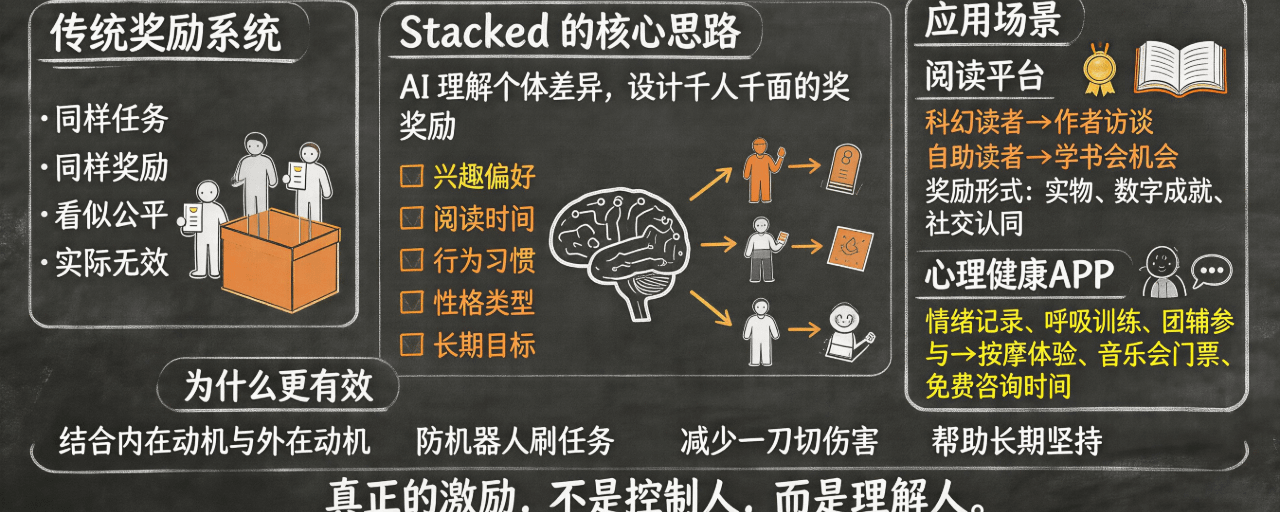

We often complain that rewards are unfair: on gaming platforms, completing the same task sometimes results in different people receiving exactly the same rewards, while at other times, some individuals are favored. The founding idea of Stacked is to break this dilemma, allowing AI to understand player differences and achieve personalized rewards for everyone. This applies not only to gaming but also to consumption, fitness, and various aspects of personal development.
Imagine yourself as a person who loves reading. When you finish a book on a reading platform, the system does not simply issue you a 'generic' point. Instead, it analyzes your reading time, preferred themes, and reading frequency to give you a reward that best stimulates your next action. If you enjoy science fiction, it might unlock a rare author interview for you; if you lean towards self-help books, it could offer an opportunity to participate in a book club. The form of rewards also varies from person to person: some prefer physical gifts, others enjoy digital achievements, and some appreciate social recognition. Stacked's AI module can make these judgments based on personality types, daily behaviors, and long-term goals.
This involves an important psychological concept: the combination of intrinsic and extrinsic motivation. When a person completes a task, they are more likely to maintain long-term motivation if the rewards align with their intrinsic value needs. Traditional reward systems are too simplistic, leading to a lack of differentiation between 'gold farmers' and real players; whereas Stacked analyzes behavioral differences to prevent bot task spamming while avoiding harm to genuinely passionate players. This approach may be used for corporate incentives in the future: employees may receive rewards tailored to their personal development after completing projects, such as training opportunities, conference tickets, or health experience cards.
Personalized rewards can also be applied in the mental health field. Suppose a mental health consulting app sets a series of small goals for users through Stacked, such as recording emotions daily, completing breathing exercises, or participating in group counseling. The AI selects appropriate rewards based on the users' emotional fluctuations and completion status: for example, a free massage, a concert ticket, or additional free consultation time. This avoids the oppressive feeling of mandatory tasks and gently guides users to enhance their self-care motivation. This makes $PIXEL 's value transcend mere economic significance, becoming a tool to guide people towards a healthier lifestyle.
The article illustrates how AI can understand individual motivation and formulate rewards through examples from reading platforms and mental health apps. As a reader, I realize that fairness does not mean a one-size-fits-all approach; what truly motivates people is differentiated feedback that comes from being understood and respected. If every reward system in the future can understand me like Stacked does, perhaps doing things will no longer require 'self-control' but rather collaboration with one's intrinsic motivation.@Pixels #pixel