I've spent enough time digging into Web3 games to know that most of them don't hold my attention beyond the first hour. The ones that do, like Pixels, make me curious about the machinery underneath. Not the blockchain—that part is almost boring now—but the decisions the team keeps making about how people actually use a game like this. The game runs on Ronin, a sidechain built for handling game transactions without the friction you get elsewhere. That technical choice matters, but what's more interesting is the shift in thinking that's been happening over the last year. The project moved away from chasing vanity metrics and started focusing on something harder: keeping the people who actually care around longer.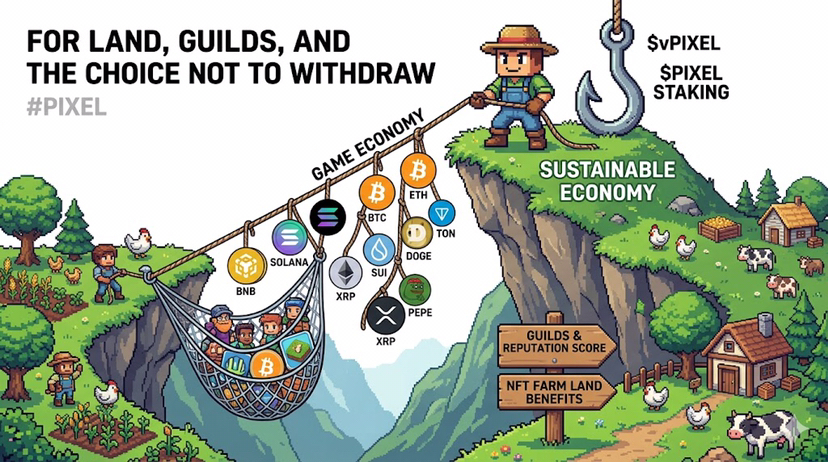
The core loop is deceptively simple. You farm. You gather resources. You craft items, complete quests, and gradually build up a little pixelated homestead. The art style borrows from the same warm, familiar palette that made games like Stardew Valley and Harvest Moon stick. You don't need a tutorial to understand what to do. Plant seeds, wait, harvest, repeat. There's a comfort in that rhythm, and I think that's exactly why it works. The team has said outright that they're not trying to build a casino. That's not just talk. You can feel it in the way the game doesn't push you toward constant spending or high-risk bets. It rewards consistency, not luck. Chapter 2 introduced new resource tiering and crafting systems that made the economy feel more deliberate. Then came the animal care mechanics earlier this year, adding another layer of management that doesn't feel like a chore. Each addition seems aimed at giving players more reasons to log in without turning the whole thing into a second job.
I keep coming back to the two-token system because it's the clearest sign that someone thought this through. There's BERRY, the workhorse currency you earn by playing normally. Then there's PIXEL, which functions as premium currency—used for speeding up builds, unlocking skins, getting special items, minting new land, or joining guilds. The whitepaper draws a direct parallel to gems in Clash of Clans, and that comparison is apt. You don't need PIXEL to progress through the basic game, but having some opens up optional paths and conveniences. One hundred thousand new tokens are minted each day and distributed to active players who engage in behaviors the ecosystem wants to encourage. There's also a burn mechanism built into the in-game store: proceeds go to a treasury, and a large portion gets burned daily. That's not a small detail. It means the supply side has some discipline baked in, which matters when you're dealing with an economy that real people are participating in with real expectations.
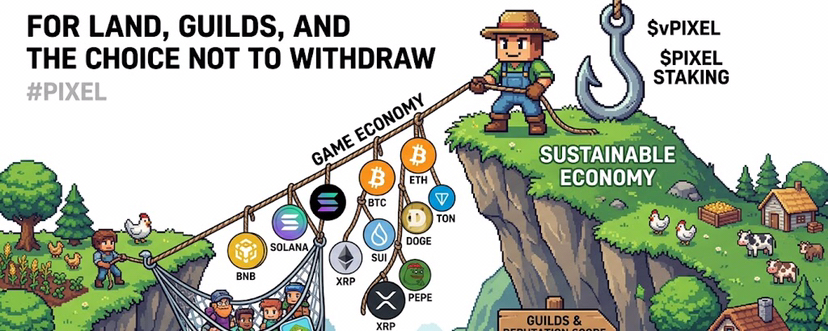
What's changed recently is the introduction of $vPIXEL, a non-withdrawable token backed one-to-one by $PIXEL. You can spend it in-game, use it across multiple titles in the ecosystem, and stake it without paying withdrawal fees. The choice it presents is clean: either pay a fee to take your PIXEL out, or convert to $vPIXEL and keep it circulating inside the game world. I find that mechanic clever because it aligns incentives without being punitive. It rewards the kind of player who's more interested in playing than cashing out. It also helps stabilize the broader economic flow, which is something the team has been explicit about prioritizing. Higher withdrawal fees now get redirected to stakers, and if you hold Farm Land NFTs, you receive bonus rewards on top of that. Auto-staking is the default for in-game holdings, which removes friction and nudges people toward longer-term participation.
The guild system deserves a mention because it's not just a social layer glued on for appearances. Guilds let landowners associate their NFT Farm Land with a group, providing access to higher-tier resources and private plots where members can complete daily tasks without competing with the public. Creating a guild costs fifteen PIXEL and requires a reputation score of nineteen fifty, which acts as a soft barrier against spam. It's a small but thoughtful way to build communities that have a stake in the game's long-term health. I've seen too many projects bolt on guild features without giving them any real function. Here, the land association and resource benefits make guild membership something you might actually care about.
Looking ahead, Chapter 3 is where things get more ambitious. The team has been talking about competitive land mechanics that lean toward economic PvP rather than random-number-generator gambling. The idea is to create a system where the risk you take is something you can model and understand, not just a dice roll. They've been open about wanting to hit a Return on Reward Spend above one, which would mean the economy is generating more value in sinks than it's leaking out. That's a technical way of saying the game needs to earn its own keep. Alongside this, the roadmap includes smoother progression paths and rebalanced resource loops, all aimed at making the farming and crafting core sustainable over the long run. Multiplayer alignment is getting attention too, with plans to strengthen shared goals and social incentives. None of this sounds like a relaunch. It reads more like tightening bolts on a machine that's already running.
I'm not trying to sell anyone on Pixels. I'm just pointing out that when you look past the pixel art and the farming loops, there's a team making deliberate, sometimes difficult choices about how to keep a game economy breathing. They've acknowledged that the shift toward sustainability reduced the playerbase temporarily, and they're working to bring those numbers back up without breaking what they've fixed. That kind of candor is rare. It's easier to hype user counts and pretend everything is fine. What's happening here is less flashy but probably more honest. And in a space that often feels allergic to honesty, that's worth paying attention to.
#Pixel @Pixels $PIXEL