
Zcash (ZEC) Financial Analysis Report $ZEC

Analysis Period: April 3 – April 18, 2026 (Last 15 Days)
Current Price (as of April 18, 2026): Approximately $341–357
Market Cap: Approximately $5.69–5.93 billion
📈 Key Price Movements (Last 15 Days)
April 3 (Recent Low): ZEC traded at approximately $240.70, marking the low point of the period following a broader market correction. Prior to this, ZEC had hit a low of approximately $200 in March before beginning a recovery.
April 6–11 (Consolidation & Critical Test): Price traded in the $248–$341 range. On April 6, analysts warned ZEC was at a "make-or-break" moment—if it failed to break above its descending trendline, a 20% drop toward $200 was possible. ADX fell below 25, indicating weak momentum, while large short positions accumulated in the $238–$257 zone.
April 12–15 (Major Breakout): A decisive breakout occurred as ZEC surged approximately 25% in a single session, climbing to a three-month high of $330. This breakout was confirmed by bullish signals from Supertrend and MACD indicators, along with the price emerging from a descending triangle pattern. On April 15, ZEC traded at $363.83, up 66.06% over the prior 30 days.
April 16 (Resistance Breaks): On April 16, ZEC shattered the critical $370 resistance level that had capped gains for months. This technical breakout opened the path toward the $400–$420 range, with analysts projecting a move to $400+ within 7–14 days. The token was trading at $341.46 (Gate data) to $356.88 (XT data) with 24-hour trading volume of approximately $420 million.
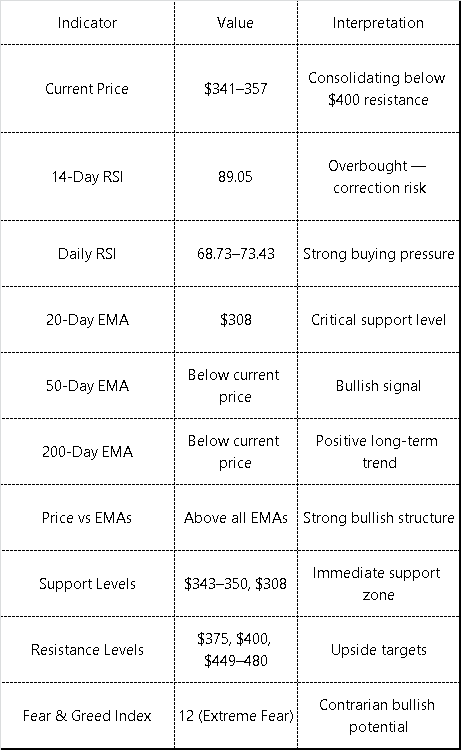
April 17–18 (Pullback & Consolidation): Following the explosive breakout, ZEC experienced a slight pullback, trading in the $341–$357 range. The 20-day EMA at $308 served as critical support, with the token remaining above the $300 level—a key condition for maintaining the medium-term bullish trend.
💡 10 Key Financial Lines
Here are ten key data points and insights that define ZEC's recent performance:
Period Low: On April 3, 2026, ZEC closed at $240.70, the lowest level observed in the past 15 days. Just prior, in March, the token had reached a low of approximately $200.
Period High: On April 16, ZEC broke through $370 resistance—its highest level in months—and touched as high as $372.23 (CoinLore data) before pulling back slightly.
30-Day Performance: ZEC has surged 66.06% over the past 30 days, demonstrating strong bullish momentum after bottoming near $200 in March.
One-Year Performance: The token has risen 964.94% from $34.16 one year ago, highlighting a remarkable long-term recovery despite recent volatility.
Market Capitalization: ZEC's market cap has expanded to approximately $5.69–5.93 billion, with a market share of 0.21% of the total crypto market.
24-Hour Trading Volume: Trading volume spiked to approximately $513 million on April 15 and stood at $409–420 million by April 16–17, indicating heightened market interest.
Technical Breakout Confirmed: ZEC emerged from a descending triangle pattern on April 12–15, with bullish signals from Supertrend and MACD indicators. The critical $370 resistance—which had capped gains for months—was decisively broken on April 16.
Key Support & Resistance Levels: Support is identified at $343–350 (former resistance turning support) and $308 (20-day EMA). Resistance stands at $375, $400 (psychological threshold), and $449–480 for an extended rally.
RSI Overbought Warning: The 14-day RSI reached 89.05 on some measures—deep in overbought territory—while daily RSI stood at 68.73–73.43, signaling strong buying pressure but also potential for a short-term correction.
Institutional Accumulation Pattern: On-chain data shows large block trades appearing consistently during Asian trading hours over the past two weeks—a pattern associated with institutional accumulation rather than retail FOMO.
🔬 Fundamental Drivers
Adoption & Privacy Metrics:
Shielded pool adoption continues to accelerate. As of mid-March 2026, shielded transactions accounted for approximately 86.5% of Zcash activity, with 31.1% of circulating supply now shielded—an all-time high. Shielded pools have reached a record $5.18 billion in locked value, representing 31.14% of total circulating supply. The shift toward "encryption-first" design—with wallets like Zodl routing users into shielded pools by default—has nearly doubled shielded transaction rates since early 2025.
Post-Quantum Development (Project Tachyon):
Zcash is pursuing Project Tachyon to address quantum computing threats. Recent research from Caltech and Google suggests that quantum attacks on ECC-256 could become feasible within the next 3–5 years, compressing the timeline for migration to post-quantum cryptography. Project Tachyon includes "Oblivious Synchronization," designed to remove encrypted note data from the blockchain entirely, leaving only proofs and commitments on-chain—eliminating ciphertext that future quantum computers could collect. Zcash researchers are also testing lattice-based algorithms aligned with NIST's post-quantum standards.
Institutional Positioning:
Cypherpunk Technologies (Nasdaq: CYPH), backed by the Winklevoss twins, has accumulated over $90 million in ZEC and led the seed funding round for the Zodl wallet. Grayscale has framed Zcash as a potential repricing opportunity, arguing that AI-enabled surveillance could make privacy a core monetary feature.
Development Model Restructuring:
In Q1 2026, Zcash transitioned away from a centralized development model. The original Electric Coin Company (ECC) team resigned in January, and the ecosystem is now managed by three separate entities: the Zcash Foundation (governance), Shielded Labs (network sustainability), and Zodl (commercial wallet development). This intentional fragmentation is designed to speed execution and broaden fundraising options.
⚠️ Regulatory Headwinds
Zcash faces significant regulatory pressure globally, which continues to act as a structural overhang on price:
India: India's Financial Intelligence Unit (FIU-IND) issued updated AML/CFT guidelines on January 8, 2026, ordering registered crypto exchanges to halt deposits, withdrawals, and trading of privacy coins. Exchanges including Mudrex have delisted ZEC, with automatic liquidation of holdings into USDT for users who fail to exit before deadlines.
Dubai: The Dubai Financial Services Authority (DFSA) has restricted privacy coins within the Dubai International Financial Centre (DIFC). Licensed exchanges and financial institutions can no longer list, market, or trade ZEC. Individuals may still hold privacy coins in personal wallets, but institutional access has been effectively closed.
Multiple Platforms Delisting: OKX, Bit2Me, and Binance Dubai have announced or implemented removal plans for ZEC. The issue centers on shielded transfers that obscure sender, receiver, and amount, making compliance with sanctions and AML checks impossible for regulated exchanges.
Regulatory Outlook: The privacy coin sector is at a critical juncture. 2026 is expected to see continued regulatory pressure on fully anonymous coins in H1, followed by potential revaluation in H2 as ZEC's governance structure stabilizes and zero-knowledge proof applications accelerate in regulated financial compliance scenarios.
📊 Technical Summary
⚖️ Summary: A Balanced View of the Volatility
Zcash (ZEC) has experienced one of its most dramatic 15-day turnarounds in recent memory. Starting from $240 on April 3—fresh off a March low near $200—the token surged over 50% in less than two weeks, breaking through the critical $370 resistance that had capped gains for months. This move has been driven by a confluence of factors: accelerating shielded transaction adoption (86.5% of all activity), record $5.18 billion in shielded pool value, institutional accumulation by firms like Cypherpunk Technologies ($90M+ position), and a technical breakout from a descending triangle pattern.
However, significant risks remain. Regulatory headwinds are intensifying—India and Dubai have effectively barred ZEC from regulated exchanges, with OKX and Binance Dubai following suit. The token's privacy features, while its core value proposition, are precisely what make it a compliance target globally. Additionally, technical indicators show RSI in deeply overbought territory (89.05 on 14-day), suggesting a short-term correction is likely before any sustained move above $400.
The fundamental picture offers both promise and caution. Shielded adoption is at all-time highs, post-quantum development (Project Tachyon) positions Zcash for long-term relevance, and institutional interest is growing. Yet the governance transition away from ECC remains early-stage, and regulatory clarity—particularly regarding how "selective disclosure" features can satisfy compliance requirements—is still developing.
Key Takeaway: ZEC is at a pivotal moment. The recent breakout above $370 represents a significant technical victory after months of consolidation, opening the door to $400–480 in the short term. However, regulatory overhang from global exchange delistings remains the dominant structural risk. Investors should watch three key variables: (1) whether ZEC can hold above $350 support; (2) the pace of further exchange delistings; and (3) progress toward compliance-compatible selective disclosure solutions that could reconcile privacy with regulatory demands.
Note: Cryptocurrency markets are highly volatile. This analysis is for informational purposes only and does not constitute investment advice.