

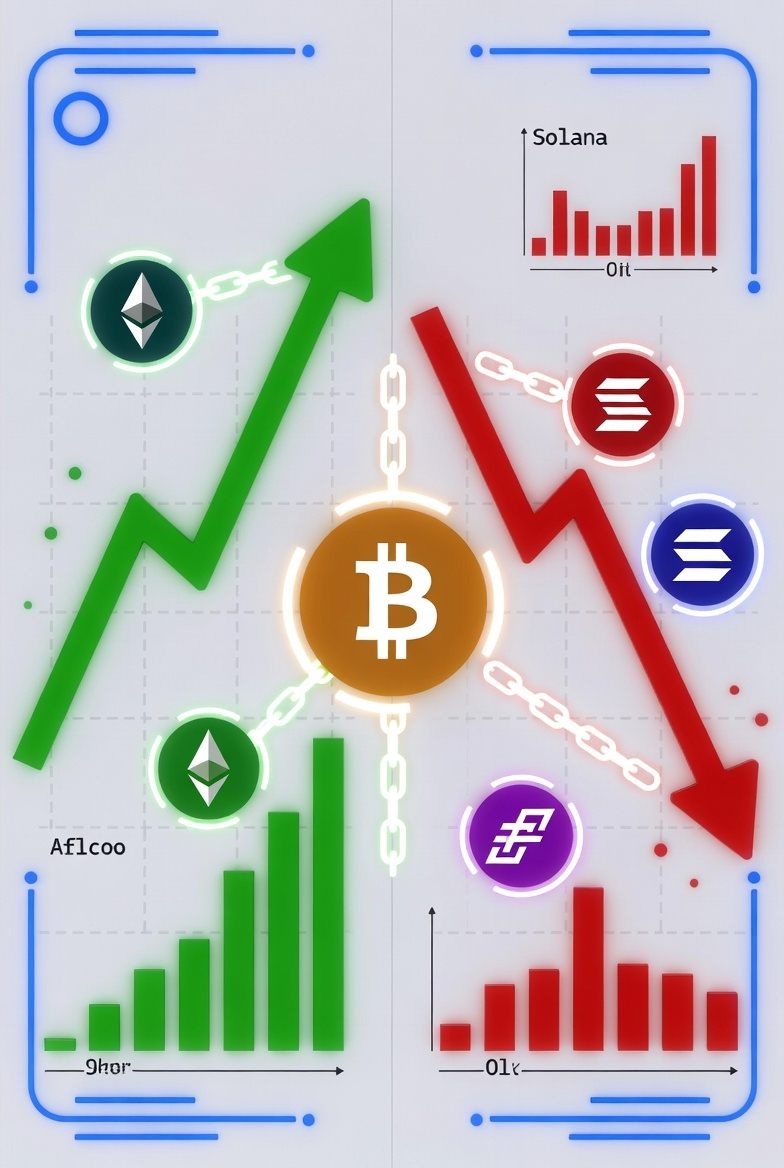
In this highly volatile cryptocurrency world, this phenomenon has always been a hot topic among investors: why can Bitcoin (BTC) rise rapidly on its own, while altcoins like Ethereum, Solana, or other meme coins do not follow suit? But strangely, when Bitcoin experiences a correction or crash, nearly the entire crypto market plummets along with it. This phenomenon is not a coincidence, but rather a result of the still immature crypto market structure, where Bitcoin acts as the 'king' or market leader. In this article, we will discuss in depth more than 600 words, complete with fundamental reasons, technical analysis, psychology, and practical tips for Indonesian investors.
First, let's understand why Bitcoin often rises “alone.” Bitcoin has the largest market capitalization, often accounting for more than 50-60% of the total market cap of all cryptocurrencies. Because of this, BTC becomes the first asset sought after by large institutional investors such as hedge funds, companies, and even countries. For example, when the Bitcoin ETF was approved in the United States a few years ago, billions of dollars flowed directly into BTC. Institutions prefer BTC because it is considered “digital gold” – a safe-haven asset with a long track record, clearer regulations, and super high liquidity. BTC trading volume can reach tens of billions of dollars per day, far exceeding any altcoin.
Meanwhile, altcoins? They are more speculative. Altcoin projects often rely on hype narratives, new technology, or DeFi/NFT ecosystems. Retail investors who FOMO (Fear of Missing Out) usually enter BTC first. Only after BTC stabilizes or "reaches a new resistance," capital begins to rotate into altcoins. This is called altseason, which usually occurs when the Bitcoin Dominance Index falls below 50%. At that time, altcoins can rise 5-20x faster. But before that? Yes, they tend to stagnate or rise only slightly. BTC rises due to strong fundamentals (halving, corporate adoption like MicroStrategy), while altcoins are still waiting for the “trickle-down effect.”
Now, back to the dark side: why does everything drop when BTC drops? This is due to the extreme correlation in the crypto market, especially in bearish phases. Historical data shows that the correlation between BTC and major altcoins often exceeds 0.8 (80%). This means that BTC's movements significantly affect the others. The main cause is leverage trading and liquidation cascades. On exchanges like Binance, Bybit, or even Indodax in Indonesia, retail traders and whales like to use 10x-100x leverage on BTC futures. When BTC drops only 5-10%, leveraged positions immediately face margin calls. Traders are forced to sell other assets (including altcoins) to cover losses, leading to a domino effect in a matter of minutes.
In addition, market psychology plays a huge role. Crypto is still considered a high-risk asset. When there is FUD (Fear, Uncertainty, Doubt) – such as an increase in The Fed's interest rates, stringent regulations from the government, or a global recession – investors panic and exit the entire class of crypto assets at once. There is no discrimination.
Low liquidity of altcoins worsens the situation: even small sales can cause prices to plummet by 20-50% in a day. Even stablecoins can be affected if there are issues in the ecosystem. A real historical example: the May 2021 crash, BTC fell from $64,000 to $30,000, and altcoins like ETH and SOL also dropped deeper (ETH fell nearly 60%). Then the 2022 bear market, BTC lost 70%, altcoins on average lost 80-95%. A similar phenomenon repeats in every cycle.
Bitcoin is more resilient because of its large market cap and institutional support, while altcoins have a higher beta (their movements are more extreme).
Another often overlooked factor is the role of whales and on-chain metrics. BTC whales often move funds to cold wallets during bearish phases, but during bullish phases, they rotate into altcoins. In Indonesia itself, many local traders on Indodax or Tokocrypto follow BTC movements as the main reference. Therefore, when BTC drops, the selling volume on local exchanges also spikes. So, what can we learn as investors?
First, understand the Bitcoin Dominance Chart on TradingView. If dominance rises, focus on BTC. If it falls, prepare for altseason.
Second, use a smart diversification strategy: 60% BTC as the core portfolio (more stable), 30% Ethereum as a blue-chip altcoin, and 10% high-risk altcoin.
Third, use Dollar Cost Averaging (DCA) every month, especially when BTC is sideways. Don't FOMO into buying altcoins when BTC is pumping alone – wait for confirmation.
Fourth, monitor macro indicators: US inflation, Fed decisions, and regulatory news. In Indonesia, also follow Bappebti developments regarding crypto taxes. Finally, control your emotions. The crypto market is still young and full of 4-year cycles (influenced by halving). Those who are patient and understand this dynamic usually come out as long-term winners.
In conclusion, the phenomenon of “Bitcoin rising alone, but dropping together” reflects the fact that BTC is the captain of the ship, while altcoins are the more vulnerable crew. When the waves rise, the captain rises first. In a storm, everyone is tossed around.
With this understanding, you will no longer be confused or panic every time the chart is red. The crypto market remains full of opportunities, as long as we trade with knowledge, not emotions. Keep DYOR (Do Your Own Research), manage risks, and may you achieve consistent profits in 2026!
Also read my other articles 👇