Recently, the topic of Pixels on the Ronin chain ($PIXEL ) has become popular again. Many tasks in the square are pushing this pixel-style farming game, and daily active users, economic models, and such are being discussed repeatedly. To be honest, I didn't have high expectations at first, as the graphics look like a farm page game from ten years ago. But I still waited for two months, checking Discord daily and looking at the data, and I actually found some design aspects worth discussing.
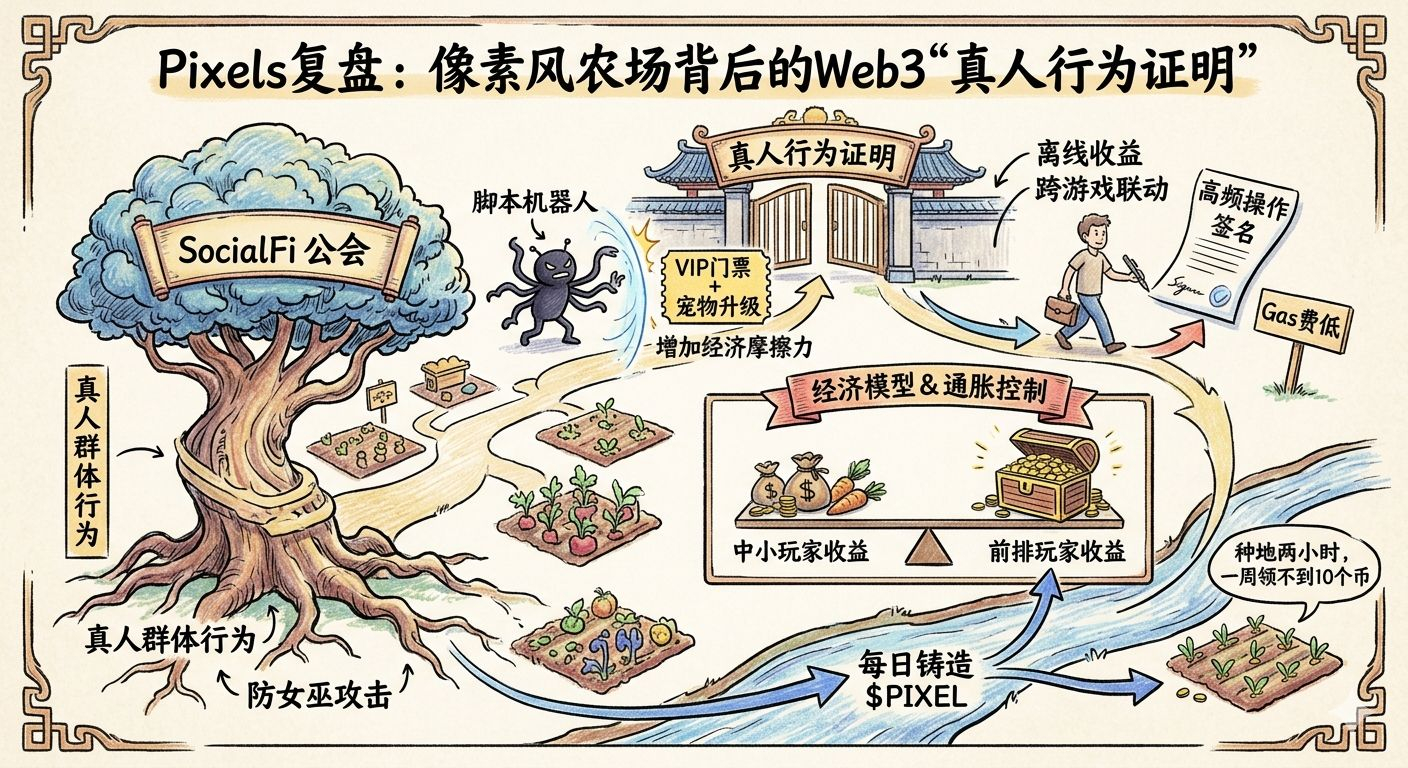
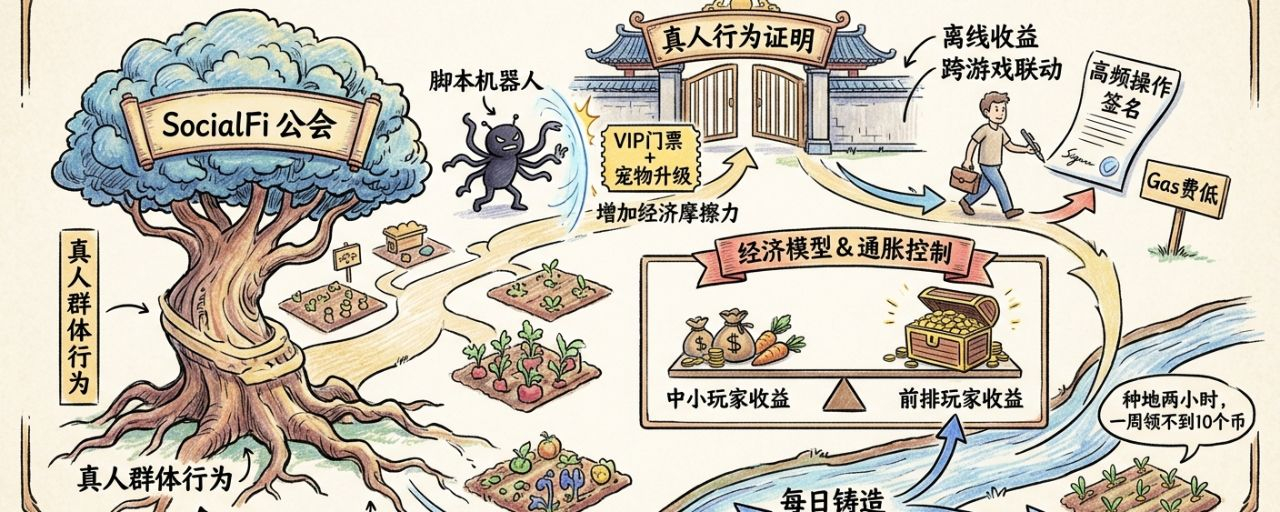
First, let's talk about what it does well. In terms of anti-bot measures, @Pixels it really has something going for it. Other chain games use CAPTCHAs and sliders, and scripts can easily bypass those. This one, however, ties VIP tickets, pet upgrades, and land output together, increasing friction with economic thresholds. I tried writing a simple script to run it automatically and found that if the account doesn't have some investment, the task rewards are directly discounted. This forces you to have real sunk costs, and accounts that are just trying to get free rewards are naturally filtered out.
The guild system is also quite interesting. The officials have come up with a SocialFi approach, using NFT membership passes to build guilds, with rankings and activity levels directly affecting rewards. I observed for a few days and found that the members of the top guilds have very regular online times, with very little deviation. This actually resembles 'proof of human behavior'; real human schedules have fixed patterns, and while robots can run 24 hours a day, it’s quite difficult for collective behavior to be so consistently regular. Of course, small guilds do receive fewer rewards, and the Matthew effect is quite obvious, but it indeed encourages players to organize themselves to maintain activity, which can be seen as an attempt to gamify defense against witch hunts.
In terms of the economic model, it doesn’t employ the high APY token distribution tricks, but instead uses dynamic tasks and an energy pool to control inflation. The amount of $PIXEL minted daily for active players is fixed, and distribution is ranked by contribution. This encourages sustained participation, but it also leads to front-row players taking most of the rewards, while small and medium players see very low daily earnings. I often see people in the community saying, 'After farming for two hours, I can’t even get 10 coins in a week,' which is also the most criticized aspect.
In terms of user experience, the Gas fees on the Ronin chain are indeed low, around $0.02 per transaction, but the issue is that the operation frequency is too high. Each time you harvest, farm, or complete a task, you have to sign, and signing dozens of times a day is really annoying. The officials say they are considering batch operations, and I hope they can optimize it in the future. The offline earnings design is quite good; the plants you sow don’t need constant attention, just come back after a few hours to collect, which reduces the burden significantly. However, the single transaction earnings are relatively low, and after playing for a long time, the marginal utility declines quickly, so it’s understandable that some people feel it’s 'fragmented' and 'exhausting.' Cross-game interactions, such as the collaboration with Forgotten Runiverse, attempt to bridge the usage scenarios of $PIXEL, which is the right direction. But currently, the cross-chain process is quite cumbersome, and the threshold is not low for ordinary players, so the actual number of participants is likely to be limited.
Overall, Pixels is one of the more iterative types in Web3 gaming. It tries to bind social relationships, economic incentives, and real user identification together, which is more substantial than many projects that rely solely on empty promises. The daily active user data looks impressive, but there must be scripts and gold farming accounts involved (this is a common issue in the industry). The real retention and long-term experience for ordinary players still need further observation. My personal stance at the moment is '70% recognition, 30% reservation.' The core challenge remains how to provide better perceived returns for small and medium players while lowering the thresholds for guilds and participation. If they can focus more on batch operations, yield balancing, and support for small guilds in the future, it will be more attractive. This article is just some ramblings based on on-chain data, community observations, and my own testing during this period, and it is not investment advice. The crypto market is highly volatile, and it’s best for everyone to verify on-chain information themselves before making any decisions and to participate rationally. Please feel free to share your true experiences playing Pixels in the comments section, and let’s discuss together. (This article is a platform task and does not constitute any investment advice.)