
Not all token burns are created equal.
Some are powered by real profits.
Others rely on market activity cycles.
Right now, the difference is becoming impossible to ignore 👇
⚔️ PROFIT-POWERED vs VOLUME-DEPENDENT TOKENOMICS
Two leading DeFi tokens. Two fundamentally different engines:
🟢 $JST (JustLend DAO) → Profit-driven buyback & burn
🔵 $UNI (Uniswap) → Volume-driven fee-based burn
Same sector. Same cycle.
Completely different outcomes.
🔥 JST: REAL REVENUE → REAL BURNS → REAL IMPACT
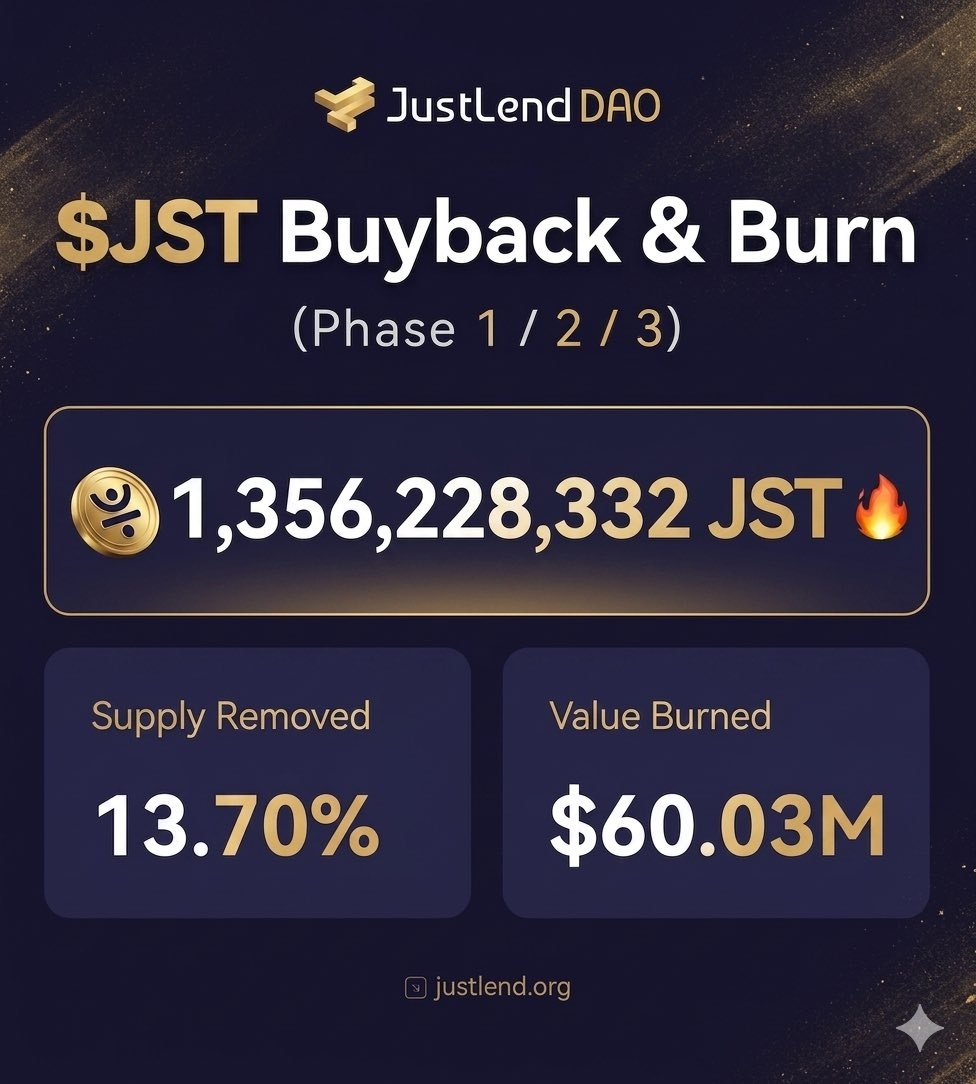
JustLend DAO just completed its third buyback & burn:
💥 271M+ JST burned (~$21M+)
📉 13.7% total supply already removed
💰 ~1.356B JST destroyed cumulatively
And here’s what matters most:
👉 100% funded by actual protocol profits
👉 Quarterly, predictable, transparent execution
👉 Fully verifiable on-chain
This is not theoretical tokenomics.
This is cash flow being directly returned to holders.
🔄 THE JST VALUE ENGINE (SIMPLE BUT POWERFUL)
📈 More protocol usage
→ 💰 More revenue generated
→ 🛒 More JST bought back
→ 🔥 More tokens burned
→ 📉 Supply shrinks
→ 🚀 Value strengthens
A clean, sustainable flywheel.
No hype needed. Just numbers.
🌊 UNI: MASSIVE POTENTIAL, BUT DEPENDENT ON ACTIVITY
Uniswap’s model is different:
⚙️ Fee switch + trading volume = token burns
🔥 Treasury burn (100M UNI) adds initial impact
Core idea:
👉 “More trading = More burn”
And yes — the upside is huge.
But here’s the trade-off:
⚠️ Relies heavily on overall DEX volume
⚠️ Sensitive to market cycles
⚠️ Less predictable burn consistency
It’s powerful… but not always stable.
THE MARKET HAS ALREADY VOTED
Same timeframe. Same environment.
Results:
🟢 $JST → +111%
🔴 $UNI → -33%
This isn’t speculation.
It’s mechanism performance playing out in real time.
THE BIG SHIFT: FROM NARRATIVE → TO CASH FLOW
JST is undergoing a fundamental transformation:
❌ Before: Growth-dependent governance token
✅ Now: Revenue-linked, value-accruing asset
Thanks to the buyback + burn model:
👉 Continuous buy pressure
👉 Systematic supply reduction
👉 Direct value capture from protocol activity
This starts to resemble something deeper:
💎 “DeFi tokens behaving like cash-flow assets”
BACKED BY TRON’S LIQUIDITY ENGINE
This isn’t happening in isolation.
JustLend sits at the core of TRON’s DeFi stack:
⚡ Stablecoin liquidity dominance
🏦 Lending + borrowing markets
🔋 Energy leasing + staking layers
🔗 Deep ecosystem integration
And JST is right at the center of that value flow.
🚀 WHY JST LOOKS STRUCTURALLY STRONG INTO 2026
When you combine:
✔️ Consistent profit generation
✔️ Programmatic buybacks
✔️ Ongoing supply reduction
✔️ Strong treasury reserves (~$100M)
You get:
👉 Predictability
👉 Sustainability
👉 Compounding value dynamics
This is what markets tend to reward long-term.
⚖️ FINAL VERDICT: DIFFERENT PATHS, DIFFERENT OUTCOMES
Both models work.
But they behave very differently:
🟢 JST → Stable, profit-driven, fundamentally anchored
🔵 UNI → Scalable, volume-driven, cycle-dependent
If volume explodes, UNI thrives.
If consistency matters, JST compounds.
🧭 FINAL TAKE
The narrative is evolving:
“Burn mechanisms” alone don’t matter.
👉 What funds the burn is everything.
And right now, JST is proving:
💰 Profit-backed deflation
📉 Consistent supply shock
🔁 Self-reinforcing value loop
That’s not just tokenomics.
That’s a system designed to outperform.
🚨 2026 won’t just reward innovation…
It will reward sustainable value capture.
And JST is already positioning for that future.
Keep an eye on the fundamentals:
When revenue drives value, opportunities become clearer.
💬 Got questions or want a walkthrough? Drop them below.👇