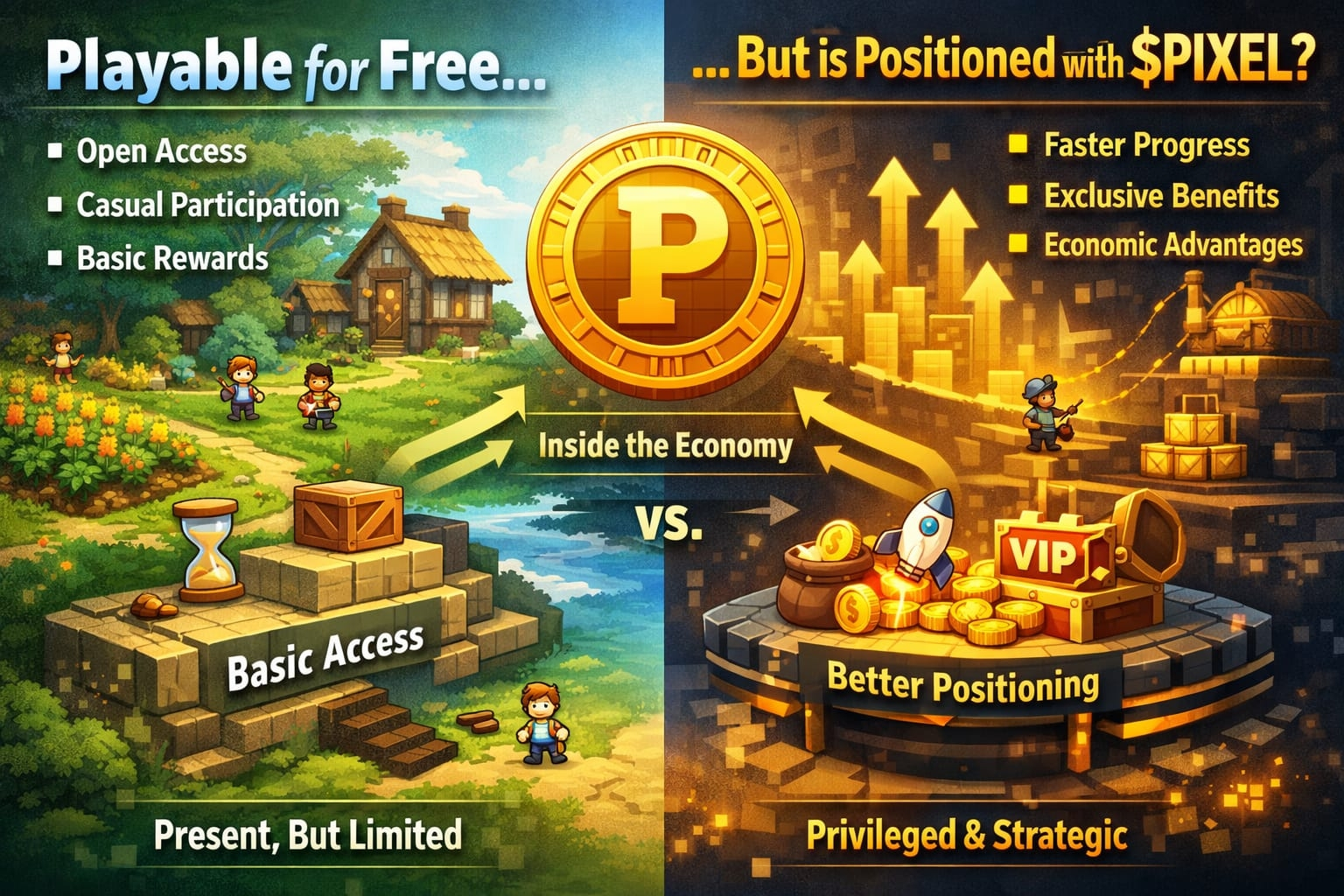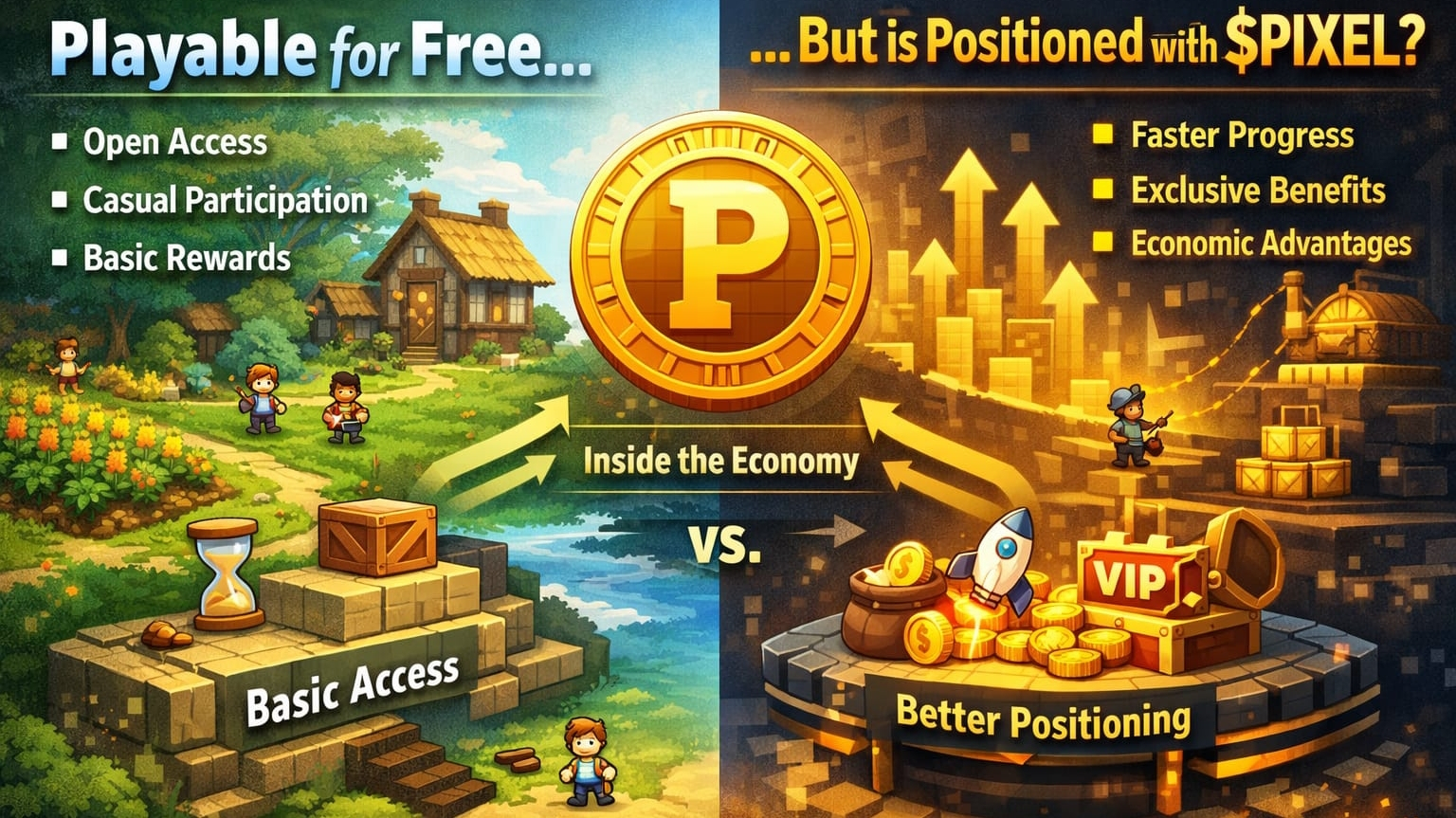
I keep thinking about how often “free” only really describes the front door. You can walk in without paying, look around, even spend time there, and for a while that feels like the whole story. Then slowly you notice something else. The room may be open to everyone, but not everyone is standing in the same place inside it. Some people are closer to the useful exits, the better opportunities, the loops that compound a little faster. That is where I start thinking differently about Pixels.
At first glance, Pixels does feel playable for free. That matters. It lowers resistance, makes the world look accessible, and helps activity form without forcing an upfront economic decision. I do not think that part is fake. But accessibility at entry and equality inside an economy are not the same thing, and I think that distinction gets missed when people talk about game tokens too casually. A system can be open without being flat. It can welcome broad participation while still quietly pricing better positioning.
That is where $PIXEL starts to feel more interesting to me. Not as a simple payment token and not just as a reward loop output, but as a way the system may sort who gets more favorable placement inside the economy once the player base is no longer behaving like tourists. I mean positioning in a practical sense. Better speed. Better access. Better optionality. Maybe better ability to stay visible inside the most productive loops. Not necessarily dominance in one dramatic move, just repeated economic convenience that stacks over time.
That stacking matters more than people admit. In a lot of crypto gaming discussions, there is still this lazy assumption that free users create activity while token users create demand. I am not sure it is that clean. Plenty of free activity is just surface motion. It helps metrics, helps social proof, maybe helps the world feel alive. But real demand usually starts later, when players begin caring about the difference between participating and participating well. Those are separate things. One is presence. The other is position.
And position inside a game economy is rarely sold as position. It usually comes disguised as utility, quality of life, convenience, progression support. Soft words. Sometimes fair words. Still, in practice, those tools often decide who can move through scarcity more efficiently, who can respond faster when opportunities appear, and who can keep momentum without constantly restarting from friction. In that sense, the token may not be monetizing play itself. It may be monetizing reduced drag inside a system where drag has economic consequences.
That feels more durable to watch than the usual question of whether people are “using the token.” Usage can be noisy. A token can show activity because rewards are cycling, because players are testing features, because incentives temporarily make the loop look alive. Demand is harder. Demand shows up when the token keeps mattering after the novelty fades, after the event ends, after behavior becomes repetitive and less theatrical. The important thing is not whether players touched pixel once. It is whether the game quietly teaches them that better economic placement keeps requiring it.
I think this is where the free-to-play framing can become a little misleading. Not false, just incomplete. Free play tells us the system is open. It does not tell us how advantage is distributed once users settle into routine. And routine is where economies reveal themselves. When behavior repeats, the system stops being a promotional experience and starts becoming operational. You see who advances smoothly, who gets delayed, who can absorb volatility, who can pivot when game conditions change. Those differences are easy to downplay individually. Together, they form a structure.
There is also a market angle here that I do not think gets enough attention. Tokens tied to game ecosystems often get evaluated as if value should come directly from item buying or obvious consumption. But sometimes the stronger source of demand is closer to economic routing. The token becomes the thing that helps users secure better placement within the network’s internal flows. Not ownership of the whole system. Just a better lane through it. That can matter more than cosmetic utility, and maybe more than raw transaction count too.
What makes this harder to judge is that the system can still feel generous on the surface while doing all of this underneath. A player can honestly say, “I can still play for free,” and that can be true. Another player can quietly realize, “yes, but some forms of progress are being organized around who can stay better positioned,” and that can also be true. These are not contradictory statements. They are just describing different layers of the same economy.
I keep coming back to that because crypto markets often misread friendliness as neutrality. If a system does not hard-paywall access, people assume it is economically flat. But soft access models can still create real gradients. In some ways they are more effective because they do not force the issue too early. They let users discover the value of better positioning through experience. By the time the token starts mattering, it does not feel like a toll. It feels like a practical adjustment. A small edge. Then another one.
Maybe that is what $PIXEL is slowly becoming. Not the price of entering Pixels, but the price of standing in a better place once you are already inside. And if that is true, then the real question is not whether the game is free. It is whether the economy keeps teaching players that free participation is enough to stay present, but not enough to stay well-positioned when the system gets crowded, layered, and a little more serious. That line is subtle now. I doubt it stays subtle forever.