
Here’s the thing — Pixels isn’t just a farming game. It’s a behavior engine.
And once you see it, you can’t unsee it.
Built on the Ronin Network, Pixels looks simple at first. You plant crops. You craft things. You run around. You talk to people. It feels open. Relaxed. Almost cozy.
But give it a few days.
Something shifts.
You start noticing that not everything you do matters equally. Some tasks move you forward fast. Others… just exist. You can do them, sure. But they don’t really pay. They don’t really help. They’re just there.
And that’s where things get interesting.
Pixels doesn’t block you with walls. It blocks you with irrelevance.
You can plant anything.
You can explore anywhere.
You can craft whatever you want.
But only one path really pays.
So players don’t get forced. They self-correct.
And honestly? That’s way more powerful than forcing people.
Because when players choose efficiency, they don’t complain about it. They feel smart. Like they figured it out themselves. Even though the system quietly guided them there.
I’ve seen this before in other games, but Pixels does it in a softer, cleaner way. No big announcements. No “meta” patch notes. Just incentives doing the work behind the scenes.
It works. Period.
Then something else happens.
Players start aligning.
Nobody tells them to. Nobody writes a rulebook. But over time, everyone starts running the same loops. Same crops. Same tasks. Same routines.
It’s weird at first. Then it makes sense.
The Task Board rewards stability. Not creativity.
So experimentation starts feeling expensive. You can try new things, sure. But if you do, you slow down. You fall behind. And let’s be real — most players don’t like falling behind.
So creativity shrinks. Efficiency grows.
Slowly. Quietly.
No one talks about this enough, but this is where Pixels stops being just a game and starts becoming an economy.
Because when players converge, volatility drops. Supply becomes predictable. The system stabilizes itself.
And that’s not an accident.
Now let’s talk about the part that’s kind of genius… and a little brutal.
Coins.
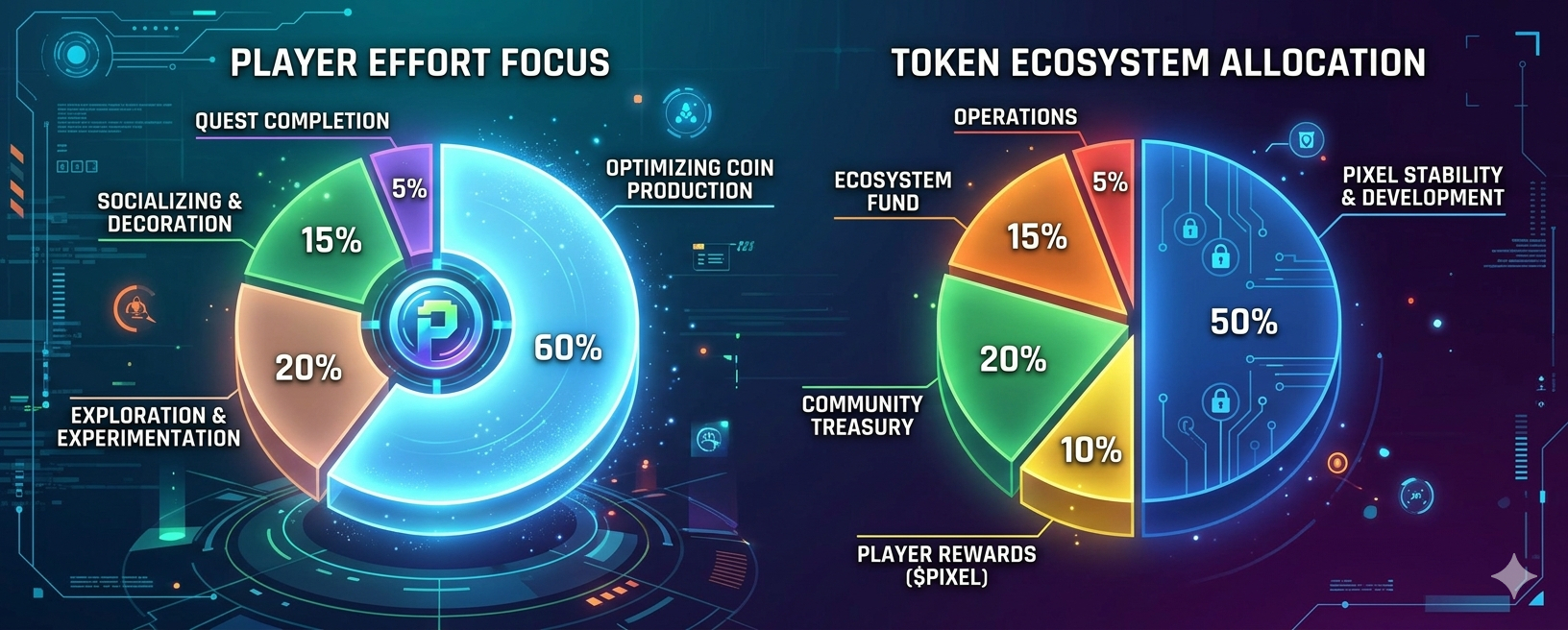
Most of what players earn stays trapped in Coins. Coins feel valuable. They look valuable. You grind for them. You optimize for them.
But they’re not the real prize.
Meanwhile, PIXEL stays protected. Stable. Controlled.
So what’s happening?
Most player effort fuels Coins.
Coins absorb activity.
And $PIXEL stays insulated from constant selling pressure.
It’s clever. Really clever.
And yeah, there’s a slightly uncomfortable truth here — around 90% of player effort doesn’t directly hit the token economy. Players are working. Grinding. Optimizing.
But only part of that effort translates into real token value.
That sounds harsh. But it also solves one of the biggest problems in Web3 gaming.
I’ll be honest — we’ve seen this cycle too many times. Games promise Play-to-Earn. Players rush in. Tokens inflate. Everyone sells. Economy collapses. Repeat.
Pixels clearly looked at that mess and said: “Yeah, we’re not doing that.”
So instead of Play-to-Earn, Pixels quietly built something closer to Play-to-Stabilize.
It’s slower. Less flashy. Way more sustainable.
And honestly, it works.
There’s also the social layer, which people sometimes overlook. Players share strategies. They compare loops. They help newcomers. This accelerates convergence even more.
It’s like watching a hive mind form.
And here’s the weird part — players like it.
Because they feel like they’re discovering things. Not following orders.
That’s psychology. And Pixels leans into it hard.
Players optimize themselves.
Players align themselves.
Players stabilize the economy themselves.
No force required.
At some point, Pixels stops feeling like a farming game entirely. It feels like a living system. A feedback loop. Player behavior shapes the economy, and the economy shapes player behavior.
Round and round.
No chaos. Just gradual alignment.
And look, this isn’t accidental. This is deliberate design. Someone clearly thought through how incentives shape behavior. And they built around that idea from day one.
So yeah — Pixels didn’t just tweak Play-to-Earn.
They changed the entire approach.
Instead of promising freedom, they reward efficiency.
Instead of chasing hype, they build stability.
Instead of forcing players, they guide them.
Quietly.
And that leaves us with a question that’s hard to ignore.
If everyone chooses efficiency… are they still free?
Or did Pixels just build the most elegant leash in Web3 gaming?
