
I kept thinking about something small the other day. Not a big market move, not a new feature announcement. Just a moment in a game where I almost stopped playing. Nothing was broken. It still worked. But something felt… heavier. Like the system didn’t quite know what to do with me anymore.
That’s where I started looking at $PIXEL a bit differently.
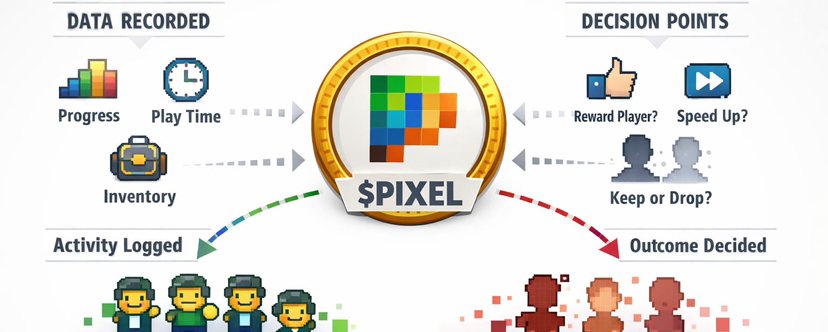
At first glance, it feels like a familiar loop. You play, you earn, you spend. Data gets recorded everywhere. Actions, progress, inventory, time spent. It looks complete. But the more I think about it, the real pressure doesn’t come from recording what players do. It comes later, at the point where the system has to decide what to do with that information.
Because data sitting there is harmless. A player exists, activity exists. Fine. But the moment a system has to act on it, things change. Suddenly it has to answer uncomfortable questions. Who should be rewarded. Who should progress faster. Who is worth keeping engaged, and who quietly falls out.
That’s not a technical step. It’s an administrative one.
And administrative systems always look simple until they’re forced to make decisions.
I think that’s where $PIXEL starts becoming more than just a token moving through a game economy. It begins to sit inside that decision layer. Not just distributing rewards, but shaping how those decisions get made in the first place. Not explicitly, not in a way users can point to. But through how access, speed, and positioning get priced.
Because distribution is not neutral. It never is.
When a player receives something, that’s not just movement of tokens. It’s the system effectively saying, “this behavior matters enough to keep.” And when a player doesn’t receive something, or receives it slower, that’s also a decision. Even if it looks like nothing happened.
What makes it more complicated is that the system often doesn’t rely on a single piece of information. It relies on what you could call credentials. Not in a formal sense, but in practice. A credential is just a claim about a player that the system believes is true. For example, that they are active, consistent, valuable to retention.
But those claims don’t automatically carry meaning everywhere.
A player might look “high value” in one loop and completely average in another. The data exists, but its interpretation shifts depending on where it’s used. And that’s where friction starts to appear. Quietly.
Because now the system has to verify those claims again. Or reinterpret them. Or adjust them based on context.
And that’s where repetition creeps in.
From the outside, everything feels smooth. You log in, you play, rewards come. But underneath, there are small decision points stacking up. Checks, recalculations, hidden thresholds. Not all of them visible. Not all of them consistent.
This is where I think most game economies start to feel unstable, even if they don’t collapse outright.
Not because data is missing. But because decisions don’t travel cleanly.
One part of the system decides something about a player. Another part doesn’t fully trust it. So it either rechecks or ignores it. That gap between “this is known” and “this is usable” becomes wider over time.
And players feel that, even if they can’t explain it.
Sometimes it shows up as unpredictability. Sometimes as grind that suddenly feels pointless. Sometimes as rewards that don’t quite match effort. Not dramatically wrong. Just slightly off.
That slight misalignment is enough.
Because retention doesn’t fail in big moments most of the time. It fails in those small, unclear decisions where the system hesitates. Or worse, where it acts without being able to explain why.
That’s where the role of $Pixel starts to feel more structural.
If it is tied to how rewards, access, or progression get distributed, then it’s indirectly tied to how those decisions are enforced. Not just what players do, but what the system chooses to preserve. Which players it quietly prioritizes. Which ones it allows to drift away.
And that introduces a different kind of pressure.
Because now the token isn’t just reflecting activity. It’s entangled with consequence.
And consequence is harder to manage than data.
Data can scale almost endlessly. You can track everything. But decisions don’t scale the same way. The more players, the more edge cases. The more inconsistencies. The more situations where the system has to decide without perfect clarity.
That’s usually where trust starts to weaken.
Not instantly. Slowly.
Players don’t lose trust because a system is complex. They lose trust when the outcomes stop feeling defensible. When two similar actions lead to slightly different results, and there’s no clear reason why.
At that point, the system is no longer just recording behavior. It’s being judged on how it interprets it.
And I keep coming back to that original moment. The point where a player almost leaves.
It doesn’t happen because the system failed to track them. It happens because the system couldn’t make a convincing decision about them.
So maybe the real question isn’t whether $Pixel can drive demand through activity or utility. That part feels almost secondary.
The more difficult question is whether it can sit inside those decision points without making them heavier. Without increasing the friction that already exists between proof and outcome.
Because if it does, even slightly, then it starts to matter at a very specific moment.
Not when players join. Not when they earn.
But right when the system decides who it’s willing to keep.