
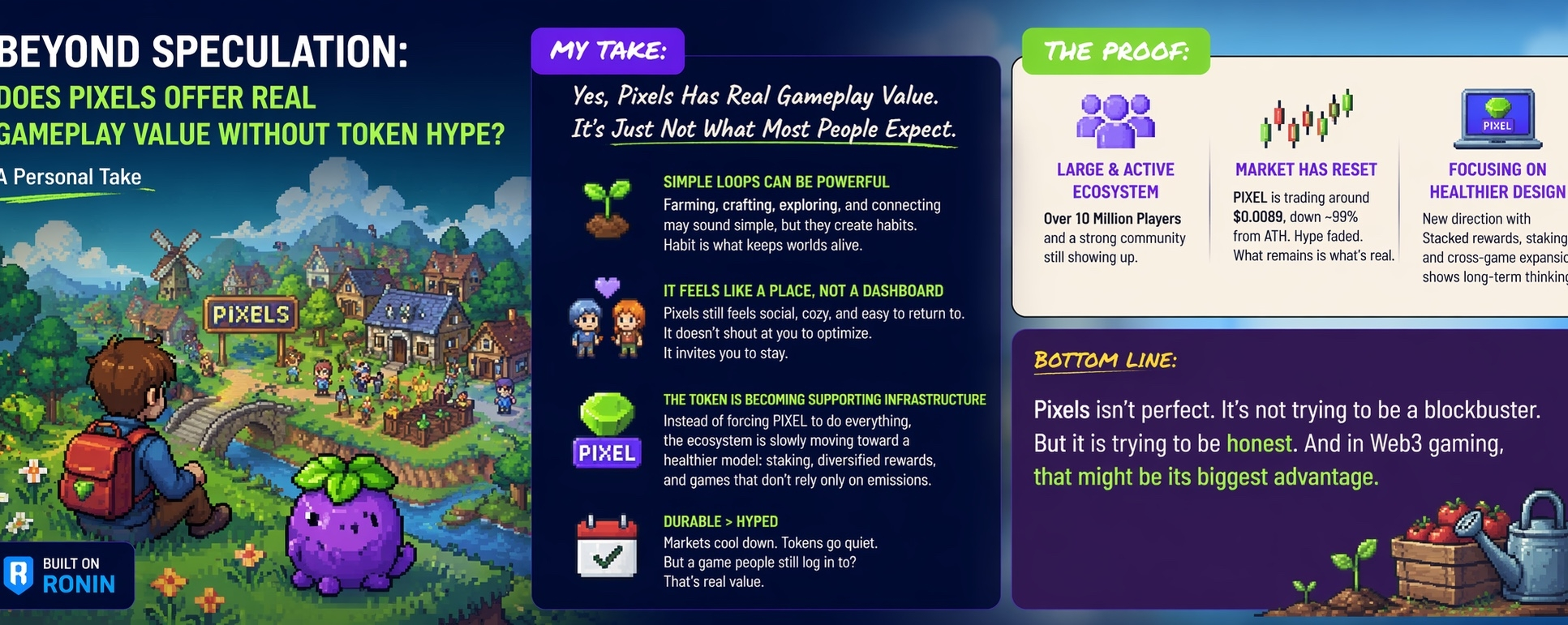

I keep coming back to the same question whenever I look at Web3 games:
If you remove the money, what is left?
Not in a dramatic sense. I mean literally — if you strip away the token talk, the reward loops, the speculative energy, and the usual “early ecosystem” optimism, is there still something a person would willingly spend time on?
That is why Pixels interests me.
Not because it is the most advanced game in Web3.
Not because its token economy is flawless.
And definitely not because it proved every big promise this sector likes to make.
It interests me because Pixels feels like one of the few projects that accidentally stumbled into an important truth: a game does not become good just because value is attached to it.
That sounds obvious, but Web3 has spent years behaving as if attaching financial rails to ordinary gameplay automatically creates depth. I have never really believed that. In fact, I think the opposite is often true. The more aggressively a game tries to convince me that every click has economic meaning, the less alive the world starts to feel. At some point, it stops feeling like a game and starts feeling like a dashboard with cute graphics.
Pixels gets dangerously close to that at times, but it does not stay there. That is the part I find worth taking seriously.
When I look at Pixels, I do not see a groundbreaking game in the traditional sense. I do not see something that reinvents design, storytelling, or player agency. What I see instead is something more modest, and in some ways more revealing: a game that seems to understand routine better than spectacle.
That matters more than people admit.
Most people discussing Web3 games still talk as if the goal is to build some massive breakthrough experience that also happens to have tokenized incentives layered on top. But that is not how real digital habits usually form. Most people do not build attachment through big cinematic moments. They build it through repetition. Through ease. Through familiarity. Through tiny acts that slowly become part of a daily rhythm.
Pixels feels designed around that reality.
It is not asking players to sit down for some epic, mentally demanding experience. It is asking them to return. To plant, gather, craft, check in, wander, socialize a little, and keep a light connection with the world. In another context, that might sound unimpressive. In Web3, I think it is actually one of the more intelligent design choices a project can make.
Because here is the uncomfortable truth: a lot of Web3 games do not actually want players. They want participants. They want activity. They want economic throughput. They want wallets behaving like engagement metrics. That is different from building a world people genuinely like being in.
Pixels, to me, sits in that tension.
There is still plenty of crypto logic inside it. You can feel that. The token matters. The economy matters. The surrounding ecosystem matters. But unlike a lot of projects, Pixels no longer feels completely dependent on pretending the token itself is the game. And that shift changes how I read the project.
I think that is where much of the real progress is.
The strongest Web3 games will not be the ones that make players feel like mini hedge funds. They will be the ones that learn how to put financial logic in the background. Not erase it, but subordinate it. Make it supportive, not dominant. Useful, not theatrical.
Pixels seems to be moving in that direction, and I think that is why it has more credibility today than it did during its loudest phase.
During hype cycles, it is hard to judge anything clearly. Communities look stronger than they are. Mechanics look deeper than they are. Tokens look more “essential” than they are. Everyone starts speaking in inflated language. But when that energy fades, a project has to survive on something more ordinary and more difficult: whether people still find it worth opening.
That is the test I care about.
And Pixels, from my perspective, passes that test better than most.
Not perfectly. But convincingly enough.
I do not think Pixels offers value because the farming loop is revolutionary. It is not. I do not think it offers value because PIXEL transforms casual gameplay into some new economic frontier. That story feels tired now, and the market has already become much less willing to believe it. What I think Pixels offers is simpler: it offers a form of digital presence that is easy to maintain.
That may sound small, but I do not think it is.
There is a reason so many products fail despite having bigger ideas. People do not live inside ideas. They live inside habits. A game that understands habit — real habit, not just reward dependency — already has something many louder projects never build.
That is why I see Pixels less as a “tokenized game” and more as an experiment in whether Web3 can support lightweight worlds without crushing them under monetization pressure.
And honestly, I think that is a much more interesting experiment.
Because if Web3 gaming has a future, I doubt it will come from every player becoming an optimizer chasing emissions. I think it will come from projects learning restraint. Learning when not to financialize every corner of the experience. Learning that a game can have an economy without becoming economically obsessed.
Pixels is not fully there yet. But it feels closer to that realization than most of its peers.
There are still limitations, of course.
If someone comes to Pixels expecting deep systems, intense skill expression, or a genuinely transformative game experience, they may walk away underwhelmed. I would understand that reaction. Pixels is not trying to be everything, and in some areas that restraint can also look like thinness. There are moments where the loop feels more functional than memorable. More sticky than meaningful. More good at retention than at emotional depth.
That criticism is fair.
But I also think it misses part of the point.
Not every successful game needs to feel profound. Some need to feel livable. And Pixels, at its best, feels livable. That is the word I keep landing on. It has enough softness, enough accessibility, enough social texture to feel like somewhere you can drift back into without friction. In a market full of products that constantly demand belief, that kind of low-pressure relevance is strangely rare.
So when people ask whether Pixels has real gameplay value without token hype, my answer is yes — but maybe not in the way crypto people usually mean value.
I do not mean high-intensity gameplay.
I do not mean economic upside.
I do not mean some grand technological leap.
I mean that Pixels has managed to build a world that still makes sense even after the speculative volume gets turned down.
To me, that is the real threshold.
A lot of Web3 games can perform well when they are surrounded by excitement. Very few still feel coherent when the room gets quieter. Pixels does. Not because it became a masterpiece, but because beneath all the token discourse, there is still an actual loop, an actual rhythm, and an actual reason some players keep coming back.
And maybe that is the more honest future of Web3 gaming.
Not worlds that promise to make everyone rich.
Not games that disguise labor as fun.
Not economies pretending to be communities.
Just games that know how to survive once the hype leaves the room.
Pixels has not solved that completely. But it is one of the few projects that makes me think the attempt is real.
