

A Quiet Shift in How Money Is Entering Crypto
I don’t react to “record inflow” headlines the way I used to. In crypto, big numbers can feel exciting, but they don’t always mean something meaningful is changing. Sometimes it’s just short-term positioning dressed up as momentum.
But what’s happening right now with Solana and Chainlink ETFs feels different. Not loud, not explosive—just steady, intentional movement. And that’s usually where the more important stories begin.
The Headline Story: Strong Inflows Return
Over the past few sessions, ETFs tied to Solana and Chainlink have recorded their strongest inflows in weeks.
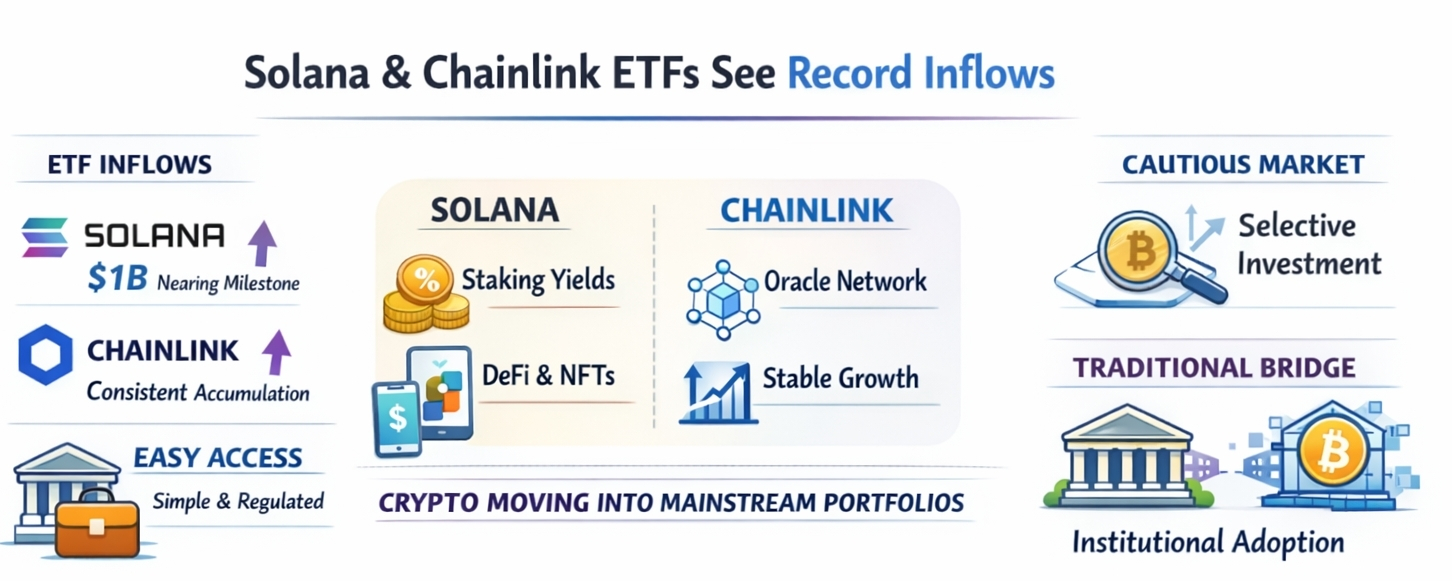
Solana-focused products pulled in their biggest daily investment since mid-March, pushing total cumulative inflows close to the $1 billion mark. That’s not a small milestone—it suggests the asset is no longer being treated as experimental exposure.
Chainlink, on the other hand, is seeing smaller numbers, but the pattern is what stands out. Several consecutive days of inflows, no major pullbacks, and a steady build rather than sudden spikes.
On the surface, it looks like a simple rotation into altcoins. But it’s not that simple.
What’s Really Driving This
This isn’t just about investors suddenly becoming bullish on Solana or Chainlink. It’s about how they’re choosing to invest.
ETFs remove friction. They turn something that used to feel technical and unfamiliar into something accessible and familiar. No wallets, no private keys, no extra steps—just exposure through a structure people already trust.
That shift matters more than the inflows themselves. Because once an asset becomes easy to access, it becomes easier to justify holding it.
Why Solana Is Getting More Attention
Solana sits in a very specific position in the market. It’s often seen as faster, more scalable, and more consumer-friendly compared to older networks. That alone keeps it on investors’ radar.
But there’s another layer here. Some Solana ETFs are being designed to include staking elements. That means investors aren’t just getting price exposure—they may also benefit from yield generated within the structure.
That changes the conversation. It turns Solana from a speculative asset into something that can be framed as productive. And that’s the kind of framing institutions tend to respond to.
Chainlink’s More Subtle Momentum
Chainlink’s story is quieter, but in some ways more telling.
It doesn’t rely on hype cycles in the same way. Instead, it sits deeper in the infrastructure layer, providing data to smart contracts rather than competing for attention as a user-facing platform.
That difference shows up in the flows. Instead of sharp spikes, you get consistency. Instead of sudden exits, you get gradual accumulation.
It’s the kind of pattern that suggests a different type of investor—less reactive, more patient, and focused on long-term utility rather than short-term narratives.
The Bigger Picture: ETFs Are Changing Behavior
A while ago, the question was whether altcoin ETFs would even exist. Now they’re here, and the question has shifted to how much capital they can attract.
That change is important.
ETFs allow investors to approach crypto without stepping outside the systems they’re already comfortable with. Portfolio managers can allocate without changing their workflow. Retail investors can participate without learning new tools.
In a way, crypto isn’t being simplified—it’s being translated. And translation always expands participation.
Why Prices Aren’t Exploding
If inflows are strong, why aren’t prices moving dramatically?
Because the broader market still isn’t fully convinced.
There’s still hesitation. Some weeks bring strong inflows across crypto funds, while others show sudden reversals. That kind of inconsistency doesn’t support a full breakout—it supports cautious positioning.
So what we’re seeing now isn’t aggressive buying. It’s selective entry.
Money is coming in, but it’s moving carefully.
A Shift in Incentives
What’s changing here isn’t just demand—it’s incentives.
ETFs reward simplicity. They favor assets that can fit into structured, regulated products. They encourage longer-term thinking instead of rapid trading cycles.
Solana benefits because it offers a mix of growth and potential yield.
Chainlink benefits because it represents infrastructure and real utility.
Different strengths, but both aligned with what ETF investors tend to look for.
Final Thought: This Isn’t Noise
It’s easy to dismiss inflow headlines as just another wave of short-term excitement. But this doesn’t feel like noise.
It feels more like a slow adjustment.
Investors aren’t just deciding what to buy—they’re deciding how to hold it. And right now, ETFs are becoming the preferred answer.
That doesn’t guarantee a rally. It doesn’t mean momentum will continue without interruption.
But it does suggest something more durable:
Crypto is no longer just being explored. It’s being integrated—quietly, steadily, and in ways that don’t need to announce themselves to matter.