


Recently, I conducted a thought experiment where I placed myself in the position of a decision-maker at a game studio, and then I asked myself a question: If someone told me that the user acquisition budget I originally allocated to Google and Meta could be directly given to the most active real players in my game through a system, and that every penny's destination is traceable and every reward's effect is quantifiable—would I consider reallocating the budget? I thought for about five minutes, and the answer is: If this system operates as described, I would seriously consider it. This is not because I have any particular faith in Web3, but because this calculation makes sense from a business perspective. Real person research · Life preservation first, the first question I assess for any project is not 'Is its story good?' but 'Is the problem it solves a real one, and is the solution truly better than the existing one?'
The existing logic for acquiring game users has a fundamental flaw that has persisted for many years, yet everyone has accepted it by default: you pay money to the advertising platform, the advertising platform gives you exposure, exposure converts to downloads, downloads convert to registrations, and a portion of those registrations remain, with some of those remaining users making payments. Every stage of this funnel has significant losses, and you usually can only analyze where the losses occurred afterwards, without real-time intervention. More critically, the proportion of the money you spend that actually reaches 'valuable real players' is, in most cases, frustrating. The money goes to the advertising platform, but what do players get? An advertisement, then maybe a download, and then maybe they stick around. What Stacked does is flip this logic on its head: it directly allocates the budget as rewards to those players who have already proven their willingness to stay, bypassing the advertising platform as a middleman and skipping all those uncertain conversion stages. For a decision-maker at a game studio, this is not a Web3 concept; it's a ROI calculation question—given the same budget, do you pay a traffic platform that cannot guarantee quality users, or do you directly reward those players who have already engaged in real actions in your game?
\u003cm-34/\u003e validated the feasibility of this logic within its own ecosystem, which is the core reason I take Stacked seriously, not because they tell a great story. Pixels itself, as an open-world game on the Ronin Network that revolves around farming, exploration, and creation, has already accumulated a substantial amount of real users and real behavioral data. Stacked has processed over 200 million real reward distributions based on this, corresponding to over $25M in real in-game revenue. The existence of these numbers indicates one thing: this logic of 'directly giving growth budgets to real players' has proven effective under real operational pressure; it is not a laboratory conclusion but production environment data. For an external game studio preparing to integrate with Stacked, this is the most convincing endorsement they can see—not a white paper, not a roadshow PPT, but revenue data generated by another game using the same system.
$PIXEL's role in this business logic has thus become more critical. It serves as the settlement currency in the entire reward distribution chain, with game studios' growth budgets converted into $PIXEL rewards distributed to players through Stacked. Players spend $PIXEL across game ecosystems, creating a continuous cycle of demand. The scale of this cycle depends on the number and quality of game studios connected to Stacked, rather than the popularity of any single game. I have one lingering question: the actual retention rate of external studios after integrating with Stacked, and their willingness to continue injecting budget; I currently do not have enough information to assess this data. However, this is the core variable I continue to observe; it is not a question I can conclude on right now.
$PIXEL Currently reported at $0.00884, with a 24-hour increase of +7.15%, a 24h high of $0.00937, and a low of $0.00797, with a trading volume of 555 million PIXEL and a transaction value of 4.7558 million USDT. This large bullish line is very conspicuous in structure. The moving average MA7 is reported at 0.00858, crossing above MA25's 0.00831, and MA99 is continuously rising at 0.00819. The three lines are in a bullish arrangement; from the low point of $0.00773, this round of increase has exceeded 14%. The rapid pullback from the high of $0.00937 indicates selling pressure above. Currently, it is resting at $0.00884, and holding above MA7 is a key level I am observing recently. This time, @Pixels' CreatorPad event total rewards neon is 15 million PIXEL, with 7.5 million PIXEL exclusive to the Chinese-speaking region, ending on April 28. Friends who want to participate have limited time left. Real-person research and prioritizing survival; today's bullish line is not a reason for me to change my judgment. My judgment is based on business logic, not on single-day increases; these two things are not on the same dimension.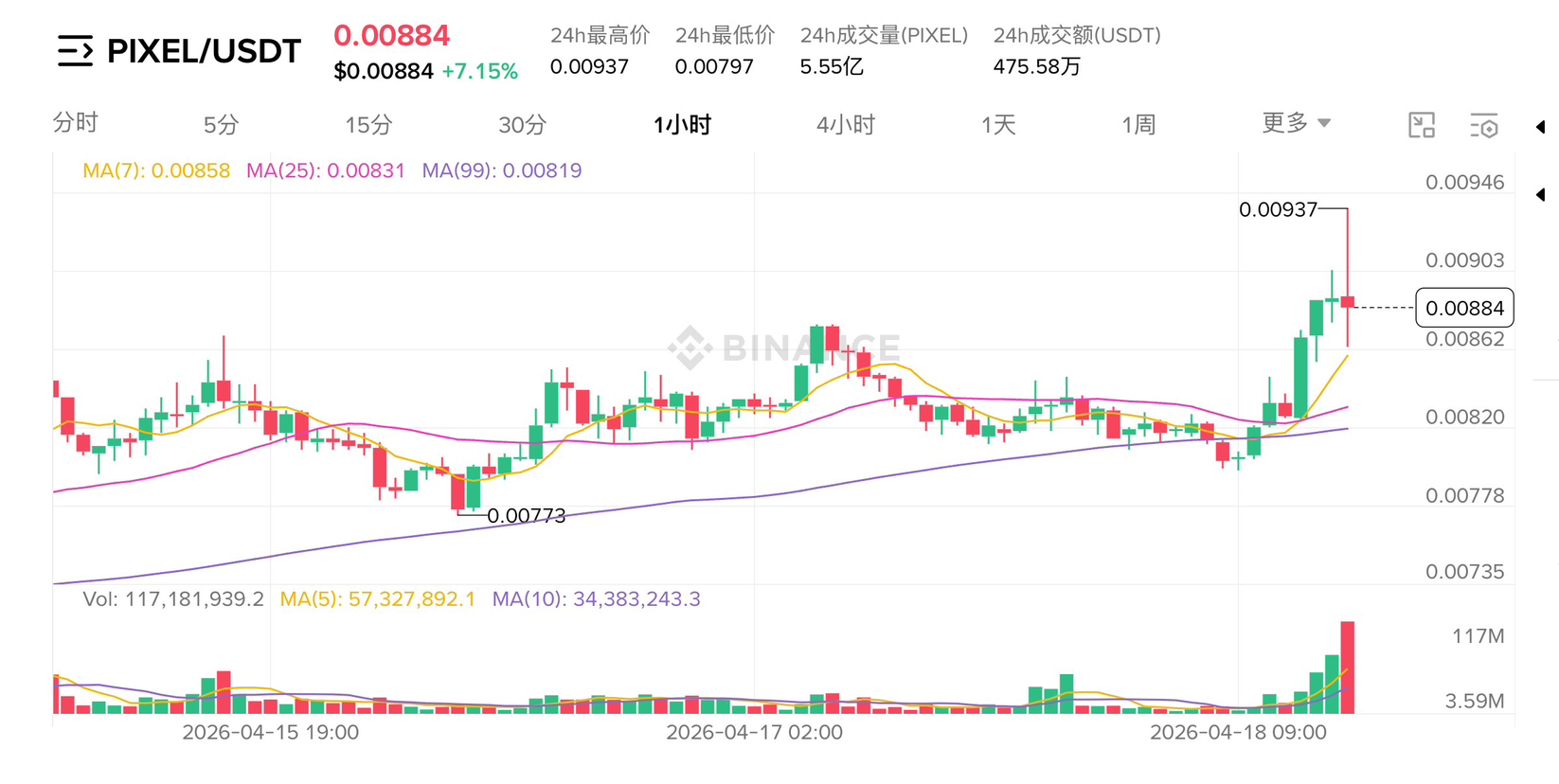
Finally, let's return to the thought experiment I started with. If I were the owner of a game studio, could Stacked allow me to move my budget over? My answer is: yes, if the data from external integrations can continuously validate that the ROI is positive. But there is still a data accumulation process between 'can consider' and 'will definitely act'; this process requires time and more real cases from external studios as references. I am not in a hurry to conclude because the first principle of real-person research and prioritizing survival is always: logical consistency is the starting point, data validation is the endpoint. Until that endpoint arrives, my attitude will always be to observe continuously and skeptically, which is the only way I can maintain independent judgment.
\u003cc-22/\u003e \u003ct-24/\u003e \u003cm-26/\u003e