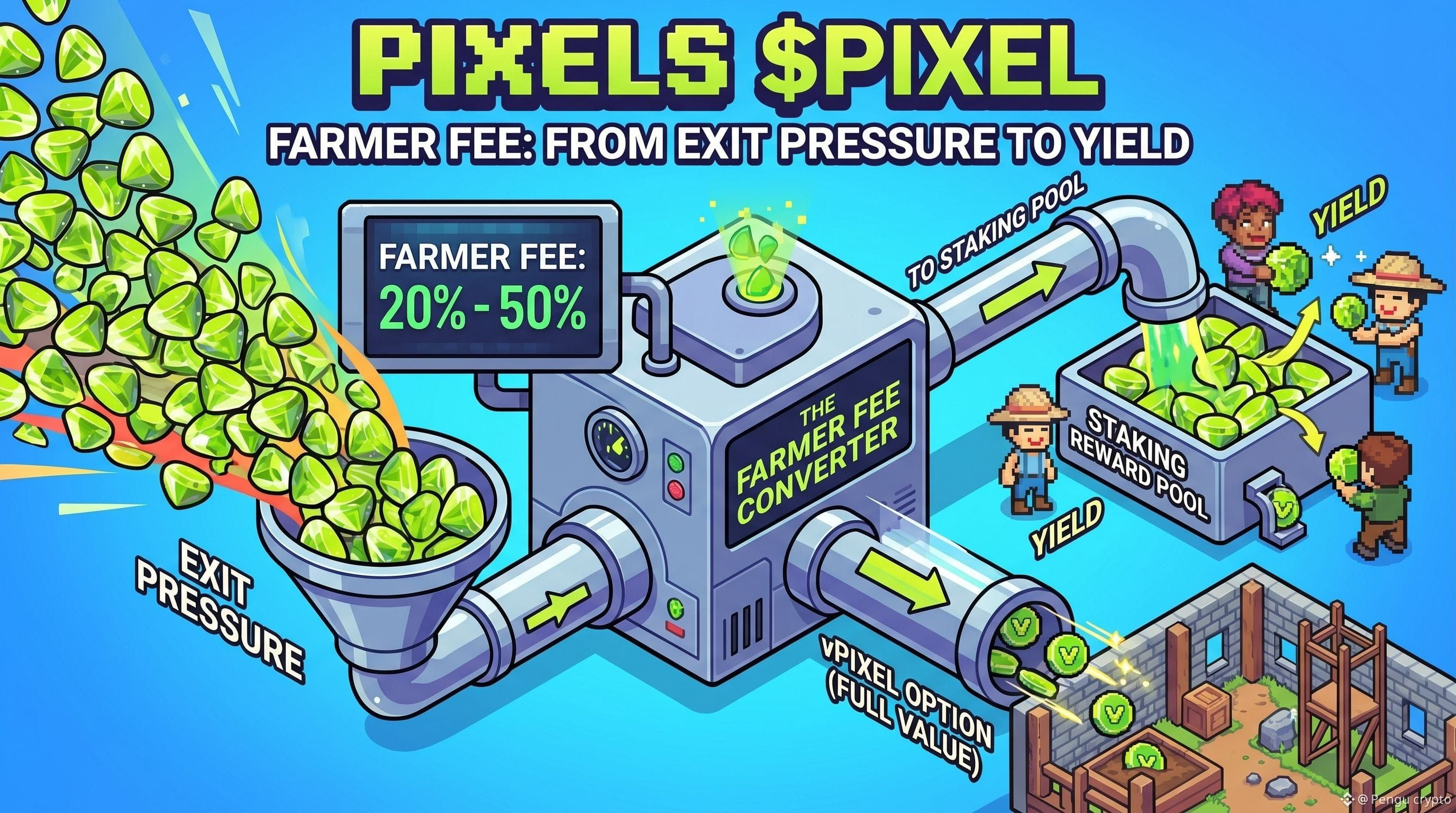
In the past few years, the blockchain gaming industry has been in a very awkward cycle: first using high returns to attract people, then relying on more new users discovering the exit of old users, and finally the model collapses, leaving behind "one place data" and a group of educated players. Many projects claim to be making games, but they are actually conducting financial experiments. Because of this, when I look at Pixel again, I find myself more concerned not about its style or the short-term price of the currency, but about whether it has pushed the series game in a different direction.
In my opinion, what is most interesting about the game Pixels is not that it offers a farming game, but that it tries to bring "behavior" back to the center of the economic system. The biggest problem in traditional peer-to-peer systems is that it pressures everyone's goals to maximize returns. Players are no longer interested in experience, world, or social interaction, and all actions end with one goal only: exchanging time for tokens as quickly as possible, then for money. Such a system is very active on the surface, but in reality, it is very fragile, because once income declines, behavior will immediately collapse and everyone will leave at the same time.
Pixels is relatively smart because it does not base its economic model on the logic of a single gold. You can farm, collect, build, complete tasks, participate in deals, and create your own path around land and resources. Different types of players play different roles in this system. Some people are producers responsible for providing resources; some are traders who make profits through market efficiency; some are consumers, pushing demand through purchases and upgrades; there are also some people who primarily work in social and long-term construction, bringing activity and stability to the entire world. Once roles are distinguished, the economy will not just be a simple closed loop of "reward sale tokens," but will be closer to a real market state.
That is why I say that the essence of Pixels is not in the game wrapper, but in the relationship of production. It not only gives you a way to play but also provides you with a set of behavioral structures that can be participated in, traded, invested in, and accelerated. The token is certainly important here, but it should not be the whole story. $PIXEL The true value does not come from the statement "it will rise in the future," but rather from whether it has use cases, whether there is demand for it, and whether it continues to trade within the system. If the token can only move through emotions, it is essentially an old narrative; but if it starts to take specific actions like consumption, trading, upgrading, identity, and resource allocation, it will have the opportunity to transform from a purely financial token to a real environmental tool.
Another point that cannot be overlooked is the importance of Ronin in the game Pixels. Many attribute the growth to lower fuel and smoother chains, but I believe the deeper value is that Ronin has proven that blockchain games can achieve a wide awareness among users. In other words, Pixels is not re-educating the market in a completely empty land, but is accepting demand in an ecosystem that already has a culture of series games and knowledge of assets. This will directly lower the conversion threshold and make it easier for players to accept the logic of "asset, transaction, behavioral value." Its growth did not explode out of nowhere, but rather stepped on a documented user base and rose.
Of course, Pixels is not close to the level of "strong wins." The challenge it faces now is very real: if new users slow down, will the demand for resources decrease? If a player quickly finds the optimal solution, will behavior gather again into one path? If content updates cannot keep up, can slow farm management continue to play? These problems still exist, but they have not been fully revealed yet.
However, I believe that Pixels has offered the industry something more important than "short-term successes": it has allowed everyone to start discussing whether blockchain games can return from financial narratives to content products, from air-drop logic to behavioral value, and from approximate support to romantic operations. If blockchain games can indeed escape to the next stage of opportunities in the future, it is likely not those with a higher annual rate, but those who can create a more realistic world, a more stable cycle, and a longer reason to stay.
So in my opinion, Pixels is not the end, nor the solution, but rather a turning point. At least it shows the market that the series games may not just survive on bubbles, but may also start to learn to operate as a real economy. #Wall Street's Fifth Giant: Charles Schwab will launch instant cryptocurrency trading services.