
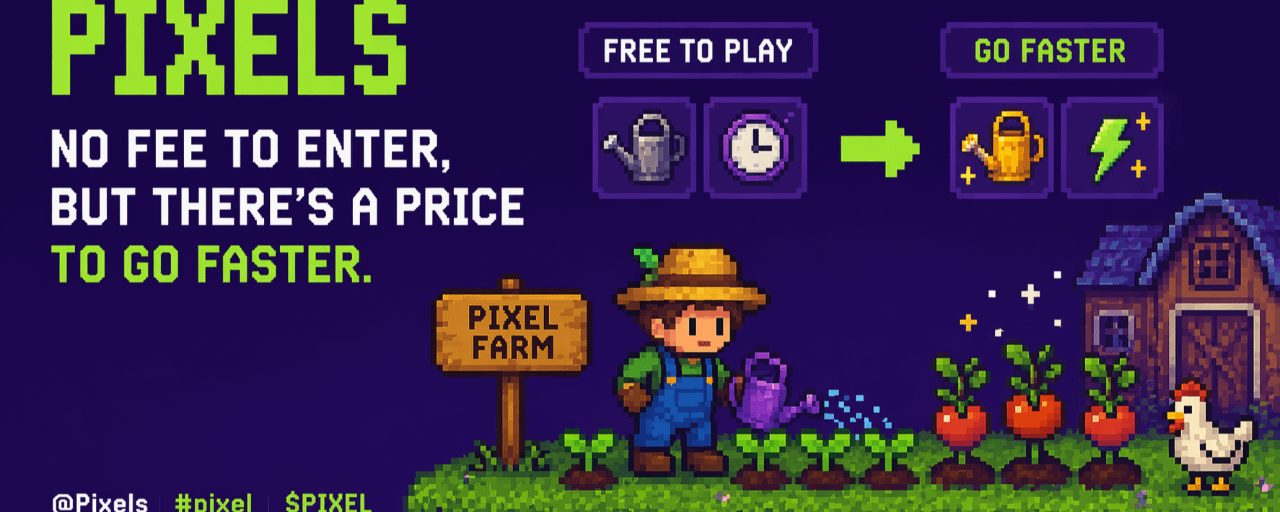
When I first joined Pixels, I didn’t think much. The experience was quite light: planting, harvesting, doing simple tasks, and then logging out. No wallet needed, no pressure to optimize, everything went smoothly like a regular web game. It felt quite pleasant.
But after a few days of continuous play, I began to realize something difficult to name. I was still doing the right things, still following the familiar loop, but the progress didn’t really open up. It wasn’t slow but felt like being held at a safe rhythm. You can move forward, but it's very hard to break out of the basic level if you only rely on time.
This makes me pay more attention to how the underlying system operates.
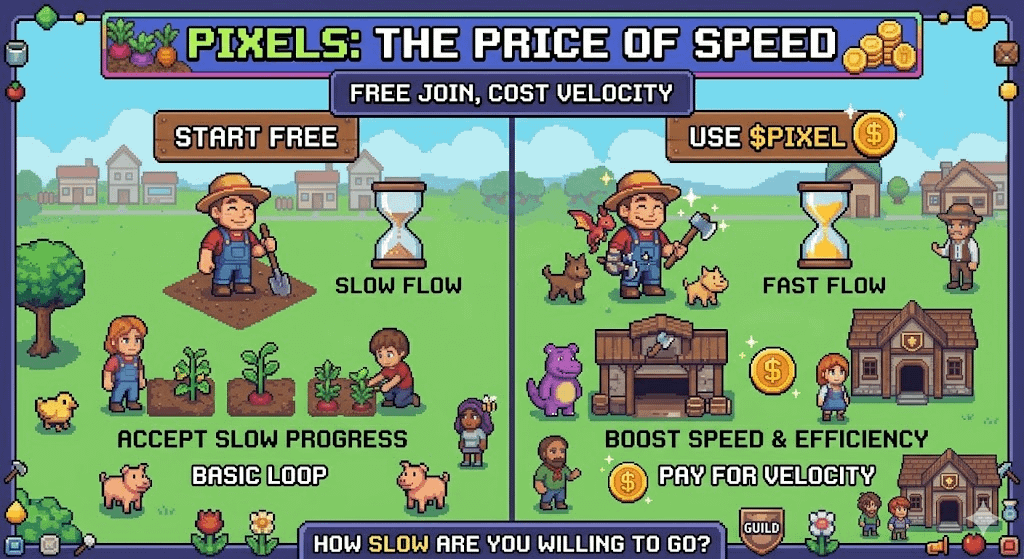
Pixels indeed allow starting for free and staying without touching $PIXEL . But 'staying' and 'going further' are two different matters. If you only play at the default pace, you will still earn resources, build a little, but the loop will repeat for quite a while without significant changes in efficiency.
And it is at this point that the role of PIXEL begins to emerge.
This is not a content lock type that requires payment. Instead, it appears as a way to enhance the gameplay rhythm. Better tools, smoother crafting processes, or options that help save time. Each individual element does not create a sense of obligation, but when combined, it significantly changes the pace of development.
What I find noteworthy is that the system does not sell 'access rights', but is rather pricing speed. Those who accept moving slowly can still play but will remain at the same progress tier for longer. Those who want to optimize need a way to shorten the repetitive parts.
If you look closely, this is quite a familiar mechanism in digital systems. You can use a basic free version, but when you need higher efficiency, the real cost lies in reducing wait times and increasing productivity. Pixels are heading in that direction, just framed in the context of a game.
What still concerns me is the long-term balance. If tokens are tied to escaping repetition, then repetition itself must always exist at some level. If the game becomes too smooth, the demand for tokens will decrease. Conversely, if too much friction is retained, the experience may become forced.
Moreover, when community factors like guilds or player trading are added, differences in speed are no longer a personal story. Faster groups will gain advantages in resource accumulation and shape how the market operates in the game. At that point, PIXEL not only affects individual experiences but also impacts each person's position in the ecosystem.
Therefore, saying that Pixels is free to play is not wrong but not sufficient.
You can enter the game without losing anything. But after a while, the question is no longer whether you can play or not, but how much you are willing to accept moving slowly.