
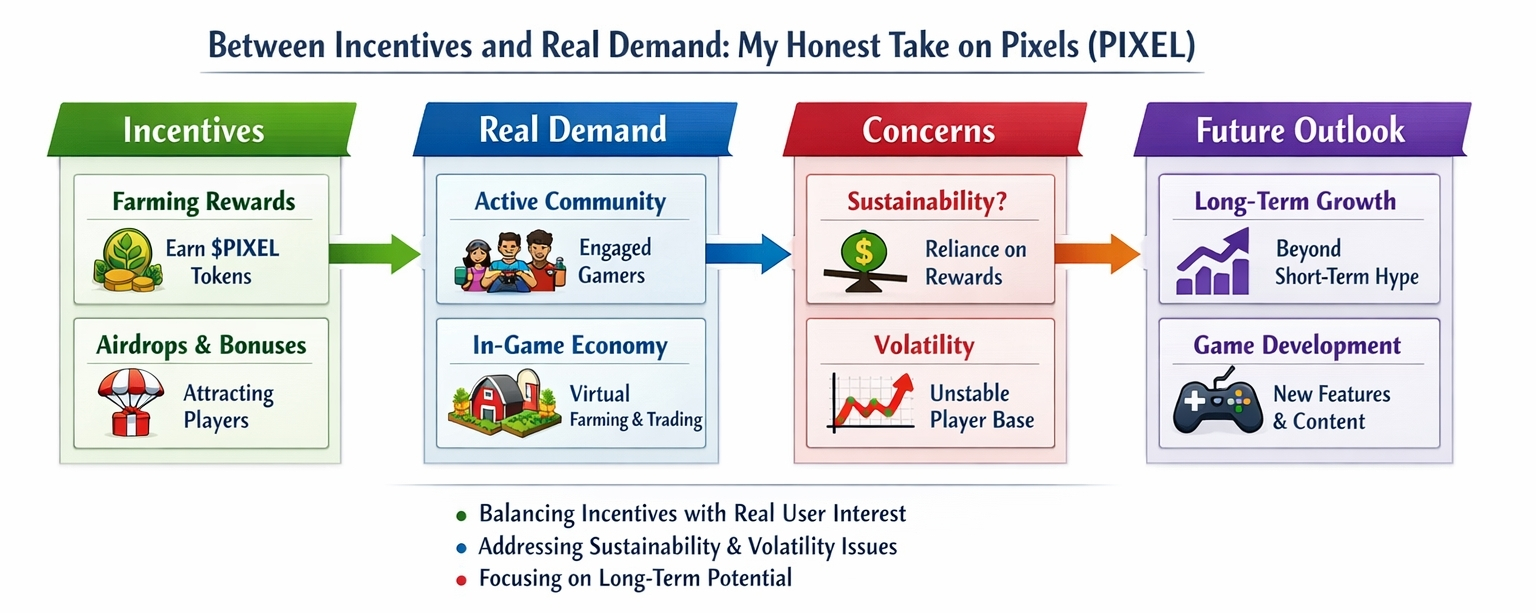

I’ve been watching Pixels ($PIXEL) for a while now, and honestly, what pulled me in wasn’t even the token—it was where it lives. Anything built on Ronin Network immediately makes me pay attention.
I’ve seen this movie before with Axie Infinity—liquidity floods in fast when a game catches attention, but it can disappear just as quickly when incentives slow down. So from day one, I wasn’t blindly bullish. I was curious, but cautious.
At first glance, the game itself actually makes sense. It’s simple—farming, gathering, crafting, social interaction. Nothing overly complex. And that’s kind of the point. It doesn’t try to scream “blockchain game.” Instead, it quietly uses blockchain in the background.
Most of the gameplay happens off-chain, while the blockchain handles ownership and value. That might sound like a small detail, but it’s not. If every action was on-chain, the experience would be slow and expensive. This hybrid approach—off-chain gameplay, on-chain assets—isn’t revolutionary, but it’s practical. And in Web3, practicality often wins.
But once I looked past the game and into the token itself, things got more complicated.
The supply is big—5 billion tokens. That tells me this isn’t about scarcity, it’s about distribution. A large chunk is already in circulation, but there’s still a lot waiting to be unlocked over the next few years.
And that’s where my caution kicks in.
There’s a steady flow of new tokens entering the market every month. Not huge enough to crash things overnight, but enough to create constant pressure. From experience, this kind of structure changes how a token moves. You don’t get long, clean rallies. You get shorter bursts that rely on fresh buyers stepping in again and again.
Then there’s the trading activity.
At times, the volume has been… extreme. Way higher than what you’d expect relative to its size. I’ve seen this pattern before—it usually comes from things like exchange listings, reward campaigns, or short-term speculation.
And to be fair, PIXEL has had all of those.
But the real question I keep asking myself is simple:
Is this real demand—or just people chasing rewards?
Because in Web3 gaming, those two things often look the same on the surface.
A lot of on-chain activity can just be players claiming rewards, moving tokens, or preparing to sell. That’s not the same as people genuinely enjoying the game and choosing to stay. The real signal is what happens when incentives drop.
Do players keep playing?
Do they spend the token—or just farm and exit?
That’s still unclear to me.
On paper, the token has utility. It’s used inside the game, tied to NFTs, and plays a role in the ecosystem. But utility alone doesn’t create demand. People need a reason to want the token—not just earn it and dump it.
And that’s where most Web3 games struggle.
There’s also the dependency on the Ronin ecosystem itself. That’s both a strength and a risk. If activity on Ronin grows, PIXEL benefits. But if things slow down, it probably feels it just as fast.
Looking at valuation, it’s not crazy. The hype has already been washed out. The price has come down massively from its early highs, which tells me expectations have already been reset.
But a lower price doesn’t automatically mean it’s a good opportunity. It just means the easy narrative is gone.
So now, I’m not really watching the price—I’m watching behavior.
Are players sticking around without heavy rewards?
Is the token actually being used, not just circulated?
Are there real reasons to spend it inside the game?
Because at the end of the day, this isn’t just about a token—it’s about whether the game can build a real economy.
Right now, I’d say it’s still figuring that out.
I like the direction. The design makes sense. And being on Ronin gives it a real advantage in terms of distribution.
But at the same time, the tokenomics create pressure, and a lot of the current activity still feels incentive-driven.
If things go wrong, it’s pretty straightforward:
too many tokens unlock, too much selling, and the game turns into a loop where people just extract value instead of creating it.
If things go right, though, it gets interesting.
If players start spending instead of farming… if they stay even when rewards slow down… then the token starts behaving less like a payout and more like an actual currency.
That’s the shift I’m waiting for.
For me, the biggest signal would be simple:
consistent player activity without heavy incentives, and real reasons to use the token inside the game.
If I start seeing that, I’d look at PIXEL very differently—not just as a trade, but as something that might actually last.
