
I remember the first time I looked at Pixels and felt more doubtful than impressed.
Not because it looked weak. Not because it lacked players. And not because the idea itself was bad. It was something more specific than that. I had seen this feeling before with other Web3 games. A project looks full of life, full of movement, full of transactions, and for a while that activity is enough to make people believe something real is being built. But if you sit with it a little longer, a harder question starts forming underneath all that noise.
What exactly is keeping this world alive?
That was my first real thought about Pixels.
At the beginning, it was easy to look at the game and see momentum. Players were farming, trading, building routines, talking about rewards, moving through the economy in ways that made the whole thing feel active. From the outside, that kind of movement can be convincing. It can make a project look healthy. It can make an economy look strong. But over time, I’ve learned that visible activity and real economic depth are not the same thing.
A world can look busy and still be hollow.
That is why Pixels keeps staying in my mind. Not because I think it has already solved Web3 gaming. Not because I think it is some perfect model. I keep coming back to it because it has reached the stage where the easy excuses don’t work anymore. The early excitement has cooled. The simple token story is no longer enough to explain everything. And once a project reaches that point, you start seeing its real structure much more clearly.
For me, the real question is no longer whether Pixels can attract players.
The real question is whether Pixels can hold player attention, player trade, and player purpose when token incentives stop carrying most of the emotional weight.
And honestly, I think that is the only fair test.
My view is simple. Yes, Pixels can sustain a player-driven economy without relying too heavily on token incentives. But it can only do that if it stops acting like incentives are the main event and starts using them the way strong game economies are supposed to use them: as support, not as the soul of the system.
That difference sounds small when you write it in one line. In reality, it changes everything.
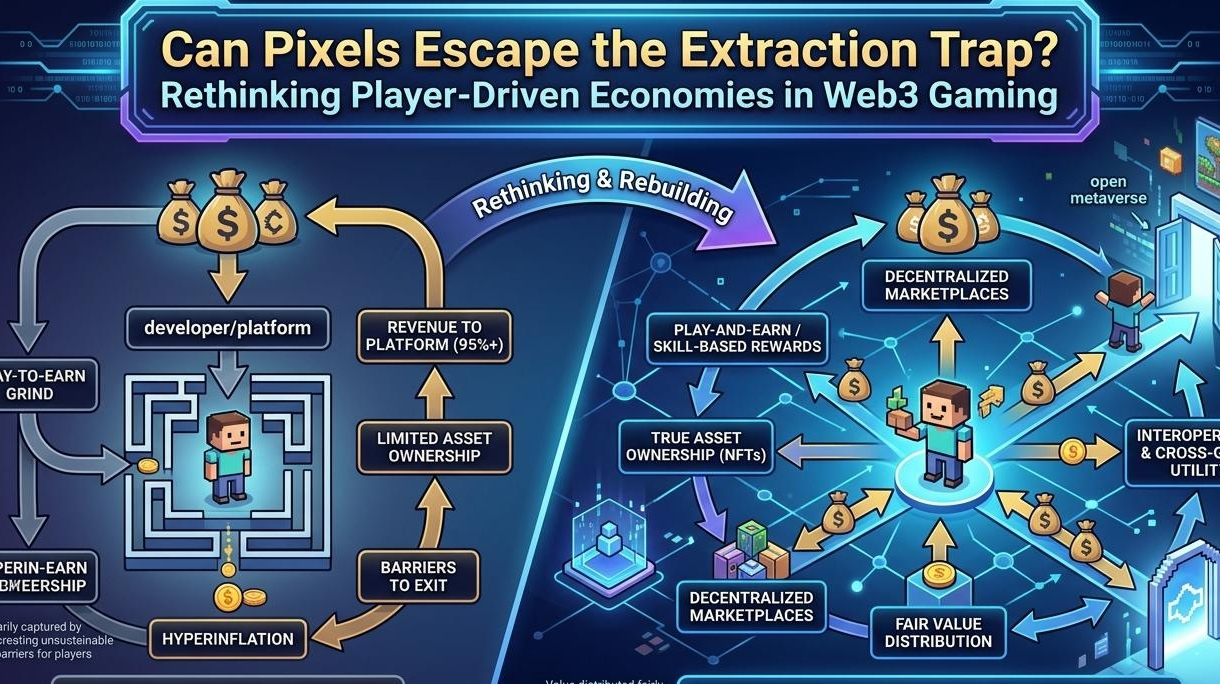
The biggest weakness I see in many Web3 games is that they are built from the outside in. The reward loop comes first. The token comes first. The extraction path comes first. Then gameplay is added around that structure, almost as if the game exists to justify the economy rather than the other way around. So people enter the world already trained to think in a certain way. They are not asking, what kind of place is this? They are asking, what can I get from this while it still works?
That mindset damages a game more deeply than many teams seem to understand.
Because once players learn to treat a world mainly as a payout system, everything inside that world slowly loses its natural meaning. Time starts feeling like labor. Progress starts feeling like calculation. Items start feeling like output units. Even other players stop feeling like part of a shared environment and start feeling like people on the other side of a transaction. The economy may still function on paper, but emotionally it becomes thin.
It moves, but it does not breathe.
That is the trap Pixels still needs to avoid.
If the strongest reason to log in is still the reward itself, then the economy is fragile no matter how active it looks today. It may hold for a while. It may even look impressive during strong market periods. But the weakness is already built into the foundation. The moment returns become less attractive, the moment inflation feels heavier, or the moment broader crypto sentiment cools down, the game has to face a truth it can no longer delay.
Do players actually care about this world, or were they mainly responding to the economics wrapped around it?
That is where the difference between a temporary crypto system and a lasting game economy starts to appear.
To me, a real player-driven economy only becomes durable when players want things for reasons that belong to the game itself. They should want resources because those resources are genuinely useful in someone’s progression. They should want crafted items because those items make life in the world easier, better, faster, more expressive, or more social. They should trade because specialization creates real dependency between players, not because everyone is feeding the same reward machine from a different angle.
That is the kind of demand that matters.
If one player grows or gathers something because another player truly needs it for their own goals, that creates a healthier market. If land, tools, materials, and crafted goods matter because they serve actual in-game purpose, then the economy starts becoming more organic. It starts feeling less like a funnel and more like a living exchange between people who each have a place in the system.
That is where I think Pixels still has a real opportunity.
Because unlike many Web3 games, it already shows traces of something more sustainable. There is routine in it. There is repetition, but not all repetition is bad. Sometimes repetition is what becomes habit, and habit is what makes a world sticky. There is also social presence, light interdependence, and the sense that player activity can influence other players in ways that go beyond simple reward farming. Those things matter more than token-heavy projects usually admit.
Most durable economies are not built first on speculation. They are built on ordinary usefulness.
People come back because they have crops to manage, items to make, plans to finish, trades to complete, spaces to improve, or some quiet rhythm that starts feeling familiar. That kind of return behavior is easy to underestimate because it looks small compared to token hype. But in the long run, it is far more valuable. Hype creates spikes. Familiarity creates retention.
And retention is what gives an economy real shape.
This is also why I think the strongest future for Pixels is not one where the token becomes even more central. I actually think the opposite is true. The token should become less emotionally visible, not more.
I do not mean useless. I do not mean removed. I mean properly positioned.
A token can still be important. It can reward participation. It can support ownership. It can help connect effort, scarcity, and exchange. But it should feel like infrastructure in the background, not the main reason the world feels worth entering. The more the token becomes the emotional headline, the more the game quietly teaches players to prioritize extraction over attachment. And once that lesson becomes dominant, the economy may stay active for a while, but it becomes shallow in a way that is hard to reverse.
That is why Pixels feels like such an honest case study to me now.
It is no longer protected by early excitement alone. It is entering the stage where it has to prove whether its economy can be held together by lived player behavior instead of financial gravity. That is a much harder thing to prove, but it is also the only proof that really matters.
Because I’ve seen too many Web3 systems look successful from a distance while feeling empty up close. High activity does not always mean strong attachment. Strong transaction numbers do not automatically mean real demand. A chart can look healthy while the culture underneath it is weak. And when that happens, decline usually starts before people are willing to admit it.
That is why I keep coming back to the same thought when I look at Pixels.
Not whether the token can create another burst of excitement. Not whether the market can temporarily lift attention again. Not whether players can still extract value from the system this month.
I keep thinking about whether the world itself is becoming worth returning to.
Because if the answer to that question becomes yes, then Pixels has a real path. Not just as a Web3 game with rewards, but as an actual economy shaped by player habits, player needs, and player relationships. But if the answer remains tied mostly to incentives, then it will eventually face the same limit that many blockchain games faced before it. Activity without loyalty. trade without attachment. movement without meaning.
And that, to me, is where the whole story lives.
Pixels does not need bigger incentives to become more convincing. It needs deeper reasons for players to care when incentives feel smaller.
That is the test. That is the pressure. And that is exactly why I still find it worth watching.
Because in the end, the strongest game economies are not the ones that pay people the most for showing up. They are the ones that make people feel like showing up still matters even when the rewards are no longer the loudest part of the experience.