

At first, I approached $PIXEL the same way most people do as a game. You log in, complete tasks, earn rewards, and slowly progress. It feels simple, structured, and easy to understand. Nothing about it seems unusual at the beginning.
But over time, I stopped focusing on what #pixel is supposed to be, and started paying attention to how people actually use it. That’s when my perspective began to shift.
Because usage often reveals more than design.
In most games, player behavior is unpredictable. People explore different paths, try things that don’t work, and spend time experimenting without thinking too much about efficiency. There’s curiosity, randomness, and sometimes even chaos. That’s what makes a game feel alive.
But inside PIXEL, the behavior feels different.
👉 This difference becomes clearer when you look at it this way:
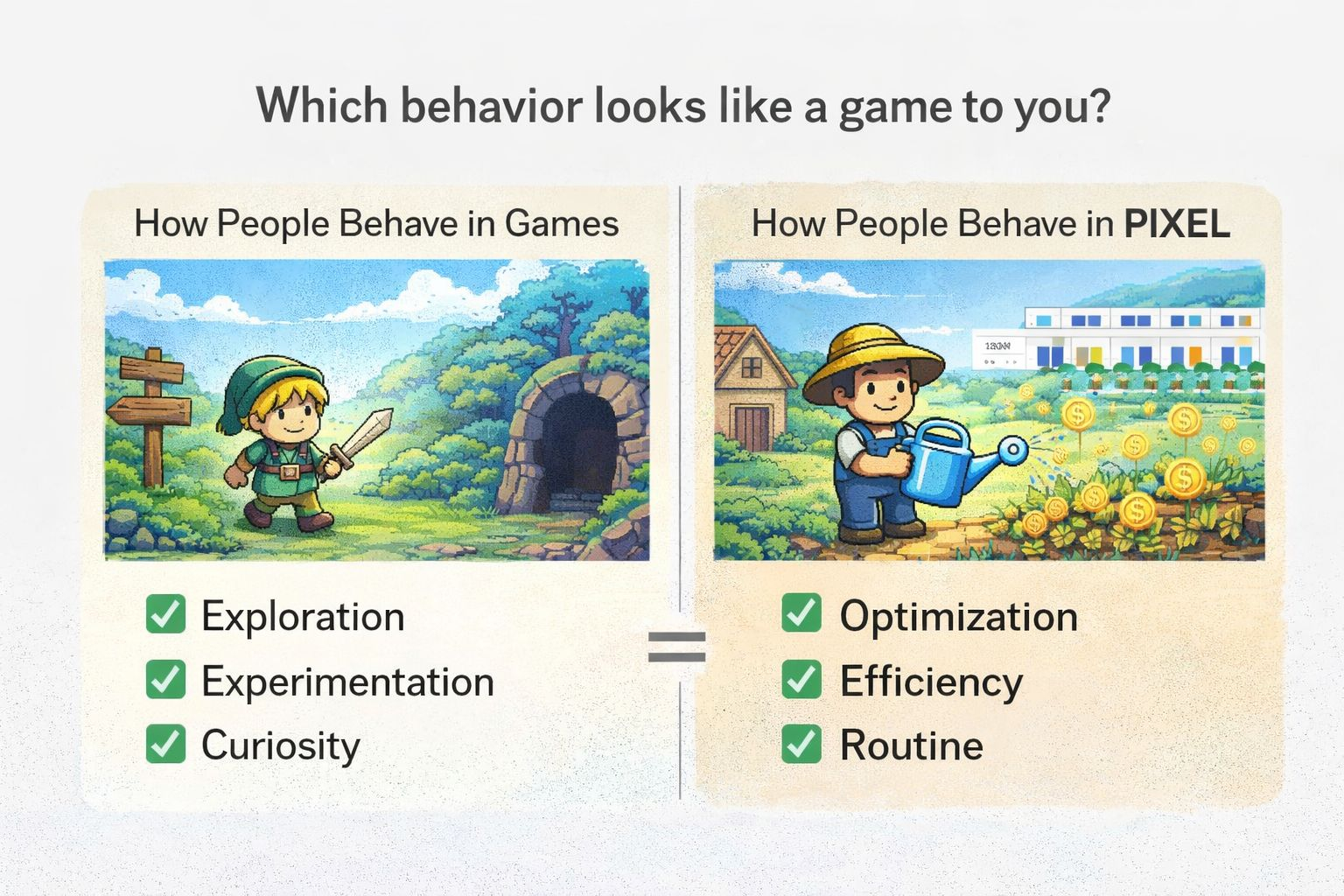
It’s more structured. More consistent. Almost optimized.
Players tend to follow similar patterns. They log in at specific times, repeat the same actions, and gradually move toward the most efficient way to play. The focus isn’t really on exploration — it’s on outcomes. On what works best.
And that distinction matters more than it seems.
Because when behavior becomes predictable, it usually means the system is guiding it in a very specific direction.
That’s when I started asking a different question. Not “Is PIXEL fun?” but “What kind of behavior is PIXEL actually producing?”
The answer is interesting.
PIXEL doesn’t just encourage activity — it encourages efficiency. Every action has a purpose, every decision has a better option, and over time, players naturally move toward optimization. That’s not accidental. That’s design.
And this is where it starts to feel less like a traditional game, and more like a behavioral system.
A system where actions are repeated not because they’re enjoyable, but because they’re effective.
Now, that doesn’t automatically make it a bad thing. In fact, it might be one of the main reasons why PIXEL is growing. Efficiency is easy to understand, easy to follow, and easy to scale. People adapt to it quickly.
But it also introduces a different kind of dependency.
Because when behavior is tied closely to outcomes, it becomes conditional. Players don’t ask what they feel like doing — they ask what makes the most sense to do. And those two mindsets lead to very different experiences.
One creates engagement.
The other creates participation.
Right now, @Pixels seems to sit somewhere in between. It has enough structure to guide behavior, and enough simplicity to keep users returning. But it hasn’t fully answered what happens when efficiency alone is no longer enough.
Because eventually, every system reaches that point.
A point where optimization starts to feel repetitive. Where routine replaces curiosity. Where users begin to question why they are still there.
That’s where the real test begins.
Not in how fast the system grows, but in how well it holds.
And that’s why I don’t see PIXEL as just a game anymore. I see it as a system that is actively shaping user behavior in a very specific way.
The outcome won’t be decided by features or rewards alone. It will depend on whether that behavior can sustain itself over time.
Because in the end, the real question isn’t whether PIXEL works today.
It’s whether people will still choose it when they no longer have to.