

What stands out about Pixels after you ve seen enough Web3 games come and g is not what it tries to do but what it refuses to rush
Most projects in this space start loud. Big promises, complicated systems, constant incentives to pull people in fast. And for a while that works. You get activity noise charts moving in the right direction. But underneath it, the actual behavior is usually fragile. People don’t stay they circulate.
Pixels feels like it was built by people who already saw that pattern happen too many times and decided not to repeat it.
At first glance, it almost looks too simple. Farming, exploring, crafting, repeating. Nothing aggressively novel. Nothing screaming for attention. And that’s exactly why it behaves differently over time. It doesn’t overload you with systems you have to “learn” before you can enjoy it. It just puts you in a loop and waits to see if you come back tomorrow.
That design choice matters more than it looks like it should.
Because what it really does is remove pressure.
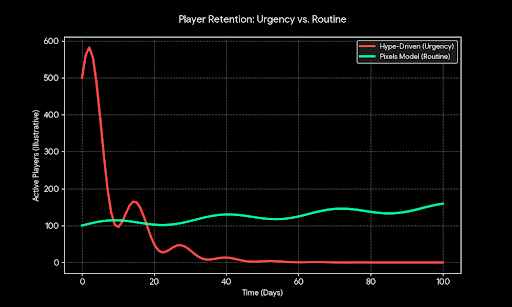
You don’t feel behind if you miss a day. You don’t feel punished for not optimizing. And slowly, that changes how you interact with it. You stop treating it like something you need to “keep up with” and start treating it like something that just exists in your routine. Almost like checking on something small you’ve been growing.
That shift—from urgency to routine—is where most of the actual retention comes from.
Early users of Pixels often stuck around for a strange reason: it wasn’t impressive in a traditional sense, but it was consistent. Even when things were incomplete or rough, the world didn’t feel like it was constantly changing direction. That stability, even in an unfinished state, built a kind of quiet trust.
Later users don’t see that same roughness. They see a more finished surface. But they also miss the experience of watching the system slowly figure itself out in real time. That difference matters more than people admit. Early users bond with the process. Later users just inherit the result.
And those two relationships with a system are never the same.
What’s interesting is how carefully new features seem to be introduced. Nothing feels like it’s dropped in just to chase attention. There’s a kind of patience in the pacing. As if the builders are asking, “Does the core loop actually still work after this?” before adding anything else.
That kind of restraint is rare. Especially in environments where the temptation is always to expand, complicate, and monetize every possible interaction.
Even when problems show up—imbalances, exploits, edge behaviors—the response doesn’t feel dramatic. No big resets or chaotic overhauls. Just small corrections that try not to disturb everything else. It’s not flashy, but it keeps the world from feeling unstable. And stability, in systems like this, is more valuable than people initially realize.
The token layer exists in the background, but it doesn’t dominate how people play. That alone changes the tone of everything. It stops the experience from collapsing into constant financial interpretation. Instead, the token feels like part of the ecosystem rather than the point of it. That distinction is subtle, but it matters for how people stay engaged without burning out.
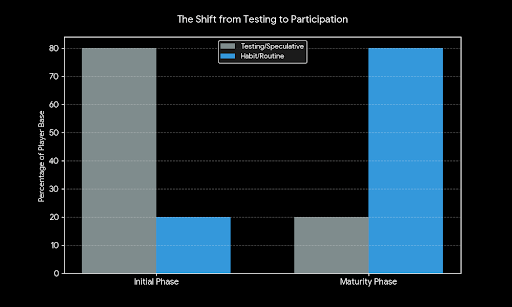
Over time, something quiet happens: players stop treating it like an experiment.
At first, everyone is testing it. Checking if it’s worth it. Watching for signals. But eventually, for some of them, it just becomes something they do. Not because they’ve been convinced by a promise, but because the system keeps behaving the same way, day after day. That kind of predictability builds a different kind of trust—one that doesn’t need to be reinforced constantly.
You can actually see it in how people use it. Not in peak numbers or spikes, but in repetition. The same players showing up in small, steady patterns. Doing simple things. Not rushing. Not optimizing everything. Just returning.
And that’s usually a stronger signal than activity bursts ever are.
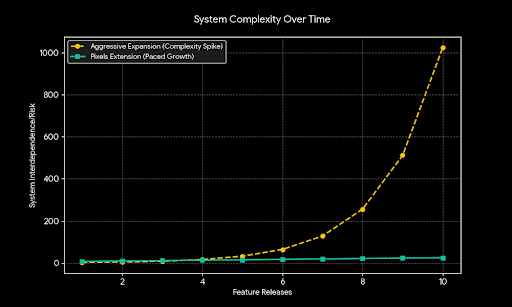
The important thing about Pixels isn’t that it’s trying to be “big” in the traditional sense. It’s that it seems more interested in not breaking what already works. The system feels like it’s being carefully extended rather than aggressively expanded. That choice slows everything down—but it also makes it more likely that people can actually build habits inside it.
At some point, it stops feeling like a game you’re trying out and starts feeling like something that just quietly fits into your day. You don’t announce it to yourself. You don’t frame it as a commitment. You just keep coming back.
And if it continues like this carefu restrained a little understated it probably won t turn into something that constantly demands attention. It ll turn into something closer to background infrastructure. Not in a flashy way, but in a it s just part of how things are now way
Those are usually the systems that last longest even if nobody describes them as exciting while they re happening