
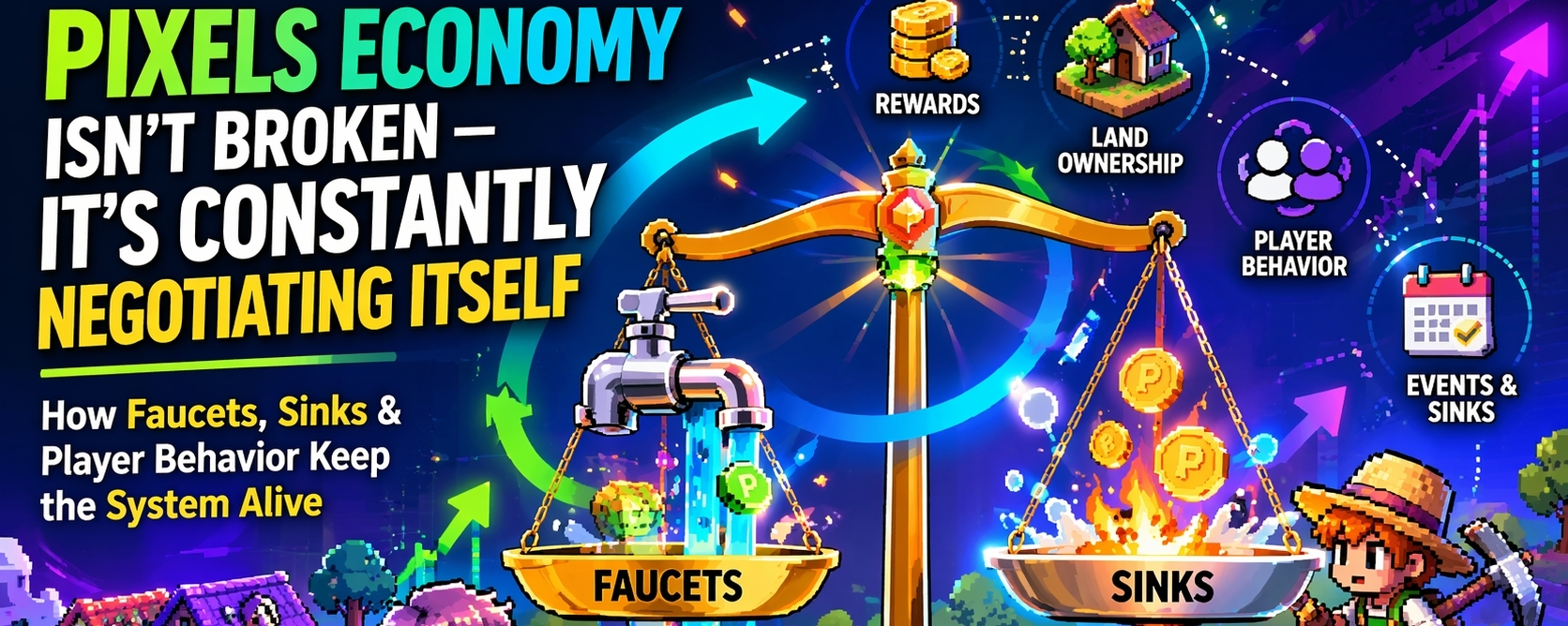
Most people look at a game economy and expect stability. That expectation is wrong from the start.
A live economy especially in a Web3 environment like Pixels is not designed to sit still. It behaves more like a negotiation between systems, players, and incentives that keep shifting over time.
At the center of this negotiation is a simple but powerful dynamic: how value enters and how it leaves.
But instead of thinking in rigid terms like “balance,” it’s more accurate to think in terms of pressure.
Where Pressure Builds
Every time players earn rewards, harvest resources, or complete tasks, the system introduces new value. This creates upward pressure more supply, more liquidity, more movement.
On the other side, whenever players upgrade assets, craft items, or spend tokens, value is pulled back out. That creates downward pressure reducing excess and giving meaning to what’s earned.
The system doesn’t fail when one side exists.
It fails when pressure stops responding to change.
The Hidden Variable: Player Behavior
What makes Pixels interesting isn’t just its mechanics it’s how sensitive those mechanics are to player shifts.
During high-hype phases, activity surges:
More players → more rewards generated
More spending → stronger sinks
But when attention fades:
Fewer players → slower circulation
Lower engagement → weaker sinks
This doesn’t just shrink the economy it reshapes it.
The same system can feel generous in one phase and restrictive in another, without any code changing.
Ownership Changes the Experience
Pixels introduces a structural divide through land ownership.
Some players participate as producers, while others act more like collectors of value through land-based earnings.
This creates two different economic realities inside the same game:
One side is actively generating and spending
The other is passively accumulating
That difference isn’t necessarily a flaw but it amplifies imbalance if not carefully monitored.
Events: Short-Term Fix or Smart Strategy?
Limited-time events play a crucial role by accelerating spending during peak moments. They create urgency, pull resources out of circulation, and temporarily restore equilibrium.
But here’s the catch:
If the core system depends too heavily on events to stay healthy, it suggests that the baseline economy isn’t fully self-sustaining.
Events should enhance the system not carry it.
The Real Challenge Isn’t Design It’s Adaptation
Most Web3 games fail because they treat their economy like a fixed structure.
Pixels doesn’t seem to be making that mistake.
Adjustments, infrastructure changes, and ongoing tweaks show that the system is being actively managed. And that’s important—because no economy survives without iteration.
Still, responsiveness alone isn’t enough.
The real test is whether adjustments are:
Timely
Data-driven
Aligned with player incentives
Two Opposing Forces That Never Fully Align
There’s an underlying conflict that hasn’t been solved not just in Pixels, but across all play-to-earn models:
Some players are here to extract value
Others are here to experience value
One group benefits from easier rewards.
The other benefits from meaningful spending.
Trying to satisfy both at the same time creates constant friction.
And maybe that friction isn’t something to eliminate
maybe it’s something the system has to continuously manage.
Final Thought
Pixels isn’t a perfectly balanced economy and it doesn’t need to be.
What matters is whether it can keep adjusting faster than it breaks.
Because in systems like this, success doesn’t come from getting it right once.
It comes from never stopping the correction process. @Pixels #Pixel $PIXEL
