
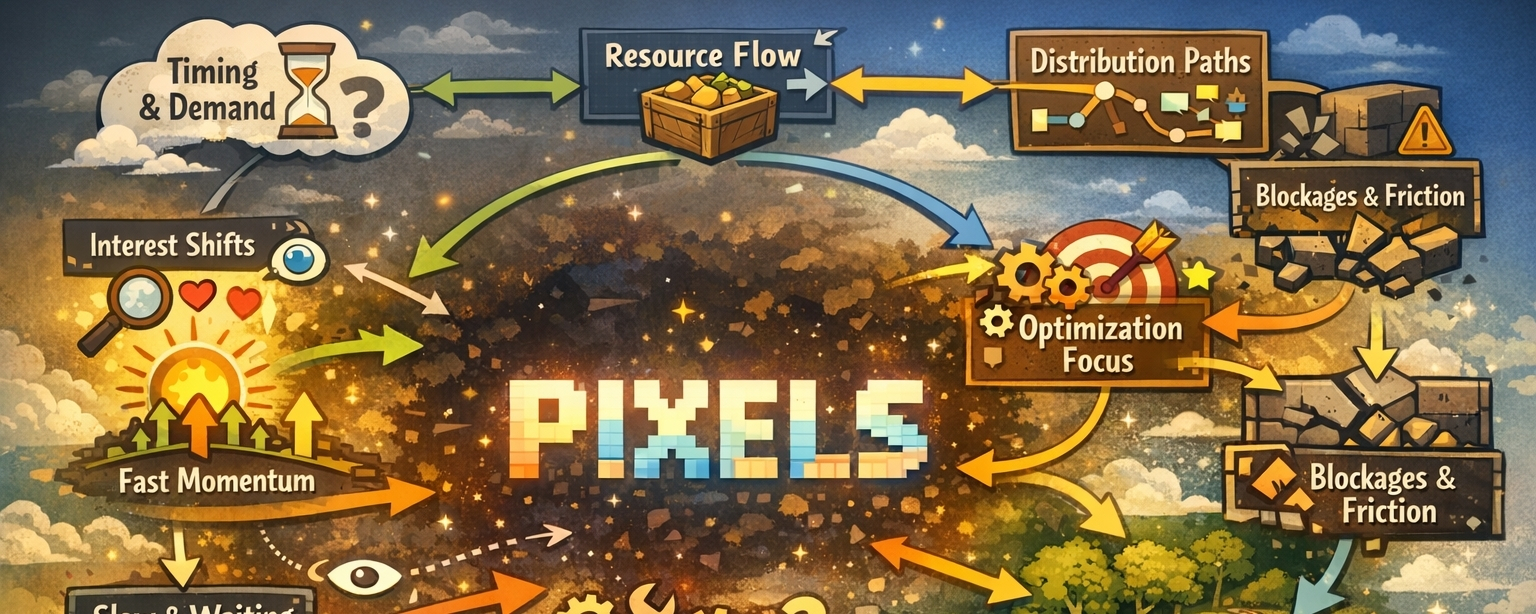
I’ve been thinking about PIXELS this closely lately, and it doesn’t really feel like I’m looking at a single game anymore. It feels more like watching something in motion—quietly adjusting itself depending on how people move through it. Pixels isn’t just sitting there waiting to be used. It’s reacting, shifting, almost like it’s aware of the rhythm around it.
The strange part is how nothing inside it really stands alone. Farming blends into exploration, exploration into creation, and somewhere in between, you stop seeing them as separate things. One part starts moving faster because people are drawn to it, and without anyone deciding it directly, everything else begins to orbit around that. Another part slows down—not because it’s weak, but because the moment isn’t right for it. It just kind of waits there, quietly.
I don’t think we notice how much timing shapes everything. The same feature can feel irrelevant one day and essential the next, without changing at all. It’s just the surrounding conditions that shift—attention, curiosity, even mood. When those things line up, movement happens naturally. When they don’t, things stall, and it’s hard to explain why.
What’s even more subtle is how the system starts to lean when something gains momentum. When one area becomes active, it pulls people in, and that pull isn’t neutral. It redirects energy. You see more activity there, more resources, more focus—and without meaning to, the rest starts to feel quieter. Not empty, just… less immediate. That imbalance doesn’t break anything right away, but you can feel it spreading, gently reshaping the flow.
And then people step in and try to make it better.
That’s where it shifts again. Once we start optimizing—pushing what works, refining what’s visible—the system tightens. Decisions become sharper, but also narrower. We naturally invest more into what’s already moving because it feels safer, more justified. But in doing that, we sometimes overlook the slower parts that were never meant to move fast in the first place. They’re not failing—they’re just out of sync.
It’s not anyone’s fault. It’s just how systems respond under pressure. They adapt to what’s being asked of them, and people adapt with them. Over time, those small adjustments add up. The flow changes, almost invisibly. What once felt balanced starts to lean in certain directions, and unless you’re paying close attention, you don’t really see when it happened.
That’s what keeps pulling my attention back. A product like PIXELS isn’t just what it is on the surface. It’s also the timing behind it, the paths it moves through, the way people respond to it, and the quiet pressure of everything happening around it. Nothing really moves on its own. Everything is slightly dependent on something else—waiting, reacting, adjusting.
And the more I watch it, the less it feels like something designed to behave in a fixed way… and more like something that’s still figuring itself out as it goes.