I didn’t expect @Pixels to go in this direction.
At the beginning, it feels almost too simple. You plant, harvest, craft, and move around a calm world that doesn’t demand much from you. In a space like Web3, where everything tries to prove itself instantly, that kind of design can be misleading. Most people play it for a few minutes, assume they understand it, and move on.
But if you stay a little longer, something changes.
The game doesn’t suddenly become complex. Instead, your perspective shifts. Small decisions start carrying weight. Time allocation matters. Resource usage matters. Even the choice to wait or act begins to affect your outcome. That’s usually the moment where @Pixels stops feeling like a game and starts feeling like a system.
And with the latest updates, that system is becoming harder to ignore.
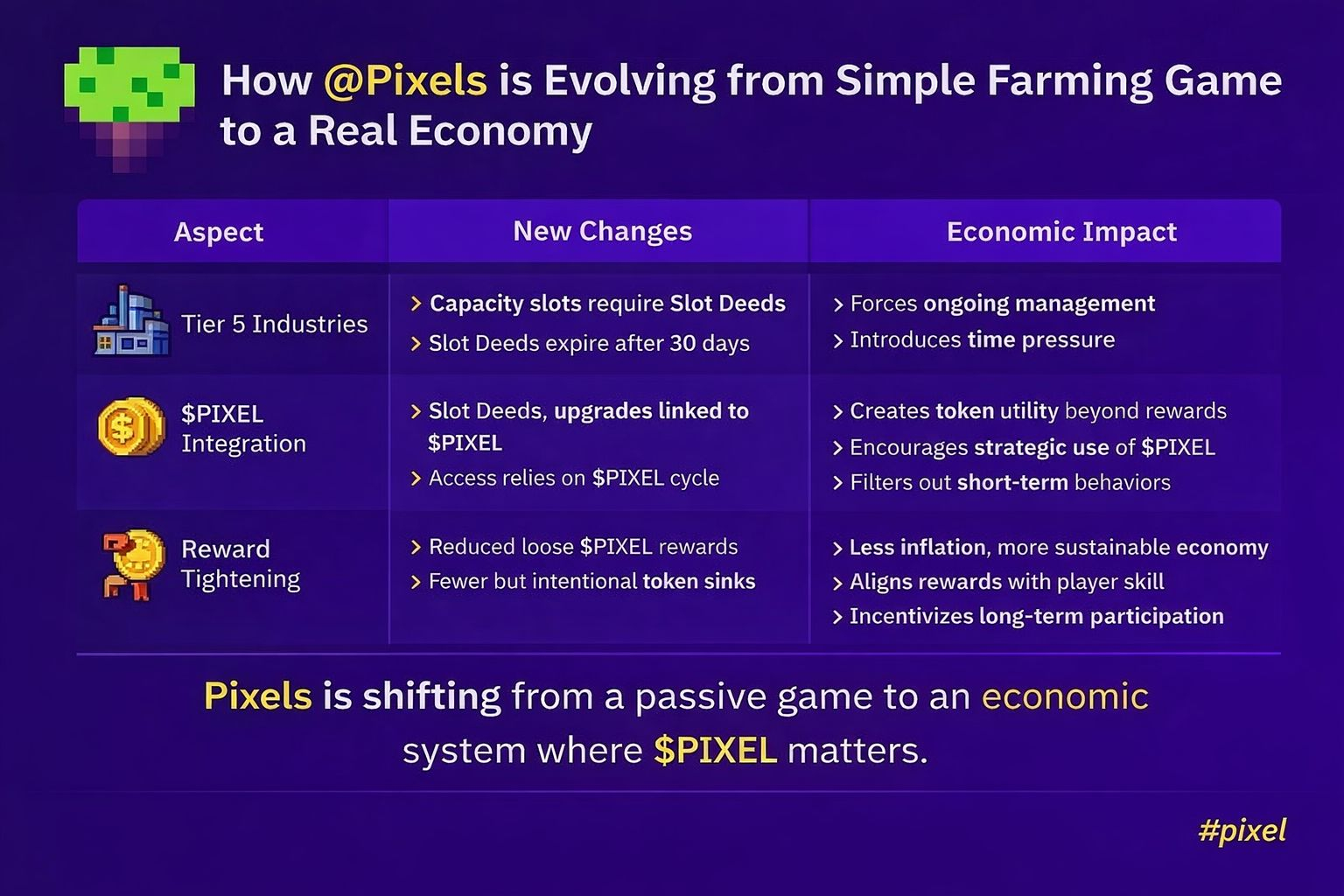
The introduction of Tier 5 industries is not just an expansion. It’s a structural shift. Before this, most players could operate casually. Log in, complete loops, collect rewards, and log out. Now, you’re stepping into something closer to production management.
You are no longer just farming. You are managing capacity.
That sounds subtle, but it changes behavior in a real way. Tier 5 requires Slot Deeds, and each deed only unlocks a portion of your total capacity. On top of that, these slots expire after 30 days. This one detail alone changes everything.
It introduces time pressure into a system that previously allowed passive engagement.
If your slots expire, your industries stop functioning properly. That means your entire setup depends on ongoing decisions. You can’t just build once and forget about it. You have to maintain it. Plan around it. Think ahead.
This is where most Web3 games struggle. They either make things too easy, which leads to inflation and short-term farming behavior, or they make things too complex upfront, which pushes players away.
Pixels is taking a different path.
It starts simple, then gradually introduces responsibility.
And that responsibility is where the economy begins to take shape.
What stands out even more is how $PIXEL is evolving within this system. Early on, it mostly felt like a reward. Something you earn through gameplay and maybe hold or sell. But with the new structure, it’s becoming part of a loop.
Production feeds into upgrades. Upgrades require resources. Resources connect back to $PIXEL in different ways. Access itself starts depending on how you interact with the token.
This is important because it shifts PIXEL from being a payout to being part of the infrastructure.
And that’s a big difference.
In many Web3 games, tokens are loosely connected to gameplay. They flow in easily, but there aren’t enough meaningful ways for them to flow out. That imbalance creates inflation, and eventually the system weakens.
What Pixels is doing now looks like an attempt to correct that.
The economy is tightening.
Rewards are becoming more intentional. Sinks are becoming more relevant. And instead of encouraging pure extraction, the system is starting to reward players who understand positioning.
Less noise. More signal.
You can already see this shift in how players behave. Casual farming is still possible, but it’s no longer the dominant strategy. Players who think ahead, who plan their industries, who understand timing, are starting to separate themselves.
That’s usually a sign of a maturing system.
Another interesting layer is how this design filters the player base. When rewards are too easy, everyone participates but few actually care about the system. When decisions start to matter, the environment changes.
Some players leave because it requires more attention. Others stay because it becomes more engaging.
That filtering process is not a weakness. It’s part of building something that lasts.
Still, none of this guarantees success.
Balancing an economy like this is one of the hardest problems in Web3. Player activity changes. Market conditions shift. Token price moves. All of these factors affect how faucets and sinks interact.
If too much value enters the system, inflation returns. If too much value is removed, players feel punished. The balance has to adjust constantly.
That’s where most projects fail, not because they lack ideas, but because they can’t maintain equilibrium.
Pixels has shown that it understands the framework. The current phase looks like calibration. Tightening the loops, adjusting flows, and observing how players respond.
It’s still early, but the direction is clear.
This is no longer just about building a game people can play. It’s about building a system people can think inside.
And that’s a much harder challenge.
From where I see it, PIXEL is starting to reflect that shift. It’s becoming less about short-term rewards and more about long-term participation. The token begins to represent access, decision-making, and positioning within the ecosystem.
That’s when things start to get interesting.
Because once a player base begins to treat a system like an economy instead of a game, behavior changes at every level.
People stop asking, “What can I earn today?”
They start asking, “Where should I position myself?”
That shift is subtle, but it’s powerful.
If pixels continues refining this balance, especially around Tier 5 industries and token flow, it could move beyond the usual play-to-earn narrative. It starts to look more like a living economy where participation actually matters.
And those systems, when they work, tend to last longer than hype cycles.
Right now, it feels like Pixels is somewhere in the middle of that transition.
Not fully there yet. But clearly moving in that direction.
And in Web3, direction matters more than noise.