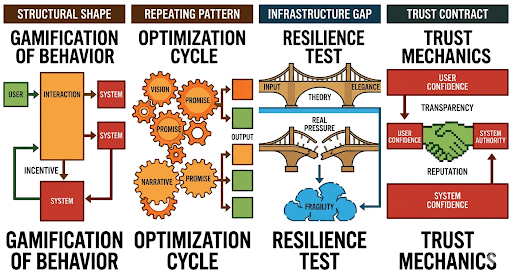
I keep coming back to the same thought whenever I watch Pixels expand: at what point does a game stop being a game and start becoming a system that quietly shapes everyone inside it? The more I look at Pixels, the harder it becomes to see it as simple entertainment. What looks like fun on the surface often feels like participation in something much larger underneath. I find myself wondering whether I am engaging with a creative world built for players, or stepping into a structured environment designed to guide behavior in ways most people never stop to question. That uncertainty is what keeps pulling me back to Pixels, because the deeper the ecosystem grows, the harder it is to tell where the game ends and the machine begins.
What unsettles me most about Pixels is not that it is growing, but the way that growth follows a pattern I have seen many times before. It starts with a compelling vision, a language of openness, freedom, and innovation, and for a while it feels genuine. Then slowly the same ideas begin repeating until they lose meaning. In Pixels, I see familiar promises wrapped in fresh language, but underneath it often feels like the same cycle of optimizing systems to capture attention, shape incentives, and turn participation into measurable output. After watching this happen so many times, I no longer react to the narrative itself. With Pixels, I am less interested in what is being promised and more interested in what kind of behavior the system quietly rewards.
That is where my skepticism with Pixels really begins. The industry keeps forcing this strange choice between transparency and privacy, as if users must sacrifice one to have the other. Pixels seems to sit right in that same tension. The more seamless and efficient a system becomes, the more invisible the data extraction behind it feels. Exposure becomes normal because convenience makes it easy to ignore what is being given away. Yet whenever privacy is introduced as the answer, it often arrives in ways that make systems harder to trust and harder to use. Pixels, like many ecosystems, appears to be walking that same line, and I keep asking myself whether balance is even the goal, or whether the idea of balance is just part of the narrative.
This is why so many infrastructure stories around Pixels leave me unconvinced. On paper, everything sounds coherent. The architecture sounds scalable, the vision sounds sustainable, and the ecosystem sounds carefully designed. But theory has become easy. Pixels may describe a future where everything works together elegantly, yet I have seen too many systems collapse the moment real pressure arrives. Real usage exposes weaknesses that polished narratives hide. That gap between ambition and actual resilience is where trust breaks for me. With Pixels, I no longer care how convincing the structure sounds in theory. I want to know what happens when the ideal conditions disappear.
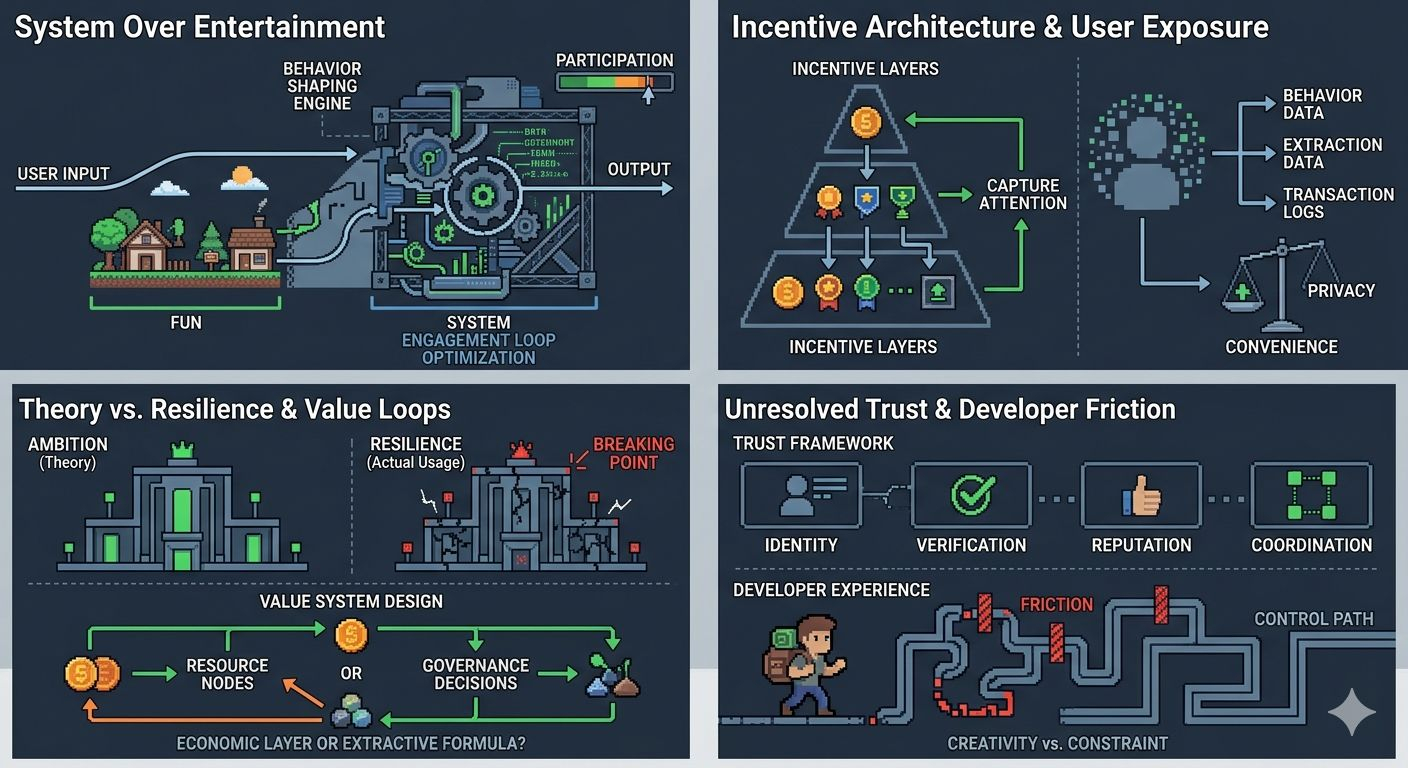
Another thing I cannot ignore in Pixels is how often developer experience becomes an afterthought. Everyone talks about ecosystems, incentives, and long-term growth, but the people expected to build inside these systems are often left dealing with friction that slowly kills momentum. If participation in Pixels depends on rigid expectations while flexibility keeps shrinking, then the ecosystem may grow in size while losing the creativity that made it valuable in the first place. I have watched projects attract attention with big visions only to lose real builders because the environment was designed more for control than for creation. That is always a warning sign, and I see hints of that risk in Pixels as well.
Then there is the question of value, and this is where Pixels starts to feel especially familiar. Too often, value systems are inserted into projects because they complete the story, not because they solve a real problem. In Pixels, the economic layer sounds important, but I cannot ignore how often these structures feel forced. I keep asking whether the value mechanism is actually improving the experience or simply giving the ecosystem another way to justify itself. When every action becomes part of an economic loop, meaning can start to disappear. With Pixels, I find myself questioning whether the economic design exists to empower participation or to formalize extraction in a way that feels acceptable.
Trust is where all of this comes together, and trust is exactly where Pixels still feels unresolved to me. Identity systems, verification systems, reputation systems—every ecosystem promises they are getting closer to solving trust, yet the experience always feels incomplete. Pixels speaks in the language of coordination and reliability, but trust cannot be engineered through polished systems alone. If users do not understand what is happening, if developers feel constrained, and if incentives are doing most of the governance, then the trust being built may be weaker than it appears. That is the contradiction I keep seeing in Pixels: systems become more sophisticated, but confidence in them does not grow at the same pace.
Maybe that is why I keep watching Pixels with equal parts curiosity and doubt. I am not dismissing the ambition. I understand why these ecosystems are being built, and I understand why people are excited by them. But after years of seeing polished ideas fail to become meaningful reality, I cannot trust ambition on its own anymore. Pixels may succeed in building something large, but scale is not the same thing as substance. The market rewards momentum, presentation, and narrative long before it rewards proof. So when I look at Pixels, I am no longer asking whether the vision sounds impressive. I am asking where the breaking point is, because that is where the truth usually appears.
And that is the real reason Pixels stays on my mind. I am tired of polished systems asking to be trusted before they have earned it. I am tired of stories being treated as substance. And I am tired of watching the same promises recycled until they become impossible to believe. Yet I keep watching Pixels because beneath all the noise there is still a real question worth asking: when systems become sophisticated enough to guide behavior, organize value, and control participation, what exactly are we interacting with anymore? Maybe Pixels is building the future of digital ecosystems. Or maybe it is simply refining the same structures we have seen before under a better story. I do not think I have the answer yet, but I know that the answer will not come from the narrative. It will come from the moment Pixels is tested in ways the narrative cannot hide.