
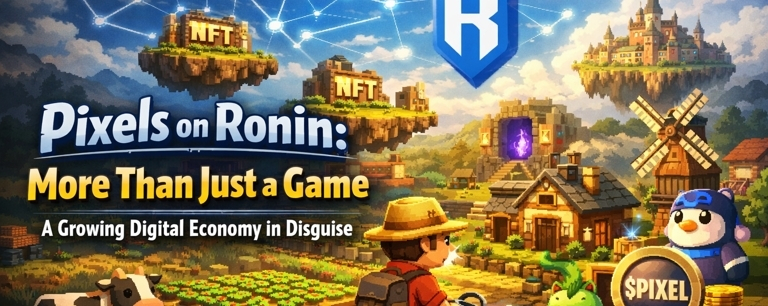
Most people still look at Pixels and think it’s just another farming game with a token attached. That view misses the bigger picture.
Pixels, built on the Ronin Network, presents itself as a casual open-world experience where you farm crops, craft items, raise animals, and explore a vibrant land called Terra Villa. On the surface, it feels familiar-very much like Stardew Valley-but underneath, there’s a deeper system quietly shaping player behavior and value.
What makes Pixels stand out immediately is accessibility. It’s free-to-play, browser-based, and doesn’t pressure you into spending before you even understand the mechanics. That alone separates it from many Web3 titles that lock meaningful gameplay behind upfront purchases. Here, you enter freely, learn naturally, and only invest if you decide the ecosystem is worth your time.
But the real shift happens when you look beyond the gameplay loop.
Ownership in Pixels isn’t cosmetic-it’s functional. Land exists as NFTs, and instead of being static assets, they actively contribute to production. Players can build industries, generate resources, and enhance their earning potential over time. A Farmland NFT, for example, isn’t just a collectible-it provides a tangible boost through staking benefits, increasing efficiency and long-term output.
The game’s depth expands significantly as you progress. Higher tiers unlock more complex systems, and by the time you reach advanced levels, you’re managing production chains rather than just farming. With new industries, specialized mechanics, and resource optimization, it starts to resemble a structured economy rather than a simple game loop. Features like crafting expansions, avatar integrations, and companion systems (like Pixel Pets) further add layers to the experience.
Then there’s the token itself-$PIXEL.
It isn’t forced into the early experience, which is a smart design choice. Players can enjoy the game without touching the token, but once they decide to engage deeper-through staking, guilds, or premium features-it becomes relevant. With a capped supply and a large portion already in circulation, the typical fear of sudden inflation or massive unlocks is less pronounced compared to many newer projects.
Staking introduces another dimension. Players can lock tokens to earn rewards, and land ownership enhances those returns, creating a system where commitment is consistently incentivized. The addition of external reward balancing-such as integrating stable assets like USDC-helps reduce constant sell pressure, making the economy feel more sustainable over time.
Beyond that, Pixels is expanding into something larger than a single game.
It’s evolving into a platform. New experiences like Pixel Dungeons are already emerging, and the staking structure is designed to extend across future titles. This means participation today isn’t limited to one environment-it potentially connects to a growing network of games sharing the same economy.
Development pace also plays a major role. Regular updates, frequent feature releases, and visible progress create a sense of momentum. Instead of relying on long-term promises, the team consistently delivers incremental changes that keep the ecosystem active and evolving.
When you step back and look at everything together, Pixels doesn’t feel like a game trying to justify a token. It feels like an economic system using a game as its interface.
And that distinction changes how it should be understood.