At first, everything in Pixels felt normal and predictable. I would log in, follow my usual routine, complete tasks from the board, and then leave without thinking much about it. It felt like a simple loop where actions naturally connected to rewards, and nothing seemed unusual.
But over time, something subtle started to feel off. The same amount of time and effort no longer gave the same feeling of progress. I was still doing the same activities—farming, crafting, completing tasks—but the results felt less connected to what I was doing. It wasn’t obvious at first, just a small sense that things weren’t lining up the way they used to.
Naturally, I tried to explain it in simple ways. Maybe I was choosing the wrong tasks. Maybe my timing was off. Maybe I was just overthinking it. But that explanation stopped making sense when I noticed the same pattern repeating even when nothing had changed on my side.
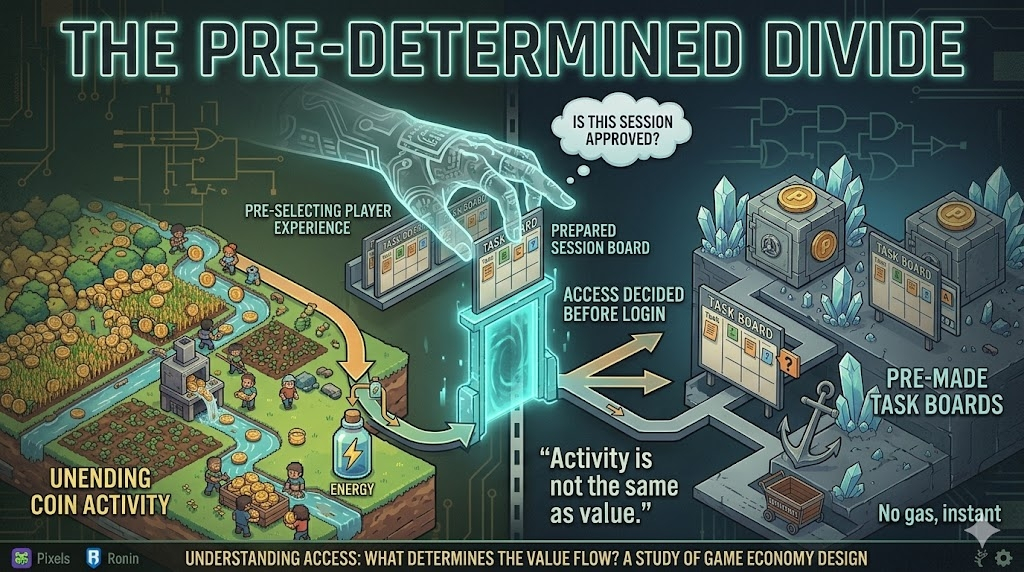
That’s when I started thinking differently about how the system might work. It no longer felt like everything was reacting instantly to my actions. Instead, it felt more like the task board I was seeing had already been prepared before I even logged in. As if I was only being shown a version of the system that had already been decided in advance.
This raised a bigger question for me: what is the system actually responding to?
The core gameplay still felt smooth. Actions weren’t blocked. Coins kept flowing. Everything inside the loop continued normally. But the part that connects actions to meaningful outcomes—the layer that turns activity into value—felt inconsistent. Sometimes it seemed active, sometimes it felt like nothing was passing through at all.
And that created a strange feeling. It was no longer about whether I was playing well or poorly. It started feeling like the real difference was whether my session was “linked” to something meaningful in the system or not.
If that’s true, then the important factor isn’t just what I do inside the game, but whether my activity is being connected to a version of the board that actually carries value. Some sessions might feel active and rewarding, while others might simply loop without ever connecting to anything beyond Coins.
What makes it harder to understand is that there is no clear signal for this. Nothing tells you when or why things feel different. You just notice small changes over time—some sessions feel more connected, others feel empty, even if your actions are exactly the same.
It starts to feel less like the system is reacting moment by moment, and more like it is deciding in advance what kind of experience you are allowed to see when you log in. Not in an obvious or personal way, but as part of how the system manages flow, reward balance, and activity distribution.
That also explains why different players can have very different experiences even when they follow similar routines. Some seem to consistently land in sessions where progress feels meaningful, while others mostly cycle through actions that never really connect outward.
So the real question becomes less about improving actions, and more about understanding what determines access to meaningful outcomes in the first place.
And the difficult part is this: if those conditions exist, they are not shown to the player. You don’t see when a session is “approved” for value flow or when it is not. You just experience the result without knowing what shaped it.
In the end, it changes how I see the whole loop. It’s not just about playing better or optimizing steps. It starts to feel like I’m moving through different versions of the same system—some that connect to value, and others that quietly don’t—without any clear way to tell the difference until I’m already inside them.