
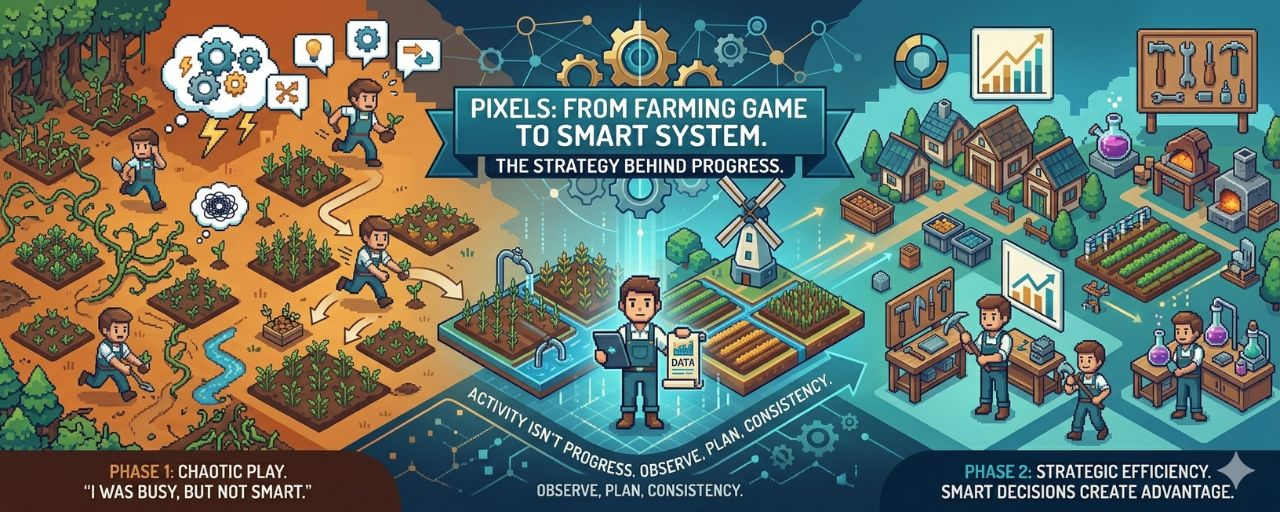

If you had asked me in the beginning what I was doing in Pixels, my answer would have been simple:
“I’m just playing a farming game.”
But today, I would answer very differently.
Because what looked simple on the surface turned out to be a system that rewards awareness, patience, and strategy in ways I didn’t expect.
When I first entered Pixels, I had no plan.
I planted random crops, harvested them, sold them immediately, and repeated the cycle. It felt productive, but in reality, I wasn’t progressing efficiently. I was busy... but not smart.
And that’s a trap many people fall into.
It took me some time to realize that activity doesn’t equal progress.
The turning point came when I started paying attention to other players. Some of them were clearly ahead... not just in resources, but in how smoothly their systems were running.
That’s when I asked myself a simple question:
“What are they doing differently?”
Instead of guessing, I started observing.
I noticed that they weren’t making random decisions. Everything had a purpose. Their farming cycles were planned. Their resources were managed carefully. Their upgrades were intentional.
So I decided to experiment.
I stopped rushing to sell everything. Instead, I started thinking about value. Sometimes holding resources or using them for crafting gave better returns than immediate selling.
That small shift completely changed my results.
Then I went deeper.
I began tracking my own actions... not in a complicated way, but enough to understand what was working and what wasn’t. I adjusted my strategy based on outcomes instead of assumptions.
And slowly, my gameplay transformed.
But it wasn’t without challenges.
There were times when I made wrong decisions. Times when I thought something would work, but it didn’t. And honestly, those moments were frustrating.
But instead of getting stuck in frustration, I used them as feedback.
Every mistake became data.
Every loss became a lesson.
That mindset made a huge difference.
Another thing I had to fix was inconsistency.
In the beginning, I played randomly... some days a lot, some days not at all. This broke my momentum. So I created a simple routine. Even if I played for a short time, I made sure I stayed consistent.
Consistency, I realized, is more powerful than intensity.
Now, when I look at Pixels, I don’t see randomness.
I see a system.
A system where small improvements compound over time. Where smart decisions create long-term advantages. And where patience is rewarded more than speed.
And the best part?
It still feels like a game.
That balance is rare.
Pixels didn’t just teach me how to play better.
It taught me how to think better.