
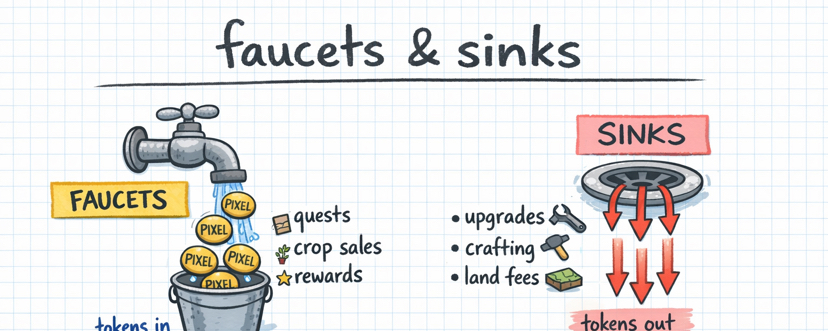
i used to think people were just making game stuff sound more serious than it is when they kept saying faucets and sinks, but the more i watched how these web3 games move the more i got it and honestly now i cant unsee it. i look at #pixel the same way too, like every time the game gives players rewards or items or some token flow that’s a faucet, and every time the game asks players to spend, burn, upgrade, craft or pay something back into the system that’s a sink. sounds simple when you say it like that but i think this is where most games either stay alive or slowly start falling apart and i’ve seen enough projects now to know the difference usually starts here.
what i like about @Pixels is that it doesnt feel fully careless with this stuff. i can see that there is at least some real thought behind how value moves around in the game. rewards come in from playing, progress needs spending, and the whole thing is clearly not just built on “give users more tokens and hope for the best” which is what a lot of gamefi stuff felt like before. that part gives me some confidence i wont lie, because i’ve seen too many games where the only real plan was emissions first and panic later. pixels at least looks like it knows a game economy cant breathe if everything is only going out to players and barely anything comes back.
still, this is where i get a bit stuck and i think this is the part people dont say enough. knowing the model and actually balancing it are two diff things. i dont think you can just say “yes faucets and sinks exist” and act like that means the economy is healthy. i care way more about if the numbers still make sense after hype dies down. when a game is hot and packed with users, almost any system can look fine for a while because there’s enough movement everywhere. but when that crowd cools off and the easy farmers leave then you really find out what was real and what was just being held up by noise. that’s where i think the real test for pixels is and i’m not gonna fake certainty on that part.
the land side makes it even more mixed for me. i find it smart but also kinda messy in that way where i keep thinking about it after. if landowners keep getting a cut while normal players do the work on those plots then yeah that can help create a stronger reason to own land, but it also means not everyone is really playing the same game econ wise. one group is collecting and one group is giving up part of what they make, and i think that changes the feeling of the whole system more than people admit. i’m not even saying it’s bad by default i’m just saying i notice that stuff fast and once you notice it you cant really ignore it.
i also think timed events and special content are probably doing more heavy lifting than some people realize. these events are good because they pull stuff out of the game and make people spend when attention is high, and yeah i’ve seen that work in normal games too, so that part makes sense to me. but if a game starts needing events too much just to keep pressure under control then i start wondering what happens in the quiet weeks when there’s no big reason to spend. thats when the base economy has to stand on its own and i think that’s where the truth always shows up even if people dont wanna hear it.
for me the real problem in $PIXEL is the same problem i keep seeing in every play to earn setup. the people who mostly wanna extract value need the game to keep giving, and the people who actually wanna play long term need enough sinks so the rewards dont feel empty. both sides are pulling the system in diff directions and i honestly dont think anyone has fully solved that yet. pixels is trying, i’ll give it that, maybe more than most, but i still think this is one of those things you only understand by watching it over time and not by getting impressed in one good phase. that’s why i stay interested in it, but also why i’m still careful.
