
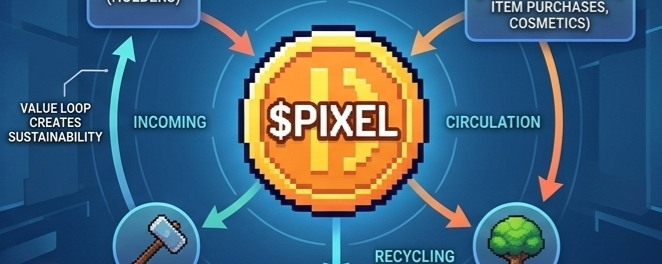
I have spent enough time watching Web3 gaming cycles to feel a reflexive sense of fatigue whenever someone brings up play-to-earn. We all know how the story goes. A game launches, the token spikes driven by sheer speculation, the player base explodes, and then the inevitable death spiral begins because there is no sustainable sink for the rewards being emitted. It becomes a race to the bottom as the economy gets drained by farmers and mercenaries. I was fairly cynical when I started digging into what Pixels was doing next.
I assumed it was just another attempt to patch a leaking boat with a new tokenomics model. But as I read through the documentation for the Stacked app and their LiveOps engine, I noticed something different. They were not just tweaking emissions. They were trying to restructure how money enters and leaves the gaming ecosystem entirely. That shift from theoretical tokenomics to active infrastructure caught my attention.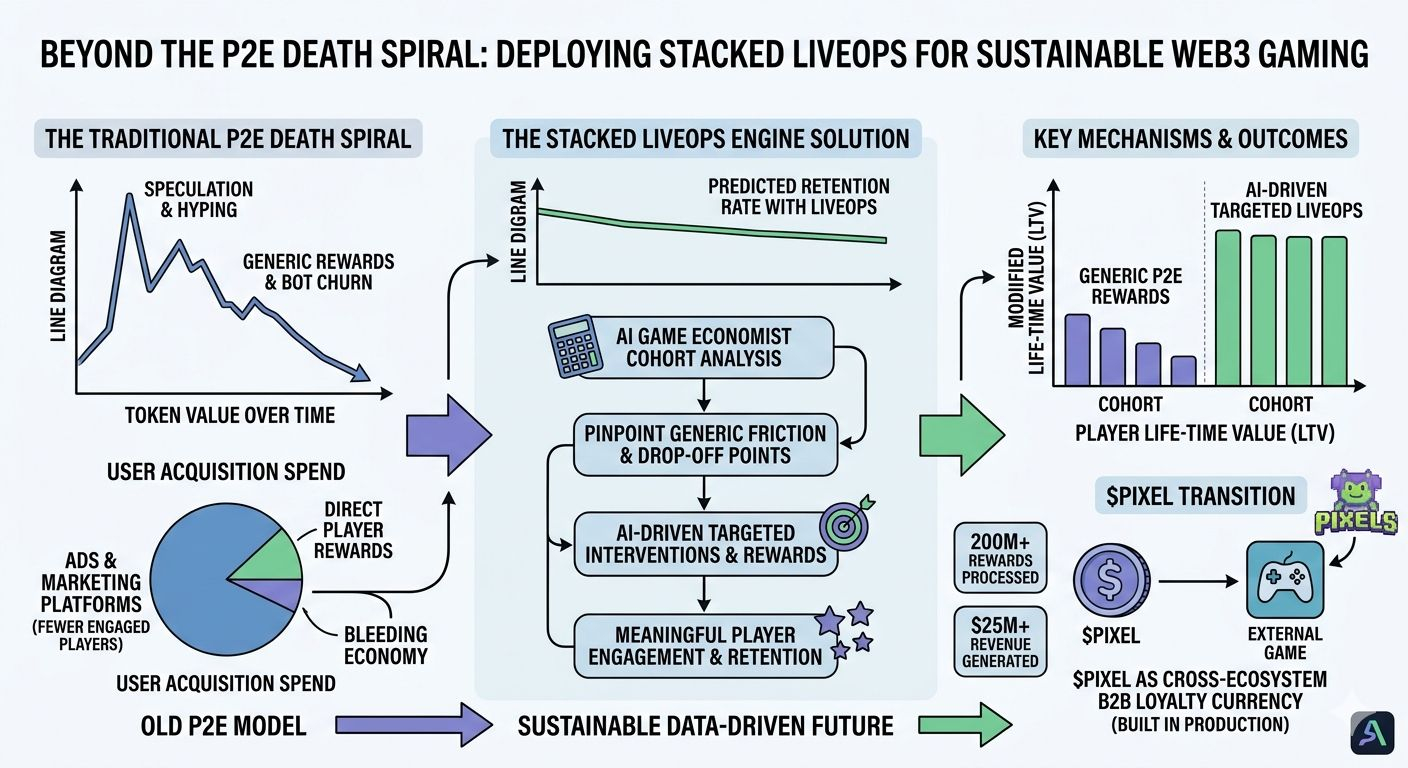
Trying to reward players fairly is difficult in practice. If you set universal tasks, you invite bots to extract value without engaging with the game. This friction kills most P2E economies. Stacked approaches this by treating player matching as a data problem rather than a simple faucet. $PIXEL use an AI Game Economist to look at player cohorts and figure out why people drop off. Instead of giving everyone the same generic daily quests, the system analyzes how you actually play. It identifies specific friction points where a user might churn and suggests targeted interventions.
This means offering real value, whether cash or crypto, but only for genuine engagement. If a player is struggling at a certain level and historically that is where people quit, the engine can trigger a reward to keep them invested. It moves the model away from spamming clicks to rewarding meaningful playtime while running through an anti-bot architecture built for scale.
This specific mechanic resonated with me because it addresses a fundamental inefficiency in how games grow. Traditional gaming studios pour billions of dollars into advertising networks just to acquire users, most of whom leave after a few days. That money goes directly to platforms like Facebook or Google.
Stacked is intercepting that traditional user acquisition budget and redirecting it into the pockets of the actual players. From an economic standpoint, this makes sense. Why pay an ad network fifty dollars to find a player when you can use that same fifty dollars to directly incentivize a player to stay and engage deeply with the game? It changes the dynamic from buying eyeballs to funding actual user retention.
But I also have to be honest about the limitations here. Nothing in this space is a magic fix. Balancing game economies is notoriously hard, and building the tools to do it is only half the battle.
The AI Game Economist can provide all the cohort analysis and targeted reward suggestions in the world, but if external studios fail to configure these tools correctly, the system will still fail. If a game developer sets the wrong parameters or misunderstands their own churn data, they can easily over-emit rewards and bleed their economy dry just as fast as before. Technology cannot completely eliminate human error.
Where this infrastructure starts to look genuinely interesting to me is the broader transition it represents. By building Stacked as a B2B service, Pixels is shifting $PIXEL from being a single-game token to a cross-ecosystem loyalty currency. This means the survival of the token is no longer strictly tied to the popularity of the Pixels game itself. It becomes the underlying fuel for a network of different games utilizing the LiveOps engine. Seeing that they had already processed over two hundred million rewards and generated over twenty-five million dollars in revenue gave the project a different kind of weight. It is functioning infrastructure handling real money and player data at a significant volume.
My approach to this moving forward is strictly observational. I am going to watch closely how external studios adopt this LiveOps engine over the next few quarters.
The real test is not just about how many developers sign up for the platform, but whether using Stacked genuinely improves a game's player life-time value over a multi-month period. I want to see if these highly targeted rewards actually prevent churn in a measurable, permanent way, or if they just delay the inevitable drop-off by a few weeks. The on-chain data will eventually show whether the model is truly sustainable or if it is just a sophisticated method of buying temporary engagement.
Ultimately, the Web3 gaming space is still largely an experiment, and we are still figuring out what actually works in the long run. There is a profound difference between a project that simply sells a vision in a pitch deck and one that is actively building, failing, and learning in production. Pixels seems to be firmly in the latter category with the development of Stacked.
@Pixels have clearly learned some painful lessons from the earlier eras of crypto gaming and are trying to build the foundational infrastructure required to prevent those specific mistakes from repeating. Whether they succeed or not remains to be seen, but the shift toward data-driven retention and redirecting ad spend directly to players is a logical evolution.
At this point, I am much more interested in watching real usage and actual product iteration than reading another rodmap.