
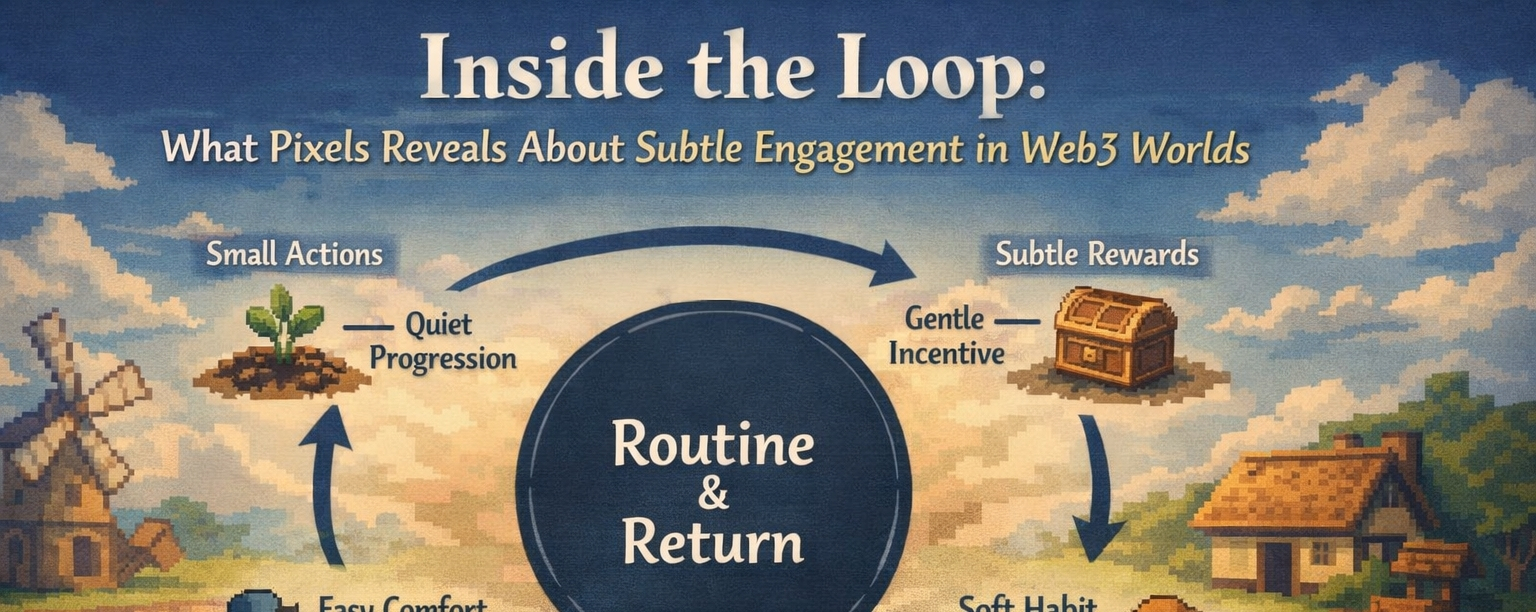
I’m watching it again, I’m waiting without really waiting, I’m looking at how these spaces form and re-form, I’ve seen this kind of loop before but still I focus on it like it might say something new this time, like something subtle might finally break the pattern, but it rarely does, it just shifts shape and calls itself different things while staying emotionally familiar in the background of attention.
Pixels sits in that familiar layer where “game” is only part of what it actually is. The rest is softer, harder to define without making it sound larger than it is. Farming, exploration, creation—these words appear almost like placeholders for repetition that has been made socially acceptable. I’ve watched similar systems before where the activity is less important than the return to it, the quiet habit of checking in, of maintaining something that does not strictly require maintenance but benefits from the feeling of it.
There’s something about the way these worlds ask for small, consistent gestures instead of dramatic engagement. It doesn’t demand intensity. It prefers continuity. That’s usually where attention starts to change shape. Not in big emotional spikes, but in the slow normalization of return. I’ve seen people call it relaxing, others call it productive, but neither quite captures the way it begins to occupy small gaps in the day that were never formally assigned to anything.
It reminds me, slightly, of earlier cycles where digital spaces promised ownership, then participation, then “meaningful interaction,” and each phase felt like it was refining how long someone could be gently held without noticing the holding. Pixels feels like it exists comfortably inside that lineage without trying to announce itself as part of it. That restraint is almost more interesting than ambition would be.
The Ronin layer, the network beneath it, stays mostly invisible unless you go looking. And I think that’s important. Systems like this tend to work better when the infrastructure doesn’t interrupt the surface experience. But invisibility is never neutral. It always shapes perception in one direction or another, usually toward ease, sometimes toward forgetting that there is structure at all. I’ve learned not to fully trust things that feel too seamless, even when they are harmless in appearance.
What stays with me is not the gameplay loop itself, but the way it mirrors certain habits outside of it. Checking in without urgency. Tending without necessity. Building without endpoint. These actions start to resemble routine more than play after a while, and routine has a way of folding attention inward, making it harder to distinguish engagement from maintenance of engagement.
Still, I can’t dismiss it completely. There is something strangely calm in systems that do not demand escalation. No constant pressure to advance, no loud insistence on progress as spectacle. Just persistence, quiet accumulation. Maybe that is its own kind of design choice, or maybe it is just how these environments settle when stripped of excess noise.
I think about time inside these spaces differently. Not as forward motion, but as something that pools. You return, and nothing feels dramatically changed, but something has been adjusted at the edges. That can be comforting or unsettling depending on how aware you are of it. I’m not sure which it is here yet.
And attention—attention is always the real currency, though that phrase has been repeated so often it has started to lose its weight. Still, it remains accurate in a dull, persistent way. What changes is not that attention is taken, but how gently it is invited to stay longer than intended.
I don’t know if Pixels is an endpoint of any trend or just another iteration of a familiar shape that keeps learning how to feel less like a system and more like a place people casually return to. Maybe it doesn’t matter. Maybe what matters is that I keep noticing the return itself, the rhythm of it, the ease with which observation becomes participation without a clear boundary between them.
And even now, after all these patterns I think I’ve learned to recognize, I’m still here watching it as if something in the next cycle might finally feel different, though I can’t quite say what that difference would even look like.
