
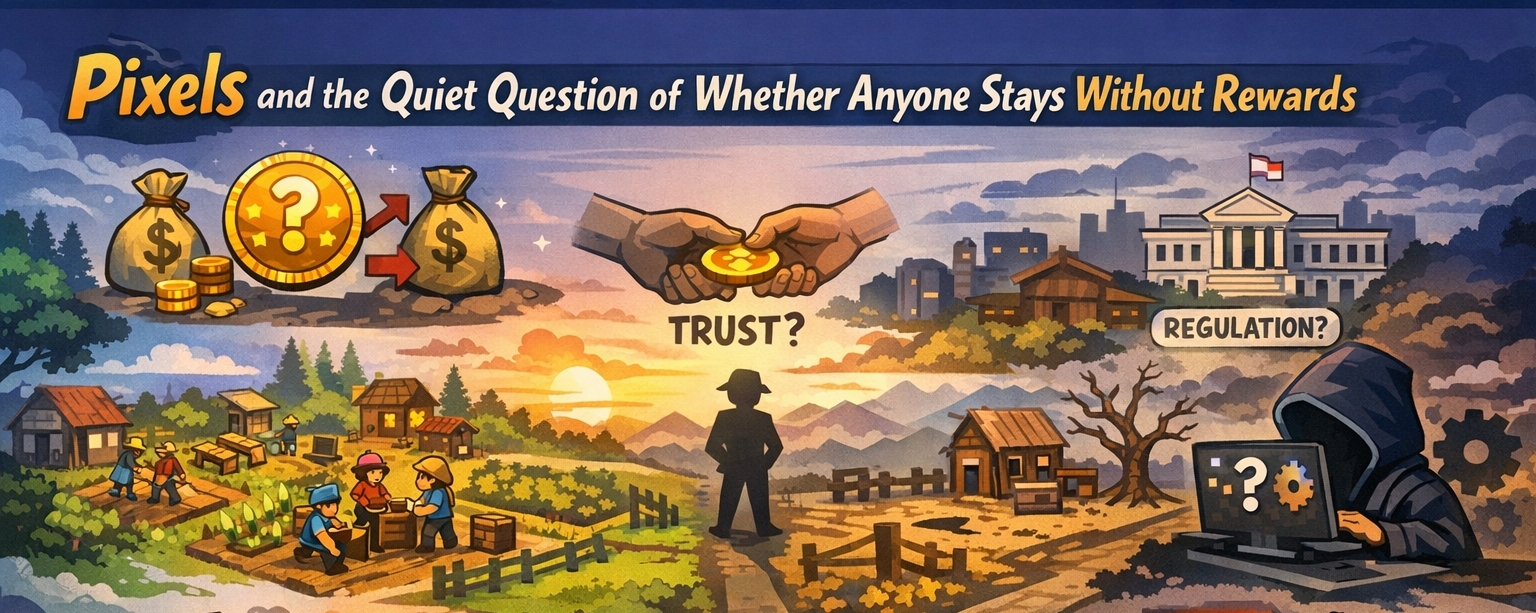
I’m watching Pixels closely these days, not because of the noise around it, but because I’m trying to understand what’s actually happening inside it. I’m waiting before forming any strong opinion. I’ve noticed that a lot of people talk about it like it’s already proven, but I focus more on how people are really using it. I stopped looking at hype and started paying attention to behavior. I remember when I used to follow trends quickly, now I just sit back and observe how things hold up over time.
Pixels, at its core, feels simple. Farming, collecting, exploring. Easy to enter, easy to understand. But simplicity doesn’t automatically mean strength. I keep asking myself why people log in every day. Is it because they enjoy the experience, or because they expect to earn something from it? That question matters more than anything else. If most users are there for rewards, then the system depends heavily on those rewards continuing.
The Ronin network gives Pixels a strong base. Transactions are fast and cheap, which makes constant interaction possible. That’s important for a game like this where small actions happen frequently. But infrastructure alone doesn’t create value. It just removes friction. The real value has to come from what users actually do and feel inside the game.
I keep thinking about the in-game economy. Farming resources, trading, crafting, all of it creates activity. But I try to look deeper. Is this real economic activity, or just movement driven by incentives? If players are only farming because they can sell something later, then the system depends on continuous demand. And demand in crypto can be unpredictable.
Another thing I watch is how attached players are. Do they feel connected to what they’re building, or are they just running a process? If there’s no emotional or social connection, then users can leave as quickly as they came. Identity matters more than people think. When players start caring about their land, their progress, or their place in the game, that’s when things begin to feel more real.
Trust also plays a quiet but important role. People need to believe that the system is fair and somewhat stable. If rewards change too often or the economy feels unclear, confidence drops. In regions where people might actually rely on these games for extra income, that trust becomes even more important. Instability pushes those users away first.
Liquidity is something I keep an eye on as well. Not just how much money is in the system, but how it behaves. If people are constantly entering and exiting, it suggests they’re not fully committed. They’re testing, earning, leaving. A stronger system usually shows signs of people staying even when things slow down.
I also think about the team behind Pixels. Are they focused on making the game better, adding depth and meaning, or are they mainly adjusting rewards to keep users active? There’s a difference between building something lasting and maintaining short-term engagement. Over time, only one of those approaches works.
Coordination between players is another sign I look for. Are people interacting in meaningful ways, trading because they need each other, building some kind of shared system? Or is everyone just doing their own thing for rewards? Real economies form when people depend on each other, not just on the system.
The bigger market environment also matters. Right now, attention moves fast in crypto. Capital flows into whatever is trending, and gaming has had its moments before. That kind of attention can boost a project quickly, but it doesn’t always stay. I try to separate temporary excitement from something more stable.
There’s also the possibility of regulation in the future. If games like Pixels start to look more like income platforms, especially in developing regions, governments might step in. That could change how tokens are used and how these systems operate.
So I keep coming back to the same simple questions. Who really needs Pixels? What keeps players coming back when rewards are lower? Is the economy growing naturally, or is it being supported by constant incentives?
I’m not rushing to judge it. I’m just watching. Because in the end, what matters is not how active it looks today, but how it behaves when things calm down. If people are still there, still playing, still building without relying on easy rewards, then Pixels has something real. If not, then it’s just another cycle that looked strong for a while and slowly faded away.