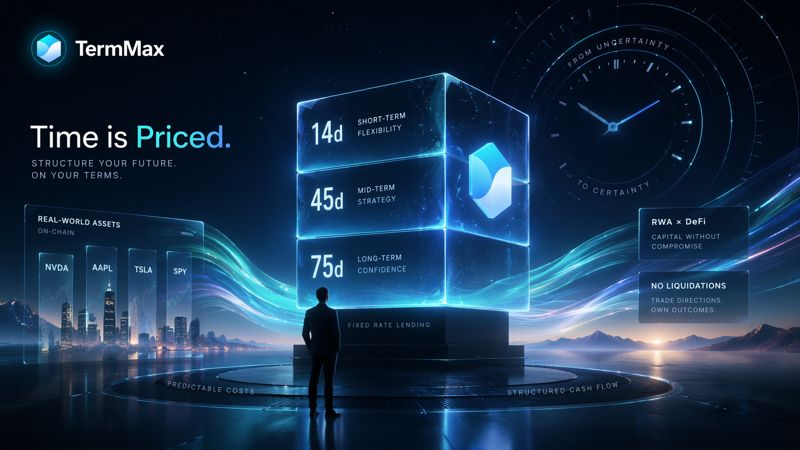
Duration Cube: TermMax is turning DeFi into a cash flow calendar.
After getting used to the bull and bear meat grinder, it's really about making money based on cycles and keeping money based on structure.
Where do most people die?
It's not that the direction is wrong, but that there is no way to survive in the process.
So the true experts never chase how much they can earn, but only care about how much I would lose in the worst-case scenario and when to end.
This is also why, while most people still see #TermMax as a lending tool, more seasoned capital is already viewing it as a set of underlying infrastructure to orchestrate the future.
Today we're not talking about APY; we're only discussing one thing—how time is priced.
One, mechanism restructuring: lending has disappeared, leaving only time slices
In traditional floating lending, you're facing an uncontrollable system:
-Interest rates can change at any moment
-Costs are unpredictable
-Liquidation can occur at any moment
You think you're financing, but you're actually bearing the emotional volatility of the whole market.
And @TermMaxFi has divided the continuous future into discrete time slots.
-14 days
-45 days
-75 days
It's no longer about choosing a term; it's about breaking the future into manageable units.
-Short-term liquidity → Put in for 14 days
-Mid-term strategy → Lock it in for 45 days
-Long position strategy → Hold for 75 days
When interest rates are pinned at 2.90% - 4.23%, costs are no longer variables, but constants that can be directly written into the ledger.
You're not borrowing money; you're pricing time.
Two, on-chain receipts: consuming the profits from time disparity
What really makes the difference is not the interest rate, but the time structure.
RWA on the BNB Chain has already exceeded $3.5 billion, but most people only see assets on-chain.
#TermMax is working on enabling these assets to generate time arbitrage capabilities.
You hold $NVDAon , bullish on long-term appreciation, not wanting to sell.
In the traditional system, this asset is locked up.
But in TermMax:
-You retain equity appreciation profits
-At the same time, lend out USDT at known costs
-Funds immediately enter the on-chain cycle
And the core difference behind this is that U.S. stocks are T+2, while on-chain is T+0.
The time difference in between was originally wasted by the system.
Now, it's been consumed by you.
This isn't borrowing; it's time structure arbitrage.
Three, risk reconstruction: from betting on paths to locking in outcomes
Most traders' downfall doesn't come from the wrong direction.
But from the process.
You see the trend correctly, yet get swept out by a spike mid-way.
This is path risk.
TermMax's Alpha market has done something extremely crucial:
It has reduced path risk to outcome risk.
-Pay a premium
-Lock in maximum loss
-Complete liquidation stripping
This means:
-It dropped → Losses are locked in
-It increased → Full retention of profits
You're no longer eliminated by the process.
Time is no longer the enemy.
It becomes a variable you've already bought out.
Four, the real watershed moment
Early DeFi was about amplifying profits.
Now, it starts to constrain time.
Most people are still asking: 'What's the APR?'
But the more critical question is how long can this profit survive?
In TermMax, you're not borrowing money.
You're breaking down the future into a timetable that can be settled.