Ladies and gentlemen! Throughout human history, many wars have been fought, but World War I was a conflict that completely transformed global politics, economy, and society. This war lasted from 1914 to 1918 and involved countries from Europe, Asia, Africa, and many other regions of the world. As a result of this war, millions of people were killed, great empires collapsed, and the political map of the world was reshaped. That is why historians consider it one of the most dangerous and significant wars in human history.
Background and Causes of the War
In the late 19th and early 20th centuries, there was intense competition among major European powers. Each country was strengthening its military, developing new weapons, and trying to expand its control over different parts of the world. This situation was further worsened by nationalism, imperial rivalry, and the arms race.
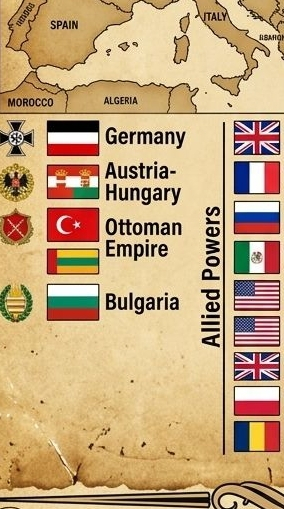
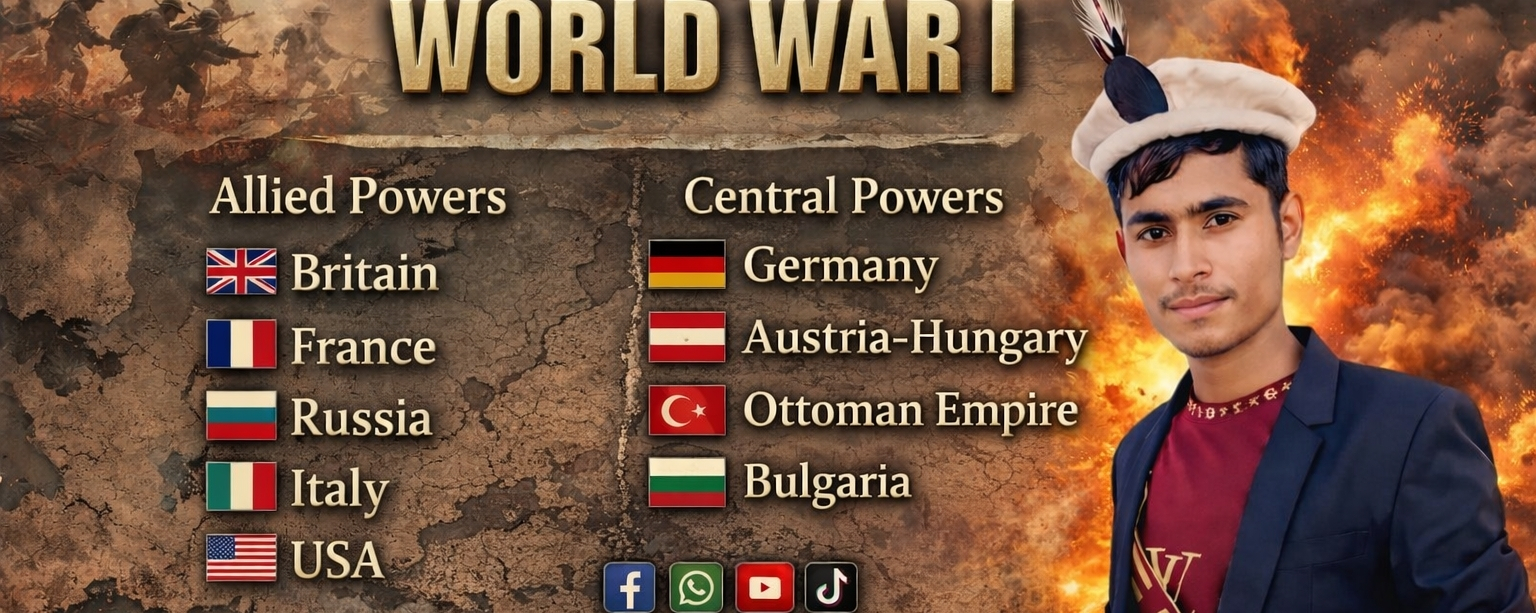
During this time, European countries formed alliances for their security. One alliance, known as the Triple Entente, included Britain, France, and Russia. The other, called the Triple Alliance, consisted of Germany, Austria-Hungary, and Italy.
These alliances were like a pile of gunpowder, waiting for a single spark.
The Beginning of the War
That spark ignited on June 28, 1914, when Archduke Franz Ferdinand, the heir to Austria-Hungary, was assassinated in Sarajevo by a nationalist youth named Gavrilo Princip. This incident is known in history as the assassination of Archduke Franz Ferdinand.
Following this event, Austria-Hungary declared war on Serbia on July 28, 1914. Due to the system of alliances, other countries quickly became involved.
Germany supported Austria-Hungary, while Russia supported Serbia. Soon after, Germany declared war on France and Russia and invaded France through Belgium. In response, Britain entered the war against Germany on August 4, 1914.
Thus, a regional conflict quickly turned into a global war.
The Bloody Battles of the Western Front
The main battlefield of World War I was the Western Front, which stretched across France and Belgium. Here, both sides fought from trenches dug into the ground, a method known as trench warfare. This made the war slow but extremely deadly.
In 1916, the Battle of Verdun became one of the longest and most horrifying battles, with around 700,000 soldiers killed or wounded. In the same year, another major battle, the Battle of the Somme, took place. On the very first day alone, about 60,000 British soldiers were killed or injured.
The Eastern Front and the Russian Revolution
On the Eastern Front, German and Austro-Hungarian forces fought against the Russian Empire. Initially, Russia achieved some success, but later German forces pushed them back.
During the war, Russia faced severe economic and political crises. In 1917, the Russian Revolution took place, leading to the fall of Tsar Nicholas II. The new Bolshevik government signed the Treaty of Brest-Litovsk with Germany in 1918 and withdrew from the war.
The Entry of the Ottoman Empire
In 1914, the Ottoman Empire joined the war on the side of the Central Powers. This led to intense fighting in the Middle East and Anatolia.
One important campaign during this time was the Gallipoli Campaign, where Britain and its allies attempted to defeat the Ottoman forces but suffered a major defeat. Thousands of soldiers were killed in this campaign.
The Entry of the United States
At first, the United States stayed neutral, but after German submarine attacks and the Zimmermann Telegram, it joined the war in 1917 on the side of the Allies. America’s entry provided significant military and economic support to the Allied forces.
The End of the War
By 1918, Germany and its allies had become very weak. Allied forces launched major attacks on the Western Front, known as the Hundred Days Offensive, forcing German troops to retreat.
Finally, on November 11, 1918, Germany signed an armistice, bringing World War I to an end.
Consequences and Destruction
As a result of World War I, around 10 million soldiers and 7 million civilians were killed, while millions more were injured and displaced.
The war led to the collapse of four major empires:
German Empire
Austro-Hungarian Empire
Ottoman Empire
Russian Empire
In 1919, the Treaty of Versailles imposed harsh conditions on Germany, limiting its military and forcing it to pay heavy reparations.
Impact on the World
After the war, the balance of global power changed. Europe weakened, while the United States emerged as a major world power.
An international organization, the League of Nations, was established to prevent future wars, but it ultimately failed to stop World War II.
Conclusion
World War I was a massive human tragedy that not only claimed millions of lives but also reshaped the global political system. It led to the fall of empires, the creation of new nations, and a shift in global power. Most importantly, it laid the foundation for the next great conflict — World War II.