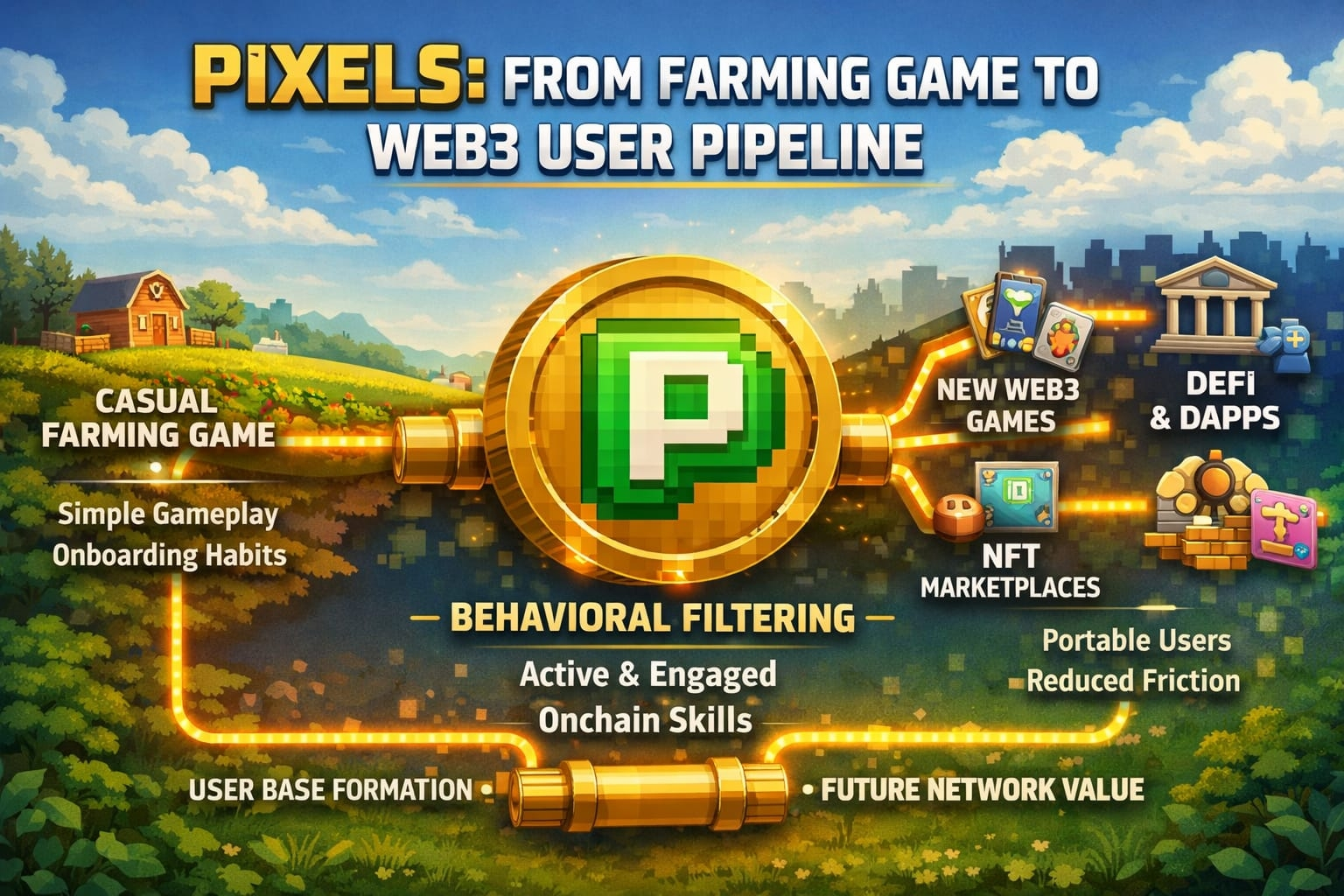
I used to think the easiest way to understand a crypto game was to watch what people were doing inside it. Who was farming, who was trading, who stayed active after the first excitement wore off. Lately I am less sure that activity inside the game is the real thing to watch. Sometimes a system looks simple on the surface, almost too simple, and that is usually where I start paying more attention. Pixels gives that feeling to me. It looks like a farming game. It feels accessible. The loop is familiar enough that you do not need a long explanation before you begin. But the more I sit with it, the less I think the important question is what players are earning there right now. I think the more uncomfortable question is whether the game is quietly becoming a sorting layer for future Web3 users.
That sounds bigger than a farming loop, but I do not mean it in a dramatic way. I mean something more operational. Web3 games keep running into the same issue: user acquisition is expensive, shallow, and unreliable. A wallet connect is easy. Real retention is not. A token incentive can create a traffic spike, but that is not the same as building a population that knows how to move through onchain systems without friction. So when a game like Pixels lowers the cognitive load and keeps people repeating simple actions over time, it may be doing more than generating gameplay metrics. It may be training users into a usable behavioral base. Not just active wallets. More like wallets with habits.
That distinction matters. Usage and demand are not the same thing, and the market still mixes them together far too often. A million low-friction actions can make a dashboard look healthy, but dashboards are good at counting motion, not commitment. What starts to matter more is whether the system is producing reusable behavior. Does the player come back without needing a fresh subsidy each time? Do they learn the rhythm of inventory, progression, timing, wallet interaction, marketplace logic? Do they become easier to move into a second game, a third one, maybe a broader network later? If yes, then Pixels may not just be monetizing gameplay. It may be subsidizing user formation.
I keep coming back to that phrase because it feels closer to the real mechanic. User formation is slower than user acquisition, and more valuable. Acquisition is a headline number. Formation is what remains after the headline fades. In older play-to-earn systems, the model often depended on restarting the funnel over and over again. Bring in more users, fund the rewards, hope the churn is masked by new arrivals. That structure looked like growth until it didn’t. What it failed to produce, in many cases, was durable player identity beyond the extraction loop. People knew how to claim, dump, and leave. That is not the same as learning how to stay.
Pixels might be doing something subtler. Not perfect, and probably not fully intentional in the clean way people like to describe systems afterward. But subtle. If players spend enough time inside a low-pressure environment where onchain behavior starts to feel normal, the game becomes a kind of soft onboarding rail. Not an educational product. Not a wallet tutorial wearing a game skin. Just a place where certain actions stop feeling foreign. That matters more than most token models admit. Friction is not only about fees or interface design. It is also about hesitation. A user who has repeated a behavior enough times becomes cheaper to move elsewhere.
And then the game starts to look less like an isolated economy and more like upstream infrastructure. That is where my view shifts a little. Because if Pixels is functioning as a user acquisition engine for future Web3 games, then the value of the system may sit partly outside its own immediate economy. The farming loop becomes the front door, but not necessarily the final destination. What is being accumulated might not just be in-game progression. It might be a structured record of who returns, who learns quickly, who tolerates friction, who spends selectively, who adapts when incentives change. In plain terms, the system may be discovering which users are portable.
Portable users are worth more than noisy ones. They can be moved into new environments with lower acquisition cost and higher activation probability. That is a dry way to say it, but markets usually end up pricing dry things later, after spending too long pricing the loud ones first. And if a network of games can inherit that user base with some confidence, then retention inside Pixels is no longer just a game metric. It becomes evidence. Not proof in a legal sense, just operational proof. A repeated signal that this wallet is not random traffic.
That is where the token question gets harder, not easier. Because if $PIXEL sits inside this process, what exactly is it capturing? Is it pricing activity, or access to a user base that has already been behaviorally filtered? Is it tied to actual demand, or just circulating through incentives that make the filtering possible? Those are very different things. One is closer to durable infrastructure value. The other is still mostly emissions wearing a better story.
I do not think the answer is visible yet. Maybe Pixels remains mostly a contained game economy with decent retention and a familiar token problem. That is possible. But maybe the more important layer is the one that does not announce itself loudly: a casual-looking system that teaches users how to exist inside Web3 long enough for other games to find them useful. If that is true, then the farming game is only the visible part. The quieter part is a pipeline. And pipelines are strange because the value often appears downstream first, while the origin still looks ordinary.