Recently, players and investors have focused on the PIXEL token unlock news on April 16, worrying about price fluctuations. However, if you only pay attention to the K-line chart, you might miss the dimensionality reduction impact that Pixels has completed in its economic model, transitioning from an inflation mining machine to an asset-backed hub—it is taking the most challenging step in GameFi history.
1. End the dual-token curse and achieve monetary unification.
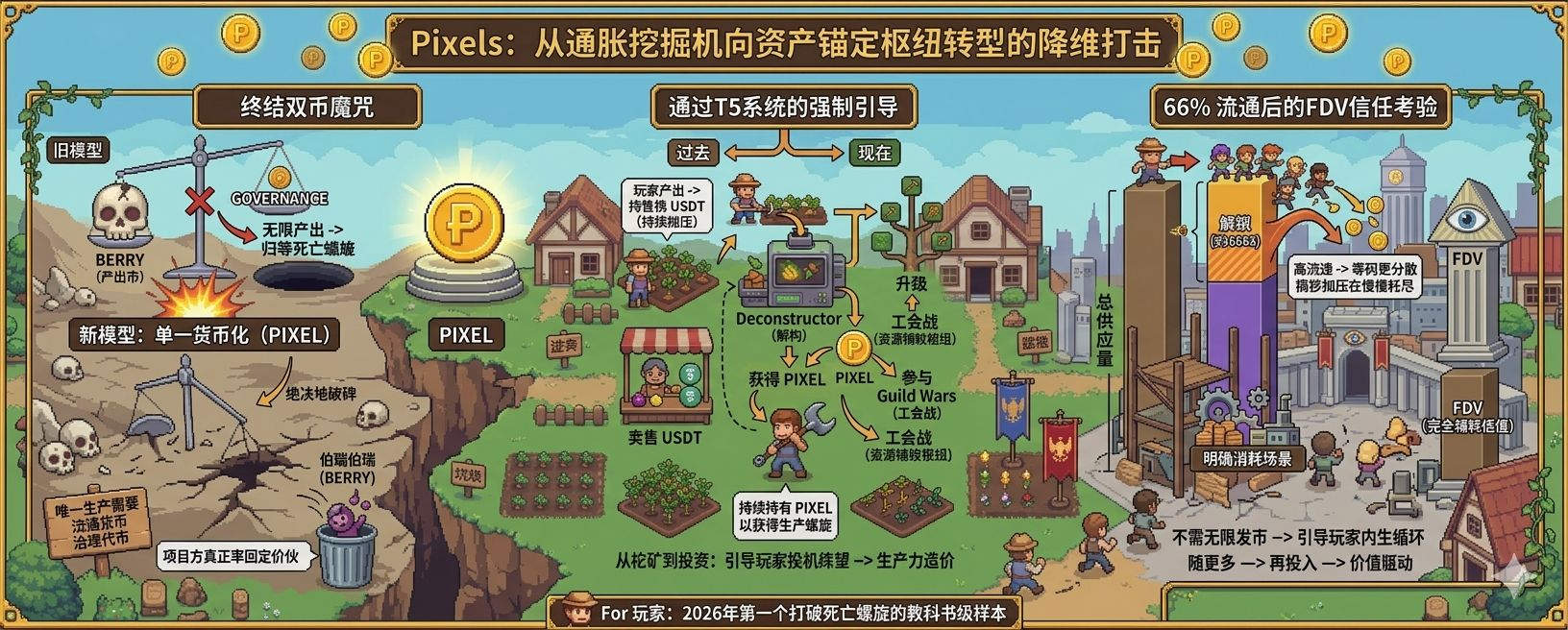
The vast majority of GameFi's death spiral originates from the dual-token model: governance token + output token. The output token (like the previous BERRY) leads to a price collapse due to unlimited issuance, ultimately dragging down the entire ecosystem.
The core of this round of self-rescue for Pixels lies in the resolute elimination of BERRY, forcing PIXEL to achieve a single monetization. This is not just a simple token merger, but a complete severance of the low-cost output-selling cycle. PIXEL has become the only production factor in the game, serving as both circulating currency and governance token, allowing the project team to truly regain pricing power.
2. Through the mandatory guidance of the T5 system, from mining to investment
Many people complain that the T5 (Tier 5) system is complex and overwhelming, but from an economic perspective, T5 is a mandatory reinvestment mechanism introduced by Pixels #pixel .
Past: Player output -> Sell off for USDT, resulting in continuous selling pressure.
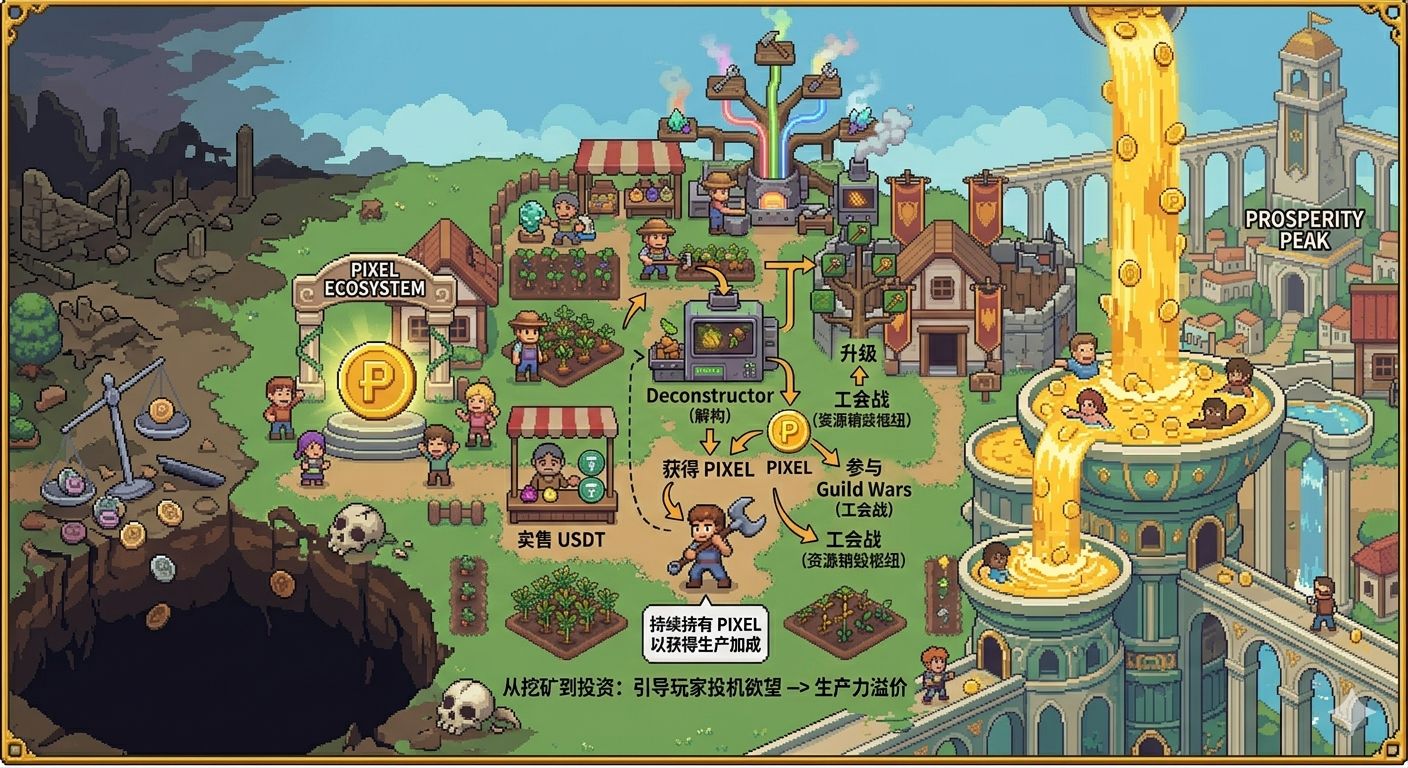
Now: Player output -> Must go through Deconstructor (解构) or upgrade tools -> Participate in Guild Wars (工会战) -> Continuously hold PIXEL to gain production bonuses. Through T5 and the upcoming Chapter 2 rules, Pixels have guided players' speculative desires toward productivity premiums. What players invest in the game is no longer just simple grinding time, but rather continuously consolidating for better returns.
3. 66% Trust Test of Circulating FDV
After unlocking, as the circulation rate of PIXEL reaches about 66%, discussions about its fully diluted valuation (FDV) have peaked. For long-term investors, this is actually a good signal, as high circulation means more dispersed chips, while hidden selling pressure is gradually depleting. Pixels' circulating supply is close to maturity and has clear consumption scenarios, giving it a far better risk resistance than those new projects with highly concentrated chips. It does not need to rely on infinite coin issuance to maintain activity but rather guides players to continuously invest within the system to earn more, forming a positive internal cycle. Through this evolutionary experiment of Web3 gaming, Pixels is no longer just a simple farming game, but is attempting to establish a decentralized ecosystem driven by player behavior.
For us players, we shouldn't worry too much about the ups and downs of PIXEL right now. Because, if Pixels successfully pass the chip reshuffling brought by this unlocking and achieve high-frequency resource destruction in the guild wars, it will become a textbook example that breaks the death spiral in the GameFi track of 2026. $PIXEL