
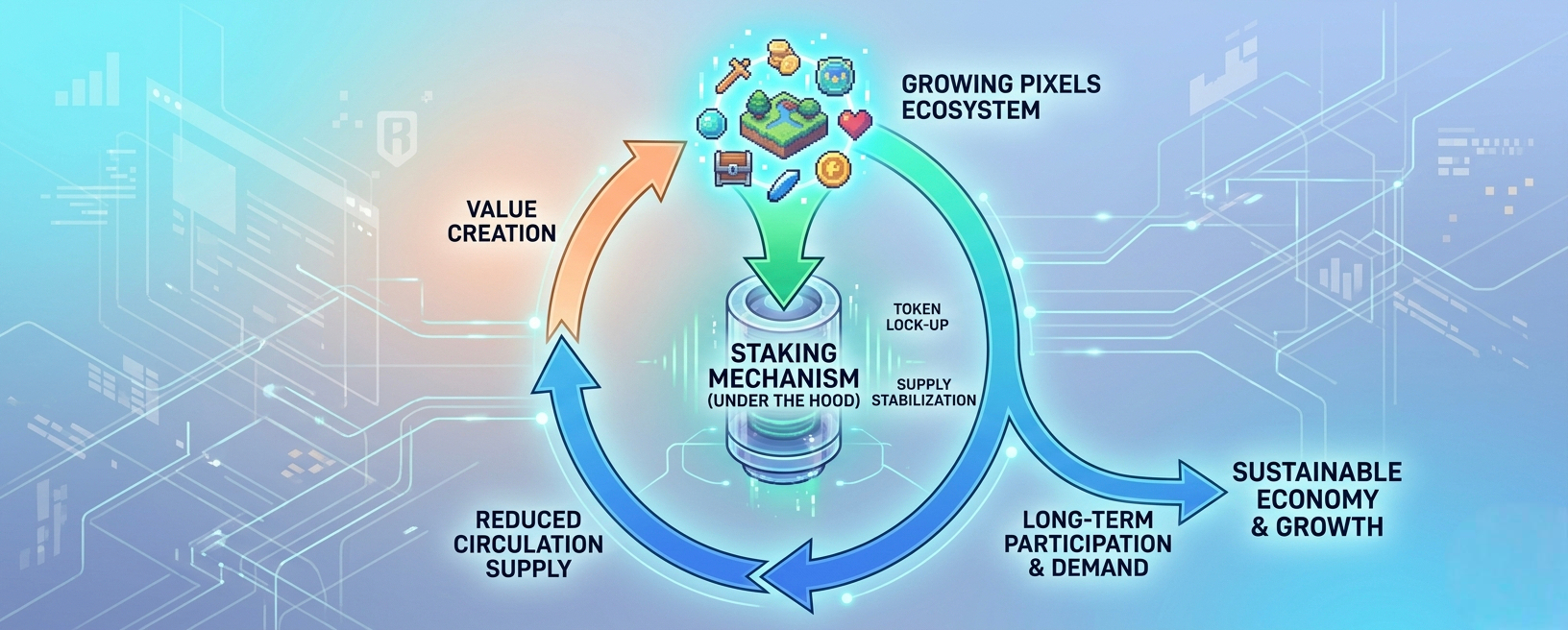
Most people focus on what they can see in Pixels.
But the real system works behind the scenes.
Pixels is a social casual Web3 game built on the Ronin Network, but its long-term direction is not just about gameplay. It is about building an ecosystem where value flows in a controlled and sustainable way. What makes this possible is not only the token itself, but how staking shapes the entire structure.
Staking in Pixels is often seen as a simple feature for earning rewards. But in reality, it acts as a hidden engine that supports the system. It works quietly, without direct visibility, but its impact can be seen in how the ecosystem stays balanced as it grows.
When users stake PIXEL, they reduce the number of tokens available in circulation. This creates a controlled supply environment. At the same time, the ecosystem continues to expand, and the token remains active across different uses and interactions. This creates a connection between reduced supply and ongoing demand.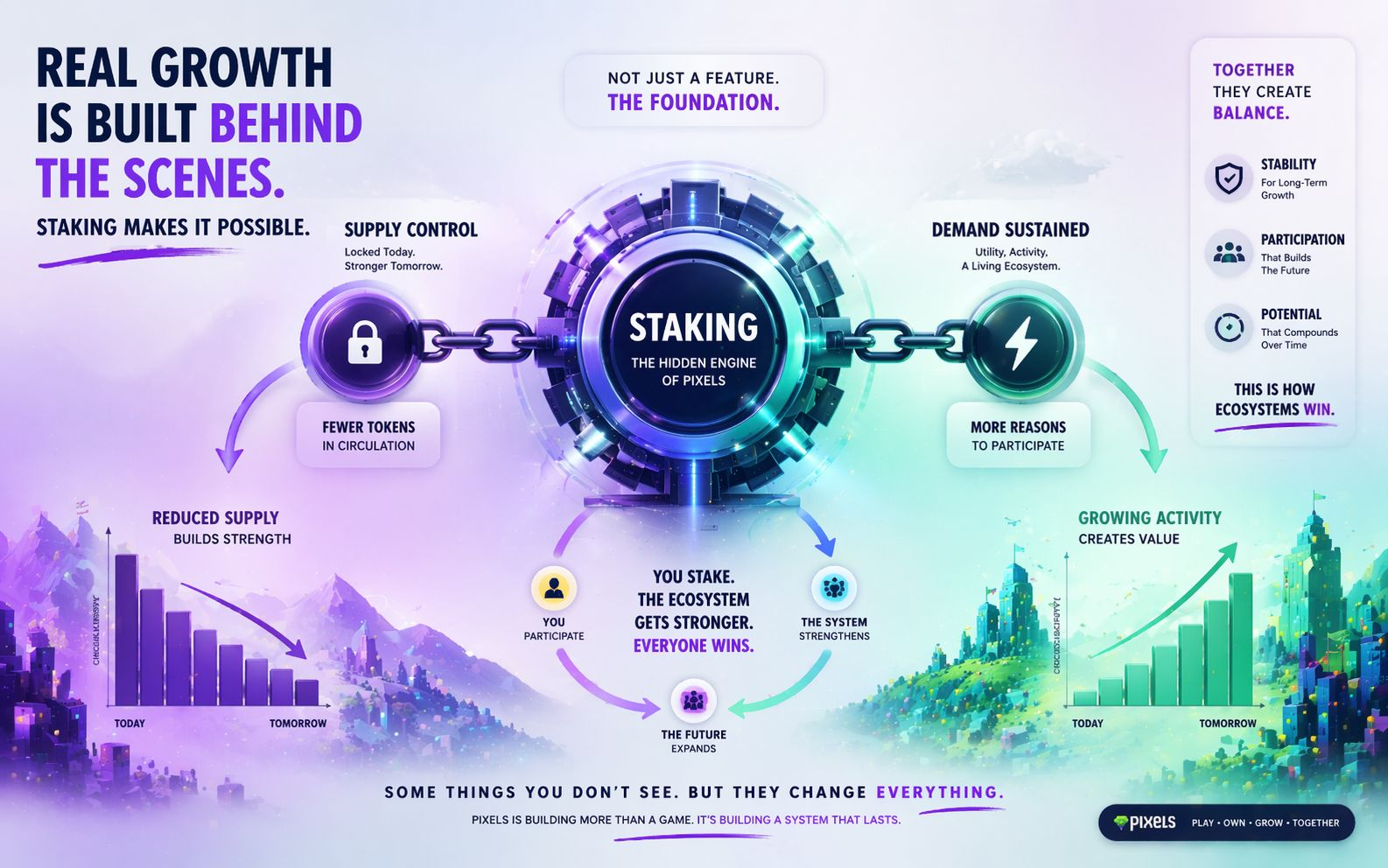
This balance is important for long-term growth.
In many Web3 projects, growth comes quickly but is difficult to maintain. This usually happens because supply increases faster than real usage. Pixels is trying to avoid this by using staking as a stabilizing layer. It ensures that as the ecosystem grows, it does not lose control over its internal balance.
Another important aspect is how staking supports long-term participation. Users who stake are more likely to stay connected with the system. They are not just reacting to short-term changes, but becoming part of the ecosystem over time. This creates a stronger and more stable foundation.
As the platform expands, this becomes even more important.
Pixels is expected to grow beyond its current structure, with more integrations and new opportunities. In this situation, the role of staking becomes more visible. It helps maintain stability while allowing the system to scale. Without this layer, growth could become unstable.
The Ronin Network also plays a key role in supporting this model. It allows fast and low-cost interactions, which makes it easier for users to participate in the ecosystem. This ensures that the system remains accessible while it continues to grow.
Over time, staking may also become more than just a support system. It could play a role in governance and decision-making, where users who are more committed have more influence. This would further connect participation with the direction of the ecosystem.
Pixels is not just growing on the surface.
It is building a structure underneath.
And staking is one of the main elements holding that structure together.
Those who understand this are not just using the ecosystem…
They are understanding how it actually works. @Pixels $PIXEL #pixel
