
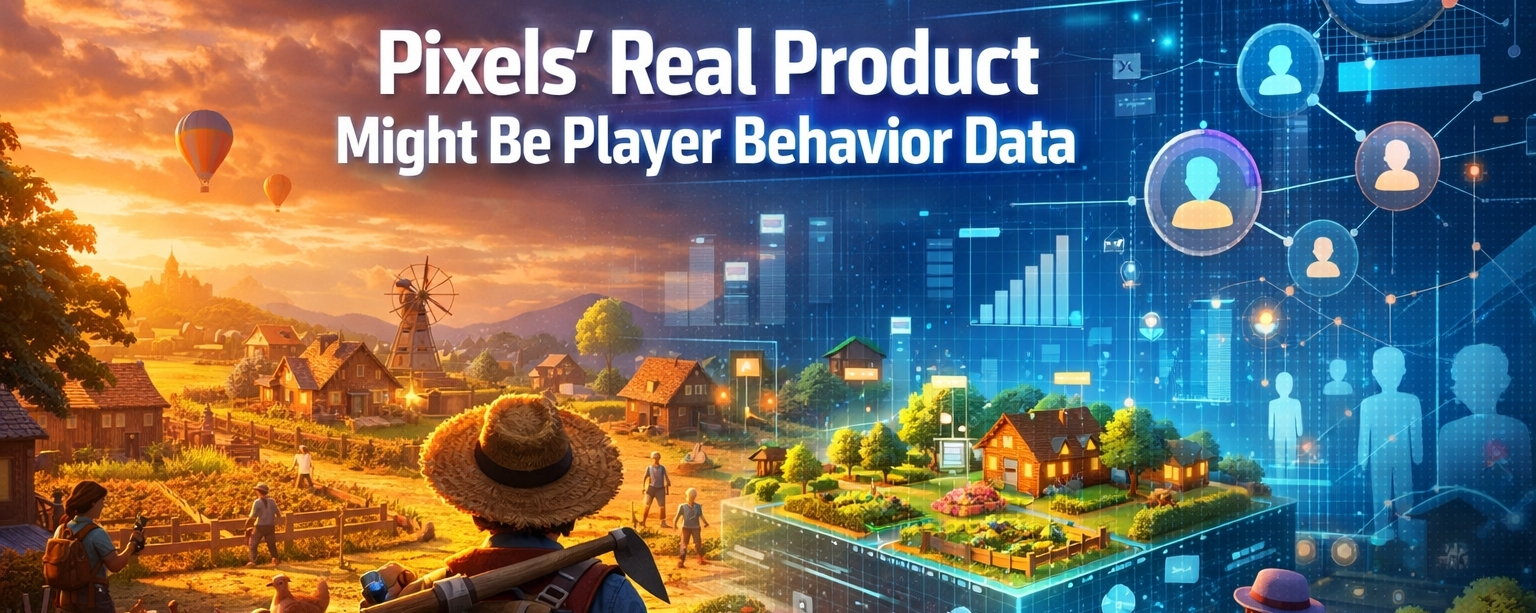
I keep coming back to a slightly uncomfortable thought when I look at Pixels. It does not feel like a game that is trying to maximize how much you earn. It feels like a system trying to understand who you are when you play.
On the surface, it is simple. You farm, you explore, you trade, you join events. But underneath that loop, the game is quietly watching patterns. Not in a sinister way, but in a structured, almost clinical way. Who logs in every day without missing a cycle. Who chases short-term rewards versus who builds long-term positions. Who collaborates naturally and who only shows up when incentives spike. Over time, these patterns start to matter more than the crops you grow or the tokens you collect.
The shift became more obvious with how reputation evolved. It is no longer just a badge or a number that signals status. It acts more like a gatekeeper. Your behavior influences what you can access, how much you can extract, and even how the system trusts you. That alone changes the dynamic. You are not just playing to earn. You are playing to be evaluated.
Then you see it again in seasonal systems like Bountyfall. On paper, it is a competitive event with unions and shared rewards. In practice, it is a controlled environment for observing decision-making. Do players cooperate or defect when rewards are pooled. Do they sabotage rivals or focus on internal growth. Do they stay consistent or fade after early gains. Every choice leaves a trace, and those traces are far more valuable than any single event outcome.
Even the small updates point in the same direction. Better onboarding reduces friction so more behavior can be captured from day one. Creator codes reveal influence and social gravity. Limits on industries and outputs create pressure, forcing players to reveal priorities. None of these features are loud on their own, but together they form a system that is constantly learning from its players.
That is why I think the real product in Pixels is not the token and not even the game world itself. It is the behavioral map being built in the background. A live, evolving picture of how people act when incentives, scarcity, and social dynamics are carefully designed.
If that map becomes accurate enough, it outlives any single reward cycle. Tokens can inflate, metas can shift, and players can come and go. But a system that understands behavior at scale can keep adapting, keep pricing attention, and keep redesigning itself around what players actually do instead of what they say they will do.
That is the part most people miss. Pixels is not just building a game people play. It is building a system that learns how people play. And that may end up being far more valuable than the game itself.