
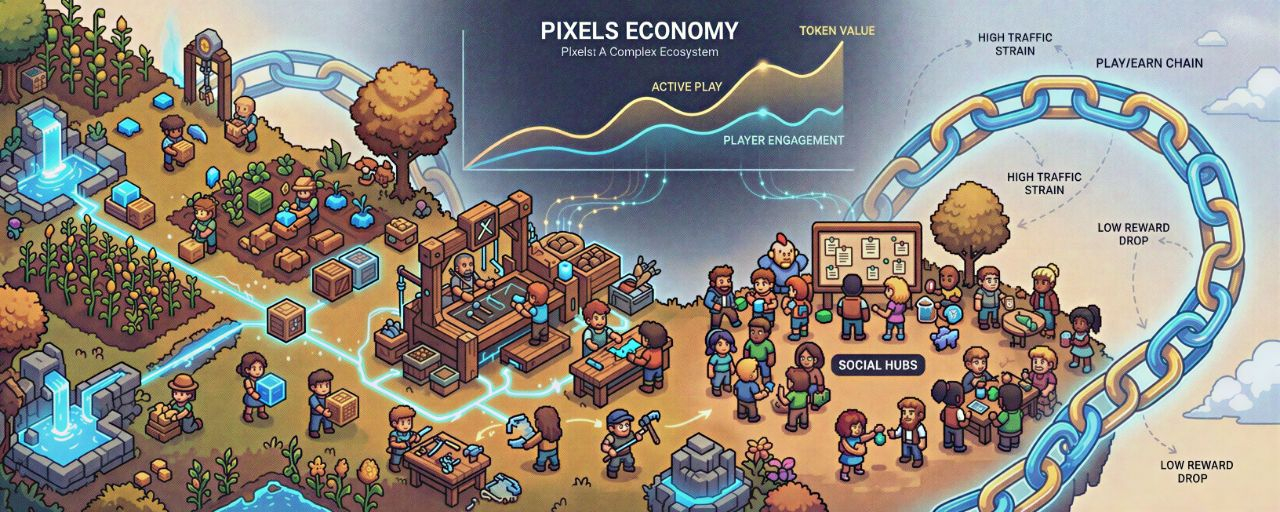
Pixels is in an interesting spot in the world of crypto games. It does not seem like something that was just thrown together. It does not feel like a test either.. At the same time it does not seem like it has been fully tested to see how it holds up under a lot of pressure.
When I look at Pixels I do not just see a game. I see a system that is trying to create its economy. That is a difference. Games can be fun. That is enough to keep people playing.. Economies need to be balanced and people need to trust them and come back to them again and again over time.
Pixels is trying to combine a lot of things like farming and crafting and social play and rewards that are based on tokens. On paper this sounds like an idea.. When you actually play the game each of these layers adds its own set of problems. When one system relies on another system it creates a chain of risks.
One thing that stands out to me is how much the design of Pixels relies on players being active and predictable. Not just playing the game. Playing it in a way that is consistent. That is hard to do in the world of crypto, where people can change what they are doing quickly when the rewards change. They can also leave quickly if the rewards are not clear or if they are delayed.
So the real question is not whether Pixels works today. It is whether the game will still work when a lot of people are playing or when hardly anyone is playing. A lot of systems seem fine when everything is normal.. Not many systems can handle it when things are not normal.
Another thing that seems important is how the game ties the assets and progression to how time you put into the game. This creates a sense of attachment to the game.. It also creates a lot of pressure. When time becomes valuable people start to think about how to get the most out of their time of just playing the game. This changes how people behave in ways that the designers of the game cannot fully control.
I also notice that the game relies on what people think about the tokens outside of the game. Even if the game itself is self-contained what people think about the tokens can still affect how they play the game. This is a connection that a lot of projects do not think about enough.
What seems solid to me is the attempt to build interactions in the game instead of just layers of speculation. There is gameplay in Pixels. The crafting and resource cycles are not just for show. They make you move through the system.
What seems stable is how these interactions will work when a lot of people are playing or when people leave the game. Small systems are easy to balance.. Large systems that are open to everyone are much harder to balance. The more things you add to the system the harder it is to predict how people will behave.
There is also the question of how to keep people motivated to play the game in the term. Now people are playing because they can see the rewards and the progression. If these rewards are not as strong the game has to rely on people enjoying the game. This is usually where crypto games struggle.
Compared to play-to-earn games Pixels seems more complex and less focused on just taking money from players.. That does not mean it is safer. The complexity of the game can actually be a risk if no one part of the game is strong enough to support the system.
When I think about Pixels as a trader I do not try to decide if it will be successful or not. I look for the connections between parts of the game. In Pixels the connection is clear. When people play it helps the economy. The economy helps people progress in the game.. When people progress it makes them want to play more. If one part of this chain slows down the rest of the chain will feel it quickly.
This is both a strength and a weakness. When the chain is working well it creates a lot of momentum.. When it is not working well it can break down quickly.
At this point it feels like Pixels is still learning its limits. It is not broken,. It is not complete either. It is in, between, where the design of the game meets how people actually play it and both are testing each other in unexpected ways.