
I’ve been thinking about Pixels (PIXEL) like this lately, in a quieter way than usual. Not really as a game to play, but as something that’s constantly moving through a system I don’t fully see. It feels less like a finished product and more like something in transit—always adjusting, always reacting, even when nothing obvious is happening.
The more I sit with it, the more it feels like no product really stands on its own. Everything depends on timing in ways that are hard to predict. Something can feel relevant one day and strangely out of place the next, even if nothing about it has changed. It’s just that the environment around it has shifted—attention moved somewhere else, demand softened, or maybe something similar came along at the right moment and quietly took its place.
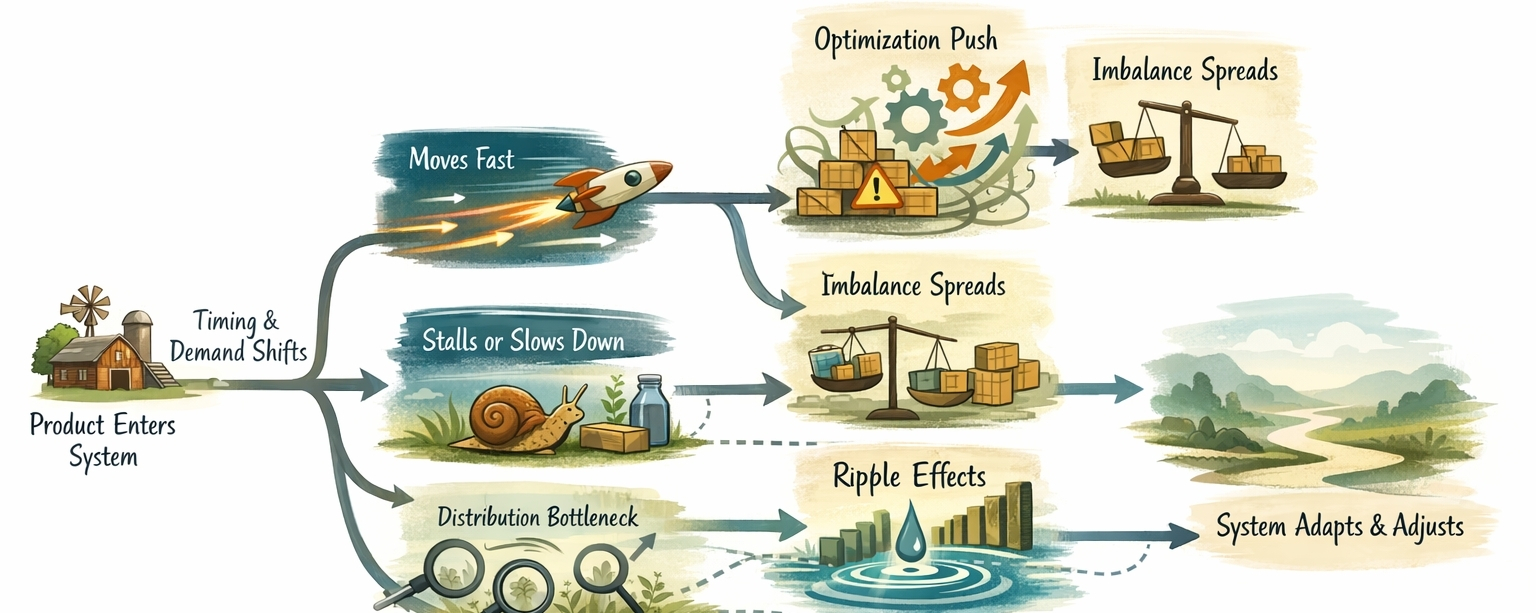
Some products seem to glide through the system. They find their rhythm early and keep moving, almost like the path was already clear for them. Others don’t. They stall a bit. Not dramatically—just enough to feel like they’re waiting for something. And that “something” is rarely obvious. It could be timing, or visibility, or just a small mismatch that’s hard to name. But once that pause happens, it doesn’t stay contained. It starts to affect everything around it in small, almost invisible ways.
That’s the part that’s easy to miss. One slow point can shift expectations. That shift changes how people respond. And before long, the system itself starts behaving differently, even if no one intended it. It’s not a big collapse or anything dramatic—it’s more like a subtle drift. Things feel slightly off, and then that “slightly” becomes normal.
When people try to fix this, it gets even more interesting. The natural reaction is to optimize—to support what’s working, to speed things up, to make better use of time and resources. But once that mindset kicks in, behavior changes. Attention becomes sharper, but also narrower. The things that are already moving get more energy, more focus. And the things that aren’t… well, they start to fade a bit, sometimes without anyone really noticing.
It’s not intentional, but it happens anyway. The system starts reinforcing its own patterns. Fast becomes faster. Slow becomes quieter. And somewhere in between, you realize that what looked like a clear signal might have just been timing or positioning, not necessarily value.
And all of this makes coordination feel more delicate than it sounds. It’s not just about keeping things organized—it’s about constantly adjusting to changes that don’t always announce themselves. Every decision connects to another. Every small shift creates a ripple somewhere else. Even when everything looks smooth on the surface, there’s a lot being balanced underneath.
I think that’s why I keep coming back to this thought. Products don’t just move through a system—they reveal it. The way something flows, or pauses, or gets picked up again later… it all says something about the conditions around it. And the more you watch it, the more you realize that nothing is ever completely stable. It’s all still in motion, still figuring itself out, just not in a way that feels obvious right away.