

 @Pixels After launching the guild (Guild) system, I was actually looking at its underlying architecture with an eye on examining the 'on-chain corporate law.' On the surface, it emphasizes social topology, but when you break down the mechanisms of shard purchases and price curves, this is not a traditional game guild at all; it is clearly forcing the bonding curve of friend.tech into a farming game.
As a habitual 'troublemaker' looking for vulnerabilities in the protocol SDK and code logic, I did not just stop at the surface vision of the white paper; instead, I ran a calculation model directly on the pricing logic of the guild contract and the on-chain interaction data of Ronin. After the calculation, this 'account' was even more hardcore than I imagined.
The 'water extraction' trap of the joint curve and the real return on investment period.
The pricing logic of guild fragments is essentially an unabashed capital model—the price of fragments (P) is positively correlated with the square of the total supply (S). The first batch of buyers for fragments is always the guild leader and the core circles, with extremely low costs; as external retail investors flood in, prices are pushed up exponentially.
Let’s look at a set of specific calculation data:
Entry Cost: Currently, for the top 20 leading guilds, the purchase cost of a single fragment has generally been pushed up to between 300 to 500 PIXEL (approximately 45-75 USD at current prices).
Marginal Returns: Assuming that retail investors are high-positioning to obtain 'guild high-level resource bonuses.' A mid-tier gold farming account's daily basic output is approximately 8-10 $PIXEL , if the guild bonus is calculated optimistically at 10%-15%, the additional net daily profit is only 1 to 1.5 PIXEL.
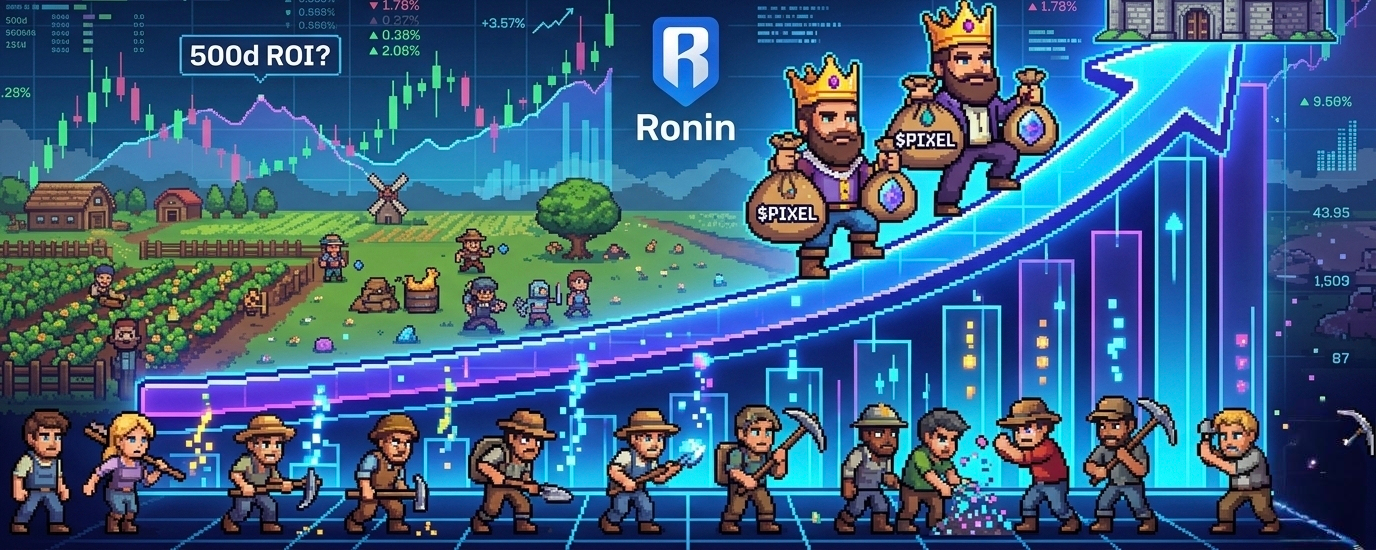
Return on Investment Period (ROI): Under the premise of not considering the risk of token price decline and that guild resource allocation is not further diluted, the static return on investment period can reach as high as 300 to 500 days.
From the perspective of multiple financial cycles, this is equivalent to retail investors buying a subordinated asset that has no underlying asset support and a price-to-earnings (PE) ratio of hundreds. Retail investors think they are buying a 'productivity tool' that enhances gold farming efficiency, but under the mathematical design of the joint curve, they are actually providing liquidity exit 'fuel' for the management team that entered early.
On-chain Gini coefficient: Resources are extremely concentrated among major landlords.
I further pulled recent on-chain resource flow data in an attempt to find the true face of those guilds that claim 'mutual assistance and mutual benefit.' The 'on-chain Gini coefficient' presented by the data is very eye-catching:
Traffic Monopoly: More than 75% of active guild members (and the associated labor value) are concentrated in the top 5% of giant guilds across the network.
The solidification of the landlord class: Resources are highly concentrated in guilds that own a large amount of land (Land NFT). The energy consumed daily by ordinary players (landless class), after being converted into resources, has nearly 30% of its hidden value (in the form of taxes, task board price differences, etc.) extracted by the guild treasury and landlords.
In World of Warcraft, guilds are emotional support and collaborative networks for team exploration; but in Pixels, guilds have turned into a hardcore financial contract of 'capital' and 'digital tenants.' As long as the output of underlying resources continues to be diluted by multi-opening scripts and studios, the so-called 'moat' of the guild is just paper-thin. Profits and losses stem from the same source, and the risk of buying fragments at high prices falls entirely on retail investors.
Audit blind spots of token deflation logic.
From the perspective of economic model auditing, the most fatal issue is: the guild system has not created a sufficiently deep 'sink.'
Although fragment trading will deduct a 5% handling fee for destruction or entering the national treasury, in the face of daily outputs exceeding one million PIXEL, this destruction mechanism relying on trading frequency is like a drop in the bucket.
Once the growth rate of new players slows down (buying stops), the joint curve will collapse downward. The panic selling triggered by the plummeting fragment prices will further trample the secondary market price of $PIXEL , forming a death spiral.
Conclusion: Awaiting the dawn of digital civilization.
My current judgment is: Don't be fooled by those top guilds currently shouting passionately in the community; what truly determines the life and death of this system is the 'emotional carrying capacity' and 'class mobility' of the bottom players. I am currently focusing on two core indicators: whether the fund sedimentation rate of the guild treasury (Treasury) can outperform the token inflation rate, and whether a consumption scenario for guilds that 'does not solely aim at pure gold farming' can emerge within the game.
Similarly, saying this is not to short Pixels. It dares to directly assetize and financialize complex social relationships, which itself is an ambitious large-scale sociological experiment, and it also shows us the foundation of Ronin Chain handling complex high-frequency interactions. But what I hope for more is that Web3 game designers do not always treat players as liquidity data on a spreadsheet. When one day, a novice player spends money to buy fragments of a certain Pixels guild simply because 'these people are interesting, and I want to build a city with them,' rather than 'this guild's fragments can rise 10% tomorrow for me to sell,' then we can truly say that chain games have stepped out of the quagmire of 'passing the parcel.'#pixel
