
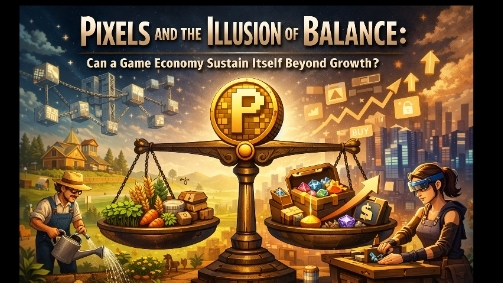

The more you dive into Pixels, the less it seems like a farming game with a token and the more like a balancing act where several opposing forces are kept moving and engaged at once. From an outsider’s point of view, the loop is rather straightforward. Farm, harvest, create, sell. Repeat. Yet, the underlying mechanics of Pixels rest on a delicate balance where time equals resources, resources equal assets, and the assets try to maintain their value via the means of a token bridge.
All seems rather elegant at first sight. It is anything but.
There are multiple layers of scarcity involved. Resources are plentiful and relatively easy to generate. The goods created using them are scarce. Some goods serve only the purpose of giving an extra boost or access, while others are required precisely because of this property. The question arises immediately: does the player need the goods, or do the goods simply need effort poured into them?
Because creating value is about more than just production. It’s about movement.
When players can keep producing crops and items without any way to consume or dispose of them, you end up with a treadmill. Production accumulates. Value drops. Motivation shifts from the gameplay to dumping. And this is where sinks come in handy. Paying for upgrades, access, convenience, and expression needs to be intuitive, organic. When token minting exceeds sinks, the currency starts to inflate fast. When sinks become too excessive, the experience takes on a different shade. Balancing them is not easy, especially as the pace of growth slows down.
Finally, there’s infrastructure, which works behind the scenes but is crucial to the process all the same. In this case, Ronin makes not only the game possible but ensures that the entire cycle runs smoothly. Low transaction fees and better user experience mean that constant actions such as trading, claiming, and transferring do not become tiresome but smooth and continuous. Otherwise, the economy would fail to mature due to too much friction. The thing is that this approach also introduces another vulnerability.
And so the question remains, is there more importance placed on creating value or extracting value from the players?
During the early phase, the focus on growth masks potential issues. As new participants come into the ecosystem, emit the emissions, and keep the momentum going, everything seems fine. Ultimately, it won't be about constantly bringing in new participants, but retaining current players despite decreased interest in the token itself.
On the other hand, Stacked continues to innovate by way of its own AI game economist. What an incredible concept. An intelligent system that will analyze the behavior of players and help optimize rewards for each one based on certain rules. Not only automation, but actual decision-making.
However, its downside could be its biggest asset at the same time because this machine learning approach is based on the Pixels data set. It's a great source of information to draw conclusions about people's behavior but is limited in its scope because it contains the data from crypto-natives who play inside a farming simulator.
In practice, it should improve by retraining the system. Early games generate new data, and as a result, the model adapts, and performance starts to grow. If the process is quick enough, it won’t be too costly. On the contrary, if it is slow or unstable, game studios will experience a long stretch of bad or inconsistent results. But that poses an issue, since the AI layer is the very heart of Stacked’s value offering.
The question of interest, then is not whether or not the model works. There’s no denying that it does, at least for its initial setting. However, the issue is more related to how quickly and successfully it can adapt to other environments.
On the one hand, Pixels is testing two concepts here. Economically, whether a game is capable of maintaining a circular economy after the growth period. Technologically, whether behavior patterns learned within one ecosystem apply to others.
But both of them remain unsolved.
