
I keep coming back to this simple feeling: Pixels doesn’t feel like a typical Web3 game… it feels like a place people quietly return to.
At first, I thought I understood it.
You log in, plant crops, maybe explore a bit, chat with other players, earn some rewards. A soft, easy loop. Compared to the chaos of earlier crypto games, it feels almost… calm. Like the pressure is gone. No constant “grind to earn,” no aggressive monetization pushing you every second.
That’s the story most people tell: Pixels is just a chill farming game with Web3 in the background.
But when you actually spend time in it, that explanation starts to feel incomplete.
Because there’s something subtle happening underneath.
I remember watching a player spend hours decorating their land moving items around, adjusting small details, showing it to friends. No token reward. No leaderboard benefit. Just… doing it because it felt good. At the same time, I saw another player carefully optimizing resources, planning upgrades, thinking about how to use PIXEL tokens efficiently.
Same world. Completely different motivations.
That’s where the real tension lives.
People often assume Web3 games succeed if they “balance fun and earning. But Pixels is dealing with something deeper: what people do vs what the system values.
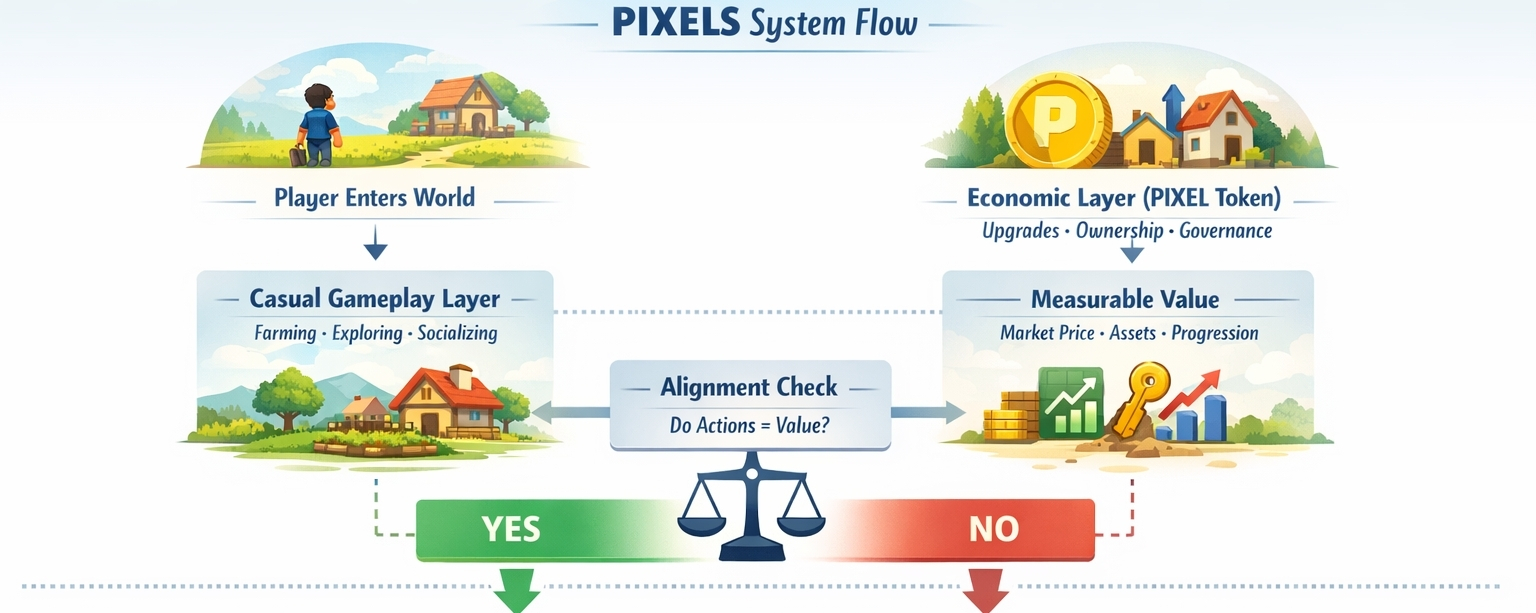
On one side, you have the game itself the farming, exploring, social layer. It’s light, almost relaxing. You could remove the token, and honestly, some players would still show up.
On the other side, you have the economy PIXEL, upgrades, land value, long-term progression. That’s where the measurable value sits. That’s what gets traded, analyzed, speculated on.
And the interesting part? These two sides don’t always move together.
There was a moment when PIXEL saw a sharp surge in the market. Prices jumped fast, volume spiked. From the outside, it looked like the ecosystem was exploding with value.
But inside the game? It felt… normal. People were still farming, chatting, doing their routines.
That disconnect tells you something important.
Markets can react instantly. Communities don’t.
And Pixels sits right in between those two speeds.
To its credit, the system seems aware of this. That’s why it separates things. Daily gameplay often runs on simpler in-game currencies, while PIXEL is used for bigger decisions upgrades, governance, deeper progression. It’s like the game is saying: not everything needs to feel financial.
And that’s a smart move. It lowers pressure. It makes the world feel more natural.
But it also creates a quiet risk.
Because now you have two realities: one where players experience the game, and one where value is measured.
If those two drift too far apart, something breaks—not suddenly, but slowly.
Players don’t quit right away. They just stop caring as much.
You can actually see how Pixels is trying to avoid that. The move to the Ronin Network wasn’t just about lower fees or better speed it was about creating an environment where activity matters. Where players show up daily, not just investors watching charts.
And that’s probably the most interesting part.
Pixels doesn’t feel like it’s chasing hype. It feels like it’s testing something quietly: Can a Web3 system survive if people treat it like a normal game first, and an economy second?
That’s not an easy balance.
If the token becomes too important, the game risks turning into a cycle of hype and burnout. We’ve seen that before.
If the token becomes irrelevant, then the whole Web3 layer loses its purpose.
So Pixels lives in this narrow space between the two.
And maybe that’s where its real strength is forming not in big features or flashy updates, but in how consistently it aligns small actions with meaningful outcomes.
When planting crops feels connected to progression… when progression feels connected to ownership… and ownership feels connected to something that lasts…
That’s when the system starts to feel real.
Not perfect. Not fully solved. But stable enough that people trust it without thinking too much about it.
And honestly, that’s the part I find myself watching most.
Not the price of PIXEL. Not the number of players.
Just this quiet question:
Will the people who are here today still want to come back… even when nothing exciting is happening?
Because if the answer to that stays “yes,” even slowly, then Pixels might be building something more durable than it looks at first glance.
