
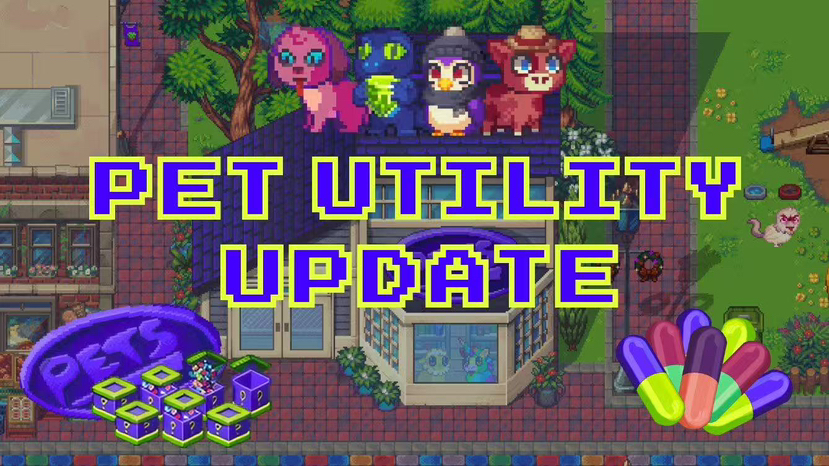
Yesterday, while idly browsing news in the circle, I was struck to see that the daily active users of Pixels had directly broken through the 153,000 mark. The young folks in the group were all excited, shouting that the bull market has arrived, and they should rush in. But as an old developer who has been crawling through the Web3 circle and piles of code for nearly ten years, my first reaction was not "It's too hot, I want to enter the market," but rather my mind instantly buzzed, and a soul-piercing technical question popped up — there are hundreds of thousands of people distributed across dozens of countries around the world! The game server is set to broadcast the complete farm status every 100 milliseconds. If you think about it carefully, from our data center in Singapore, how many milliseconds would it take to send this data packet all the way to the phones or computers of players in Brazil, South America?
Those of us who have played traditional Web2 farming games know that, for instance, the particularly popular (Stardew Valley) multiplayer version, even with a latency of 200 milliseconds, players only feel a slight pause when chopping trees and can still enjoy the game happily, but Pixels is not a purely traditional game; it inherently carries the genes of blockchain, which means that every time you painstakingly harvest a rare crop, it must be minted and recorded as an NFT on-chain! This 'on-chain confirmation' death window can be said to completely shatter the economic calculations of the previous simple server state synchronization; today, let’s brew a cup of tea and thoroughly discuss the technical architecture behind this!
The first hurdle: the illusion of 100 milliseconds and the physical limits across oceans
As usual, let's start dissecting from the very bottom layer of the technical architecture. According to the mainstream synchronization logic of game servers available in the market today, since Pixels is positioned as a relatively casual social farming game, it most likely uses the 'state synchronization' scheme rather than the extremely demanding 'frame synchronization'— so what is state synchronization? To put it simply, it means the server holds the unique 'truth' of the world, and what we see on our player clients is all the 'judgment results' sent from the server; it says you planted it, so you planted it; whereas frame synchronization, used in esports, runs a complete computational replica of the world on every player's client, and as long as everyone's input commands are exactly the same, the final calculated state of the world will be absolutely consistent!
Pixels' choice of state synchronization is something one could guess even with their eyes closed, after all, planting a carrot is not like playing DOTA where you need that extreme micro-operation refreshing every 16.67 milliseconds; a 100-millisecond broadcast interval is absolutely more than enough for us to see crops grow a little and small animals stroll around the map!
However! The problem precisely lies in the word 'global'; just look at how terrifying the geographical latency distribution in the physical world is— if even Singapore's node might only be 20 milliseconds, smooth as can be, but the guys on the west coast of the United States have to deal with 80 milliseconds, and players in Europe are about 120 milliseconds, while those in South America might see latencies soaring to 200 milliseconds or even higher! Yesterday, I sat in front of the computer spinning the globe and did some calculations. Assuming the Pixels project team is conscientious enough to deploy server nodes in the three major global core areas, like placing one in Singapore for Asia, one in Frankfurt for Europe, and one in Virginia for the Americas, according to the network quality data provided by leading cloud service providers, we can indeed keep latency firmly within the golden range of 20 to 50 milliseconds within the same region, but once crossing regions? Then we have to swallow the bitter fruit of 100 to 200 milliseconds of physical latency! This means that if a player from Singapore and another from Brazil happen to interact in the same farm, the data packet for state synchronization has to travel from Singapore across the ocean to Virginia and then jostle all the way to Brazil, resulting in a round-trip latency easily exceeding 300 milliseconds!
Yet the game fundamentally mandates a broadcast every 100 milliseconds, doesn’t this create an awkward situation? In reality, the rhythm of the entire server will be dragged down by the slowest player on the network, leaving the project team with only two paths: either pinch their nose and lower the broadcast frequency, say to 200 milliseconds; or stiffen their resolve and force the faster players with better networks to wait for the slower ones. Of course, they might also implement 'regional sub-servers', but once sub-servers are in play, the so-called 'global same-server' grand vision of Web3 becomes pure marketing rhetoric aimed at deceiving investors!
The second hurdle: calculating this confusing 'on-chain mess' of 150,000 concurrent users
And this isn't over yet; the more dangerous part is the invisible and intangible blockchain latency, which is the real bottleneck! You see, Pixels' current gameplay involves running all those high-frequency, non-critical game states on centralized off-chain servers, only when encountering crucial events involving real money, like NFT minting or token transfers, will the data be anchored to the Ronin chain! We all know that Ronin was originally created specifically for gaming, with an average block confirmation time of about 3 seconds and a transaction fee of roughly $0.003, doesn’t that sound appealing?
But don't forget, this is a comparison. If Pixels had rashly run on the ETH mainnet back in the day, the scene would have been unbearable— even if each status broadcast was just throwing a hash digest onto the chain, considering ETH's current average block confirmation time of 12 seconds and the Gas fees easily hitting $2, this wouldn't be playing a game; this would be burning money! If it had run on the BTC chain, it would have been even more magical, with a confirmation taking ten minutes and transaction fees starting at $10! Brother, think about it, for a game that needs a 100-millisecond response time, BTC's 10 minutes and ETH's 12 seconds feel like you ordered a same-city express delivery, but they sent you a horse-drawn carriage to deliver it slowly; you'd be dying from the urgency. That's also why, after so many years, the so-called 'fully on-chain games' still don't have a shadow of large-scale popularity— the underlying infrastructure simply doesn't allow it!
As an old developer, I really can't contain my curiosity and simulated an extreme pressure testing scenario myself: just calculate, if Pixels' 150,000 daily active users all go online simultaneously during peak times, assuming each person clicks the mouse just once per second— whether moving a bit, planting a seed, or watering a bit— then the total operation volume the entire server has to bear per second directly skyrockets to 150,000! If this game truly is the 'fully on-chain' as claimed, that would mean it needs to process 150,000 transactions on-chain every second, translating to 150,000 TPS. Guess what? The ETH mainnet currently maxes out at around 30 TPS, and to run this game would require a massive 5,000-fold expansion; BTC's TPS is about 7, which means it would need a more than 20,000-fold expansion to handle it!
So, what lies before Pixels is not a multiple-choice question; this hybrid architecture is the only way to survive— off-chain servers bearing the brunt of that 150,000 high-frequency operations per second, while on-chain quietly handles less than one percent of crucial asset events, about 1,500 times per second! At this point, while Ronin's claimed 20 TPS looks a bit tight, with a little batch packing technology it can barely work, and ETH's 30 TPS can also manage, but considering the cost difference of a whopping 1,000 times between the two, a fool would know who to choose, right?
The third hurdle: this deadly 'optimistic synchronization' and the vacuum period of cross-national reselling
But don't celebrate too early; there's also a super deep, interconnected pitfall hidden here— that is the waiting latency of off-chain servers while synchronizing globally! Pixels must constantly maintain consistency of game states between servers in these three major global regions; otherwise, extremely outrageous 'paranormal events' could occur: for example, I might have picked a top-notch pumpkin in my farm here in Asia, but players in America still see the pumpkin on their screens growing in the ground. If this data doesn’t match, the game economy system could directly collapse! In the past, when we handled traditional Web2 games, we could use a master-slave database replication with CDC data stream processing, and by spending some money on bandwidth, keeping latency firmly within 50 milliseconds was not an issue. However, Pixels cannot do that; it has a Damocles sword hanging over it named 'blockchain asset confirmation'! Any state involving asset changes, such as when you just mined a legendary-level item, even if the off-chain server synchronizes at light speed, it doesn't help; it must honestly wait for Ronin's lengthy 3-second confirmation to complete before it can be final!
This also means that the state synchronization between major regional servers is effectively choked by this 3-second on-chain confirmation window; the common practice in the industry now is to implement an 'optimistic synchronization' mechanism: that is, the server first assumes that your operation can succeed, allowing the game visuals to proceed, and after 3 seconds, if it turns out that the transaction on-chain has failed or is congested, the server will reluctantly roll back your game state! To be honest, this kind of design puts a severe test on the logic of conflict resolution coding; if not handled correctly, players' mindsets could explode!
Speaking of which, there's an even more core logic I still haven't fully grasped— how do they ensure the absolute security of cross-regional asset transactions? Imagine a scenario where an old player from Singapore wants to sell a piece of highly valuable land NFT to a buyer in Brazil; at the level of the off-chain server, it's just a matter of modifying a few lines of code, and the land status would instantly transfer; however, at the blockchain level, the legally valid transfer of ownership must wait for Ronin's 3-second block confirmation! This creates an extremely dangerous 'vacuum period'— in this brief 3 seconds, the game visuals show that the land now belongs to the Brazilian guy, but the blockchain explorer still shows the name of that old Singaporean guy!
If, during this critical 3 seconds, one of the core servers suddenly crashes or the network experiences extreme fluctuations, there is a high probability that the state will be lost or generate fatal logical contradictions! You see, although BTC transactions are as slow as a snail taking 10 minutes, once confirmed, they become an absolutely irreversible ironclad case; ETH may take 12 seconds, but that is also a final confirmation! Only Pixels' current approach of 3-second on-chain confirmations combined with off-chain optimistic synchronization artificially creates an extremely fragile 'temporarily inconsistent' intermediate state within the system, which is akin to walking a tightrope for assets with a strong financial attribute like land NFTs, often worth thousands or even tens of thousands of dollars!
The fourth hurdle: 'ghostly teleportation' in network jitter
Let’s dig deeper into the hardcore details of network jitter and packet loss. According to the current commonly accepted latency assessment standards in the online gaming community, 1 to 30 milliseconds is considered extremely fast and smooth, 31 to 50 milliseconds is regarded as good, 51 to 100 milliseconds is barely playable, and once it exceeds 100 milliseconds, it can only receive negative reviews! Pixels currently stubbornly clings to a 100-millisecond broadcast interval; this means that as long as your network latency slightly exceeds 100 milliseconds, you'll undoubtedly miss an extremely important state update packet, and will have to wait for the next 100-millisecond cycle of data to 'save the day'! If your network is even worse, with a packet loss rate soaring to 5%, that means for every 20 broadcasts from the server, you would miss one, reflected on your screen as neighboring players suddenly 'teleporting' like ghosts or your action of wielding a hoe getting stuck in mid-air!
When we were dealing with traditional games, we would directly apply the UDP protocol combined with a retransmission mechanism, and add some client-side prediction compensation algorithms to basically smooth things over and make players unaware of any issues. However, Pixels can't do that; it carries the blockchain verification constraint. Once the client’s action prediction is wrong, you can't simply overwrite it with new data as you used to; you have to go through that extremely cumbersome and costly on-chain rollback process, which is an unbearable burden for the project team!
The bottom line for old veterans and the final calculations
So, now what I, as an old soldier, focus on every day is not its flashy token K-line charts, but whether Pixels' official dares to publicly disclose their global server distribution map and real-time latency monitoring panel! If they are genuinely willing to invest heavily in deploying high-spec edge acceleration servers in core nodes in North America, Europe, and Asia, and can confidently guarantee that most players can keep their latency under 100 milliseconds, then I would truly give a thumbs up and praise this architecture for being impressive and mature; but if investigations reveal that to save costs, they are solely relying on a single central server in Singapore to hold things together, leaving players in Europe and America to struggle with latencies exceeding 200 milliseconds while farming, then the so-called 'global same-server ecology' is purely a marketing gimmick meant to deceive us investors! Additionally, the stability of the block production time on the Ronin chain is of utmost importance— if this chain seems fine normally, but during peak gold farming times the network congests and block times soar from 3 seconds to 10 seconds or longer, that would completely destroy all the technical assumptions needed for smooth synchronization of off-chain states, potentially crippling the entire economic cycle of the game!
Ultimately, peeling away these layers of technical outerwear reveals that the 100-millisecond state broadcast interval set by Pixels is essentially a helpless compromise made by the project team between players' gaming experience and the high costs of server architecture! If the interval is adjusted shorter, say to 50 milliseconds, it would indeed be smoother, but the project team would have to rent more top-tier servers and purchase more expensive international dedicated bandwidth, which could bankrupt the project team in no time; but if the interval is extended to 200 milliseconds, players would feel that the game is extremely 'unresponsive', sluggish like a half-paralyzed half-finished product! I ponder that this mysterious number of 100 milliseconds is definitely a critical point calculated day and night by their team: after all, we are farming, not playing FPS shooters where milliseconds matter for ultimate counterattacks; 100 milliseconds is already enough for the animation of carrots growing to appear smooth and natural; but it is different from games where you take turns slowly playing cards; we cannot truly tolerate several seconds of delay! This approach of finding a balance in between is akin to Bitcoin's resolute choice of 10-minute confirmations to ensure security, while Ethereum opted for 12-second confirmations to compete for usability—this reasoning stems from the trade-offs made by top architects regarding design philosophy!
My preliminary conclusion, calculated late into the night with pen and paper, is that the global latency distribution of this 150,000 strong army in Pixels is likely ranging from the silky 20 milliseconds of local players in Asia to the painful 200+ milliseconds of players in South America, and taking a median, it’s probably fluctuating wildly in the range of 80 to 120 milliseconds! To be fair, if this level of network latency only allows for various casual playstyles like planting vegetables and collecting wood, it can indeed be barely acceptable; but if this game has bigger ambitions in the future, insisting on real-time highly interactive player-to-player high-frequency trading, or even PVP combat activities that require positioning, then this latency will undoubtedly become a disaster! The root of all these issues actually lies in the unavoidable confirmation delays of current blockchains, which create a fundamental and unbridgeable chasm between the need for real-time interaction in games and the existing infrastructure— until this deadlock is resolved, we cannot afford to be careless. I'm still keeping an eye on this technology-level economic calculation daily; let’s focus less on the grandiose promotional speeches and wait for actual latency data to speak for itself.
