
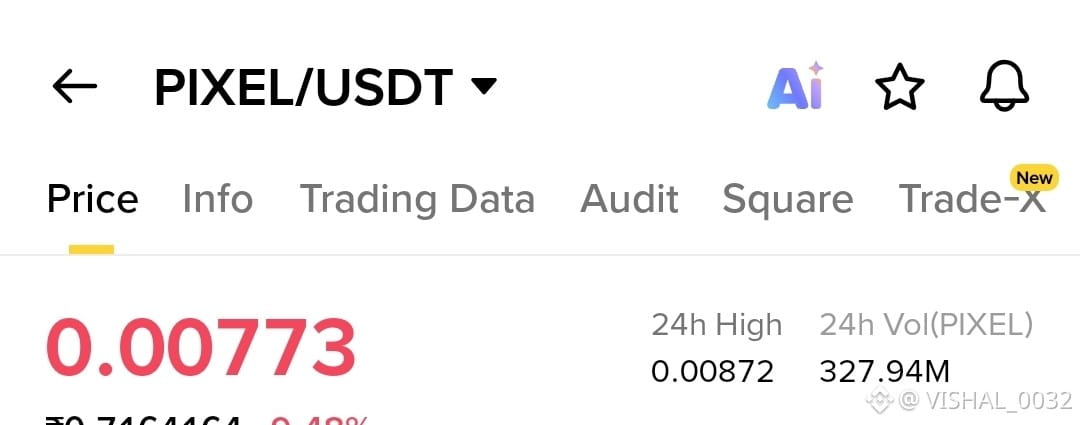
The current PIXEL/USDT market structure reflects a clear short-term bearish phase, and your 100-word summary captures the core idea well—but let’s expand it into a deeper, more practical market review.
At the present price of 0.00773, the asset has declined nearly 9.5%, which is not just a random fluctuation but part of a broader intraday downtrend. The most important structural signal here is the formation of lower highs and lower lows, which confirms that sellers are consistently stepping in earlier than buyers. This behavior typically indicates weakening confidence and a shift toward short-term bearish sentiment.
A key technical element is the price trading below the MA60 (Moving Average 60). This suggests that the average price over the recent period is now higher than the current price—another sign that momentum has shifted downward. When price remains below a major moving average, it often acts as dynamic resistance, meaning any upward movement may struggle to sustain itself unless supported by strong volume.
Speaking of volume, the earlier spikes you noticed are important. They indicate that there was temporary buying interest, possibly from traders trying to catch a bounce or break a resistance zone. However, the failure to sustain those moves—and the transition into lower volume—suggests that buyers lacked conviction. In markets, volume confirms strength; without it, price moves tend to fade quickly. The recent low-volume environment supports the idea of a weak market rather than a stable base.
The brief sideways movement before the drop is a classic consolidation phase. In technical analysis, consolidation after a small uptrend can either lead to continuation or reversal. In this case, the breakdown from that range signals a bearish continuation pattern, meaning sellers used that consolidation to build positions before pushing the price lower.
From a psychological perspective, traders are likely becoming cautious. Those who bought higher may be exiting positions to limit losses, adding further selling pressure. Meanwhile, new buyers are hesitant, waiting for clearer signs of reversal or stronger support levels.
Looking ahead, two scenarios are most likely:
Continued Downtrend:
If the price remains below MA60 and volume stays weak, the market may continue drifting downward. Small pullbacks could occur, but they may be short-lived unless supported by strong buying.
Sideways Consolidation:
The price could stabilize near current levels, forming a base. This would require decreasing volatility and gradual volume build-up before any potential reversal.
For any bullish reversal, traders would typically look for:
A break above MA60
Increasing buying volume
Formation of higher lows
Until these signals appear, the market bias remains cautiously bearish. This is not a strong panic sell environment, but rather a controlled decline with weak recovery attempts—often considered one of the more reliable bearish setups in short-term trading.