
What feels most certain in digital systems is often the least complete.A clean chart, a viral post, a breaking headline—each arrives with clarity, speed, and confidence. It feels like information in its final form. But what we are actually seeing is not reality fully revealed; it is reality reduced, structured into fragments that are easy to display but difficult to fully understand.This is the subtle distortion of the digital age: we no longer mistake noise for signal—we mistake fragments for truth.The Pixel Layer: Where Reality Becomes Visible—but PartialEvery digital system, no matter how advanced, operates by breaking complexity into smaller units. These units—pixels in a conceptual sense—are fragments of information designed for processing, transmission, and display.A market price is a snapshot of countless transactions.A trending post is a moment amplified by timing and engagement.A notification is a single event extracted from a broader sequence.Each of these is accurate. None of them are complete.The strength of a pixel lies in its precision. The weakness lies in its isolation. When removed from the structure that gives it context, even the most accurate signal becomes potentially misleading.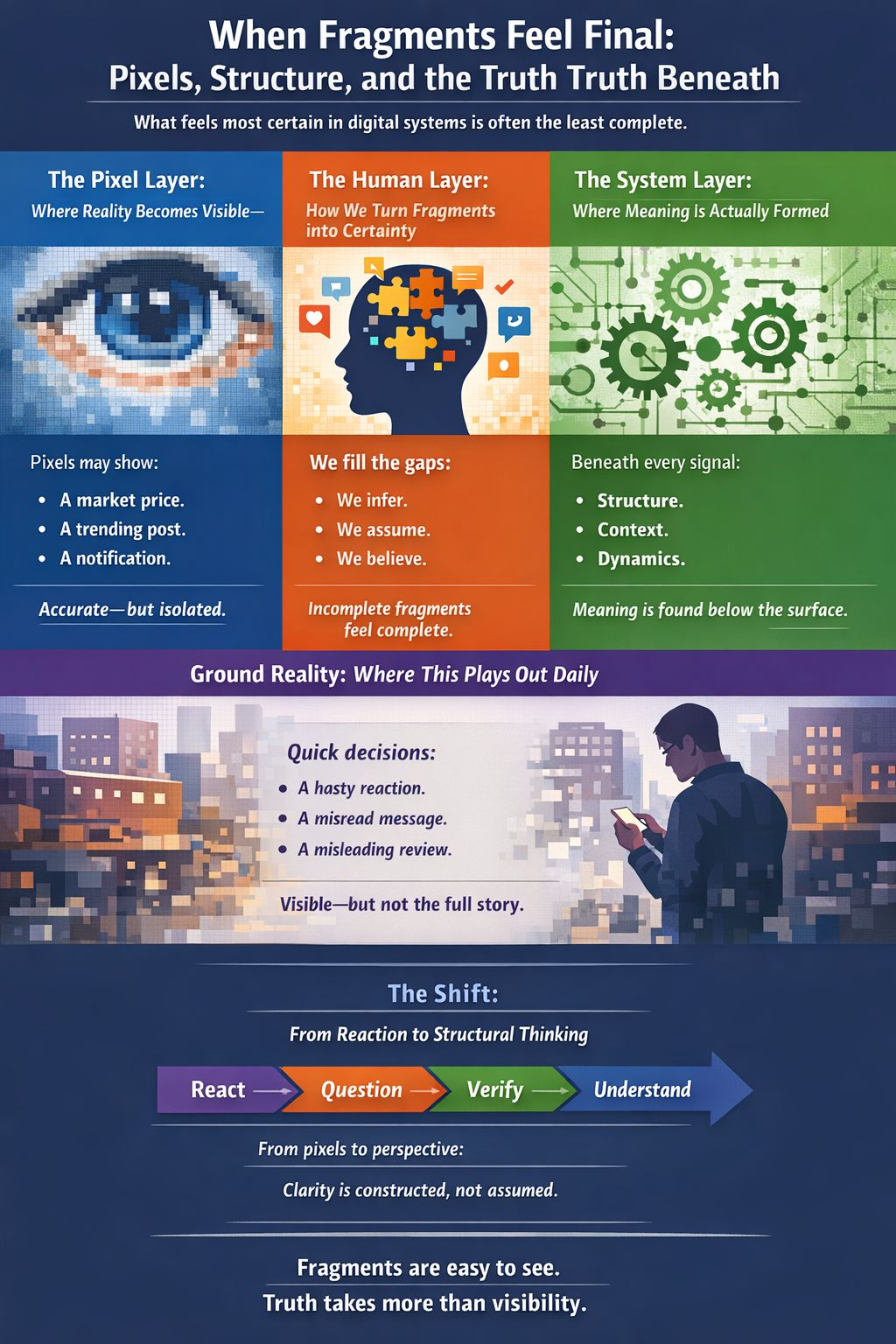
Digital environments are not flawed because they fragment reality. They are built on it. The issue is not fragmentation itself—it is the interpretation that follows.The Human Layer: How We Turn Fragments into CertaintyHuman cognition is not designed to sit comfortably with incomplete information. When we encounter a fragment, we instinctively complete it. We infer, assume, and construct narratives to fill the gaps.
This tendency is subtle—but powerful.
A trader notices a sharp drop on a chart and reacts instantly, interpreting movement as meaning. Minutes later, it becomes clear the move was driven by short-term liquidity, not a structural shift. The reaction was real; the understanding was not.
A young professional scrolls through a feed filled with promotions, achievements, and curated success. For a brief moment, it feels like everyone else is progressing faster. What remains invisible are the years of uncertainty, failure, and quiet persistence behind those moments.
A headline spreads rapidly across platforms, shaping opinion within minutes. By the time corrections or deeper context emerge, the initial interpretation has already taken hold.
In each case, the fragment is not false. But it is prematurely treated as final.
We do not just observe pixels—we build belief systems from them.
The System Layer: Where Meaning Is Actually FormedBeneath every visible signal lies an architecture that determines what that signal represents.In financial markets, the visible price is not an isolated truth. It is the output of order books, liquidity depth, execution mechanisms, and participant behavior interacting in real time. Without this underlying structure, the price itself carries limited meaning.
In social platforms, visibility is not neutral. What appears in a feed is shaped by ranking systems, engagement loops, and distribution logic. A viral post is not simply “important”—it is algorithmically elevated based on specific behavioral triggers.Even in everyday tools, structure governs interpretation. A low account balance on a banking app may appear alarming until understood within the context of pending transactions, automated payments, and timing differences.
Structure is what connects fragments.
Structure is what verifies signals.
Structure is what turns data into meaning.
Without it, visibility becomes a surface without depth.
Ground Reality: Where This Plays Out DailyThis dynamic is not abstract—it shapes ordinary decisions in quiet ways.
You read a few negative reviews and reconsider a purchase, without realizing satisfied users rarely leave feedback. The visible sample feels representative, but it is not complete.
You receive a short, delayed reply from someone and interpret it as disinterest. The context—stress, workload, or distraction—remains unseen, yet the conclusion feels immediate.
You see a sudden spike in an asset and assume opportunity, without recognizing the temporary conditions driving it. By the time context becomes clear, the moment has already passed.These are small instances, but they reflect a consistent pattern: we respond to what is visible, not what is verified.And digital systems are optimized for visibility.The Shift: From Reaction to Structural ThinkingThe difference between confusion and clarity in digital environments is not access to more information. It is the ability to interpret information correctly.
This requires a shift.
From reacting to signals → to questioning their origin.
From accepting visibility → to seeking verification.
From assuming completeness → to recognizing limitation.
An experienced participant in any system—markets, media, or technology—does not rely on isolated signals. They look for relationships, confirmations, and underlying mechanisms. They understand that meaning is rarely located at the surface.
This is not skepticism. It is discipline.
It is the recognition that clarity is constructed, not delivered.
The Consequences of Misreading Pixels
When fragments are consistently treated as full reality, the effects accumulate over time.
Narratives become distorted, built on incomplete foundations.
Confidence becomes unstable, shifting with each new signal.
Decisions become reactive, driven by immediacy rather than understanding.
In markets, this leads to impulsive behavior.
In social environments, it leads to comparison and misjudgment.
In information systems, it leads to polarization and false certainty.
The most dangerous outcome is not misinformation—it is misplaced confidence in partial information.
Because once a fragment feels complete, it stops being questioned.
The Deeper Truth
Clarity in the digital age is not about seeing everything. That is neither possible nor necessary.
It is about knowing what you are seeing, what you are not seeing, and why the difference matters.
A pixel is not a flaw—it is the foundation of how digital systems function. But it only becomes meaningful when placed within a structure that connects it to other pixels, verifies its origin, and defines its relevance.
Truth does not exist at the level of isolated signals. It emerges from systems that organize, validate, and interpret those signals over time.
As digital environments continue to evolve, the ability to distinguish between fragment and structure will define not just understanding, but judgment itself.
Because in the end, visibility offers fragments—
but trust belongs only to what is structurally true.
#meme板块关注热点 #MegadropLista #pixel #Binance #phb

