
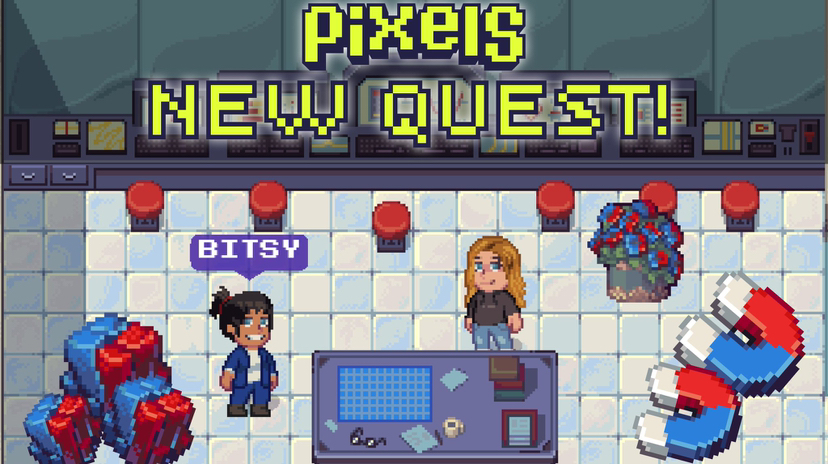
On April 15th, I logged into Pixels as usual and found a long update announcement on the bulletin board. Tier 5 has been launched, with 105 new recipes, the Slot Deed system, and the redesign of the disassembler, which is quite an amount of information. But what really made me pause and ponder was the design logic of the Slot Deed.
Simply put, what is this thing? A Slot Deed is a voucher valid for 30 days, which can be purchased at the Pixels headquarters store. It is divided into two categories: one for the manufacturing industry and one for the resource production industry. Each Slot Deed occupies 20% of your NFT land's T5 capacity. After 30 days, it must be renewed with a Preservation Rune, otherwise your established production line will stop. Preservation Runes can be crafted and traded by players themselves.
What is the essence of this design? Pixels are telling all landowners: your piece of land is no longer a one-time purchase, but an asset that requires continuous operation.
When I first came into contact with#pixel , the value of NFT land mainly came from several aspects: staking bonuses, the scarcity of the land itself, and the industrial layout built on it. But no matter how you lay it out, buying land is a one-time investment, followed by pure output. Many early landowners rarely logged in after buying land; the land automatically generated value while they went off to play other games. Tier 5 completely broke this "easy money" model.@Pixels
Do you want to participate in T5 content? Yes. T5 has brought new industries such as master-level metalworking, wood processing, and stone shaping, as well as new resources like Verdant Soil and Hammeroot Tree. But to unlock these, your land must have a Slot Deed. Deeds will expire, and when they do, you will need to get a Preservation Rune. This item is not directly sold in stores; players have to make and trade it themselves. Throughout this chain, landowners are no longer just passive gatherers of resources, but active participants in the entire T5 ecosystem.
Moreover, the surplus in T5 industries is specifically designed for landowners. If you operate these industries yourself, the production surplus can reach levels of 30% to 45%. This number has already been raised significantly in previous economic adjustments, and T5 further consolidates the position of landholders at the top of the value chain. The production surplus has been compressed to 20% to 35%, and the path of pure handcrafting is becoming narrower, making the advantages of having land more apparent.
Speaking of the Deconstructor, this update transformed the original thing called The Machine into The Deconstructor, placed in the Innovation Department. It can receive specific industrial outputs and break them down into materials needed to create T5 tools. But there is a key limitation—the core material Hearth Fragment requires a very high player level to obtain. This threshold means that T5 content is not something just anyone can touch; you have to level up first. High-level players have a new moat, while new players will need more time to catch up.$PIXEL
Industries T1 to T4 are completely unaffected and continue to operate in parallel. This decision is very pragmatic. If we cut off the old content, all the accumulation of old players would be wasted. Now T5 is incremental, not a replacement; the resources you saved and the industries you built are still useful in the T5 era. There is just a higher-level direction to explore.
This update also adjusted the leveling system of fishing rods, from T1 to T5 tiers, with different levels of fishing rods affecting the types of fish you can catch and their durability. The experience points for wood processing have also been adjusted, making the logging yields more reasonable across different levels. The balance changes for 80 existing recipes are also included, covering a wide range.
To be honest, the design of Slot Deed is rare in blockchain games. Most projects finish selling land NFTs and that's it; subsequent updates have little to do with the land, and landowners have nothing else to do besides staking. Pixels have taken a more complicated route—they actively increased the operational complexity of land, forcing landowners to continuously invest time and resources. This may seem like adding a burden to players, but from another perspective, it protects the long-term interests of landowners. Without a continuous investment mechanism, the scarcity of land would be diluted over time.
I feel that now with the binding of Slot Deed and T5, the value gap between a piece of continuously invested land and a piece of abandoned land will continue to widen. This is true scarcity.