
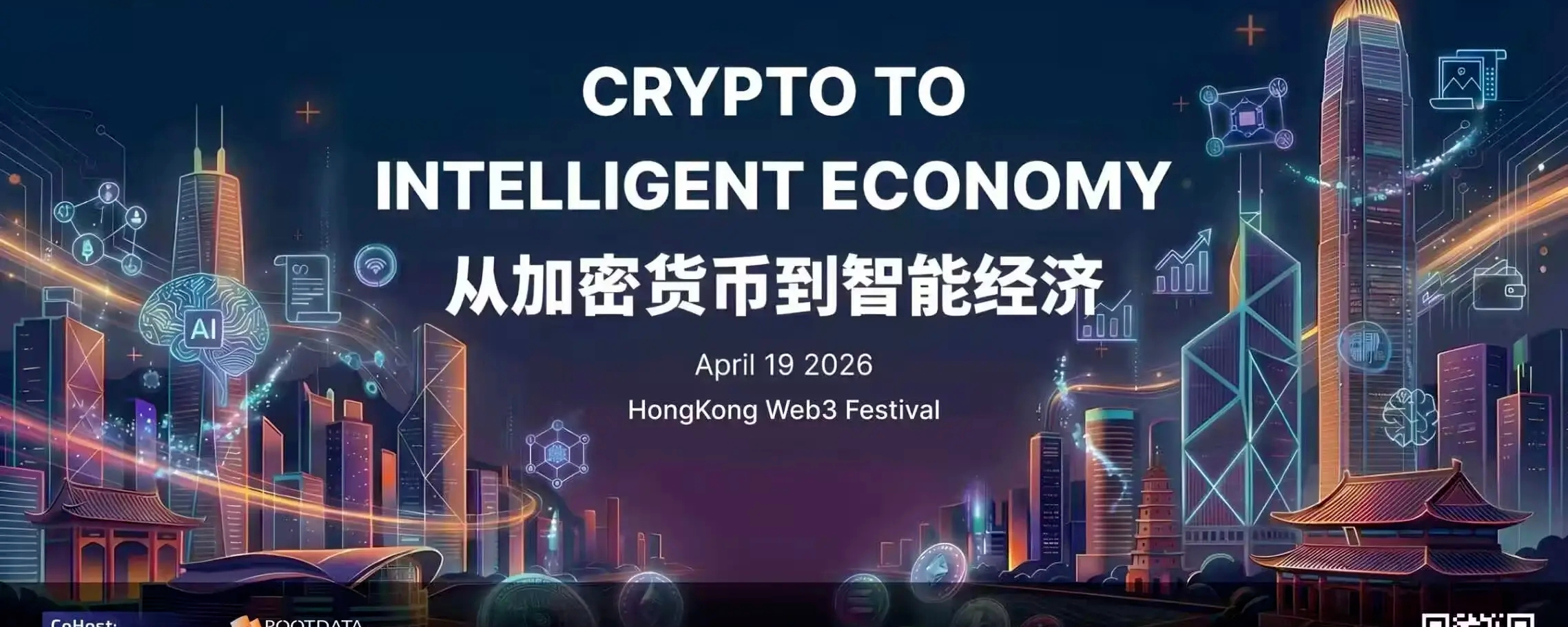
On April 19 at 14:00 ⏰, the themed forum 'Crypto 2026: From Cryptocurrency to Smart Economy', sponsored by Monera Digital and co-initiated by ChainCatcher and RootData, officially opened in Hong Kong 🎤.
As an important peripheral activity of the Hong Kong Web3 Carnival, this forum focuses on the paradigm shift under the deep integration of AI technology and the crypto network 🤖⛓️, engaging in in-depth discussions on cutting-edge tracks such as AI Agent economy, smart payments 💳, RWA, and crypto infrastructure. Many partners including Tencent Cloud ☁️, HashKey Chain 🔗, Alchemy Pay 💸, Kite AI, Sentient, Sign, Predict.fun, Monad, Brevis, UXLINK, OneBullEx, SVP Chain, OmenX jointly support this event 🤝. Only 9 days 📅 since the first batch of stablecoin licenses from the Monetary Authority, this is the industry's first public reveal of the cards after the licensing 🃏.
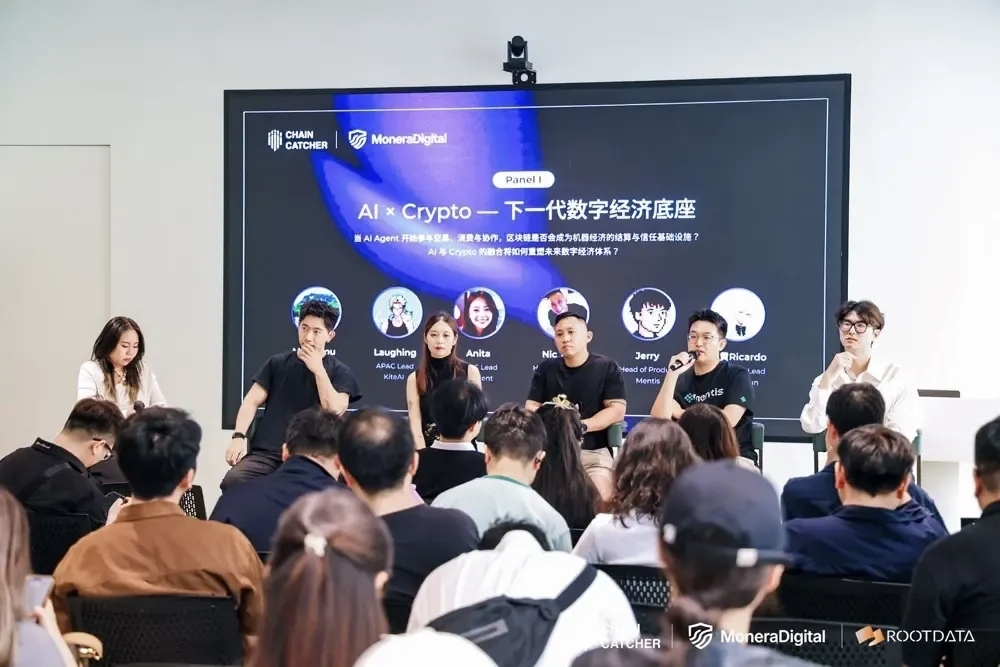
Two roundtables and two keynote speeches🎙️ released a highly consistent signal: the industry is shifting from speculative narratives to practical value💡, AI Agents are transitioning from "conversational" to "executive"⚙️, and compliant RWA and AI payments are highlighted as core engines of the new cycle🎯.🤖 AI Agent Roundtable: From "chat buddies" to "executive entities", trust is the biggest bottleneck. At the roundtable titled "AI × Crypto — Next Generation Digital Economy Foundation", five guests including KiteAI Asia Pacific head Laughing, Sentient Asia Pacific head Anita, Brevis co-founder and CEO Michael, Mentis product head Jerry, and Predict.fun Asia Pacific BD head Ah Huang Ricardo sat together🪑, discussing that the focus is no longer on "what AI can write"📝, but on how AI Agents can transition from conversational to executive, truly starting to autonomously execute economic behaviors on-chain💸. Laughing made it clear: The current explosion of AI Agents marks a paradigm shift from "conversational" to "executive"🔄, which is the beginning of a long-term trend🚀. However, he also pointed out the core bottleneck⚠️—Agents lack a physical identity🆔, making it difficult for merchants to trust their transaction behavior, and issues of data leakage and uncontrollability remain obstacles that must be overcome for scaling🚧.
Jerry supplemented based on his own experience: Current Agents face security risks such as memory confusion🧠, token consumption in loops, and file deletion🔒, while newly emerged Agents, although improved, still have shortcomings. Ah Huang Ricardo bluntly stated that behind the short-term emotions is real user demand👥, but truly reproducible profitable trading Agents are still very rare, and there is still a long way to go🛤️. How to solve the issues of trust and verifiability❓ Michael provided a technical answer: The current execution process of Agents is like a black box📦, and users cannot verify whether their decisions are executed as promised; zero-knowledge proof technology🔐 can mathematically prove the source of Agents' outputs and compliance of behavior while not exposing privacy.
Anita added that Sentient is committed to building an open, collaborative AI agent network🌐, promoting deep integration of AI and blockchain in identity, data, and incentive layers🤝, providing foundational support for the next generation of digital economy🏗️. Regarding the most likely scalable application scenarios, the guests' judgments are very pragmatic✅: The programming field is relatively mature💻, and in the prediction market, Agents perform better than humans in specific tracks due to their rationality and lack of emotions📊. In the short term, they are optimistic about API Marketplace and cross-platform shopping Agents🛒, in the medium term, they are optimistic about content creation AI🎨, while Agent-to-Agent interaction and Agent/Skill Marketplace are seen as important future opportunities🌬️.
🃏 Crypto Value Reassessment Roundtable: "From issuing tokens for the sake of issuing tokens to pursuing sustainable business models" In another roundtable "Reassessing the Value of Crypto and the New Cycle", five guests including Sign partner Sarah, HashKey Chain senior business development YuYi, Monad Greater China ecosystem head Harvey Chen, OmenX chief marketing officer Gisele, and SVP Chain market head Celest sat on stage together🎙️.
It's not about market rises and falls📉📈, nor new coins launching🪙, but the same question: Why is Crypto still worth betting on when the AI boom sweeps the globe🤖?
Sarah's response was the most direct💬: "The hotter AI gets, the more use cases there are for Crypto assets, and in the future, transactions between AI Agents must rely on digital assets." When AI Agents begin to autonomously execute economic behaviors on-chain—payments💸, settlements🏧, asset transfers🔄—what they need are native digital, programmable assets that do not require trusted intermediaries. This is precisely the natural home of Crypto✅.
YuYi provided another dimension of observation from the perspective of the market cycle📊: "The bear market is precisely where the real value is sifted out🌊, compliant RWA is landing🏗️, speculative assets are being eliminated❌, and the era of on-chain infrastructure is arriving." He particularly mentioned that Hong Kong's first physical silver token and other compliant RWA projects are landing🥈, not conceptual hype💭, but real assets are being put on-chain⛓️.
Harvey Chen focused on the technical foundation🏛️: "High-performance public chains are the basis for supporting large-scale applications, and Monad is committed to this." Gisele pointed out that Crypto solves fairness and value transfer⚖️, while AI solves efficiency issues⚡, and the two complement each other. Celest emphasized: "AI does not have a native value system; the more it develops, the more it needs Crypto to provide value verification and decentralized trust."
🔐 Regarding the understanding of Crypto's value changes, the five guests reached a high consensus🤝: The industry is shifting from "issuing tokens for the sake of issuing tokens" to pursuing sustainable business models, paying more attention to funding efficiency💰, low costs📉, 24-hour settlements⏱️, and other practical values. The value of public chains should be assessed based on real business scenarios and user transaction volumes, rather than narratives and financing📊. Regarding future growth engines, the guests are generally optimistic about compliant RWA🏢, AI payments💳, and sovereign blockchains⛓️, advising entrepreneurs to "focus on real application scenarios, avoid empty concepts💭, and maintain a long-term construction mindset"🧱.
☁️ Tencent Cloud: Three major bottlenecks for Web3 enterprises, how does the "Cloud + AI" dual engine break through? At the same forum, Tencent Cloud industry architect Alan Nie delivered a keynote speech titled (Cloud + AI Dual Engine: Tencent Cloud Supports New Growth for Web3)🎤, breaking down the current dilemmas of Web3 enterprises from an infrastructure perspective🔍. Alan Nie pointed out that Web3 enterprises face three major bottlenecks in global infrastructure🌍, R&D efficiency⚙️, and business intelligence🤖.
In plain language💬: node deployment is too slow🐢, R&D efficiency is too low😩, and data analysis is too expensive💸. Tencent Cloud's solution is the deep integration of "Cloud + AI" dual engines🔗. In terms of infrastructure, the globally covered low-latency network is the foundation🌐—the Singapore data center is the only cloud vendor in the world that provides four available zones🇸🇬, and the self-developed TDSQL-C database can achieve second-level elastic expansion⚡, with Redis single-node performance reaching over 300,000📊.
For on-chain applications that require high-frequency read and write and low-latency responses, these numbers mean that there is no longer a need to hoard servers in advance for traffic peaks🖥️, nor to endure data query lags😤. In terms of AI empowerment, Tencent Cloud has launched two tools🛠️: CodeBuddy (AI pair programmer)👨💻 and WorkBuddy (personal AI assistant)🤖.
The former can automatically generate code💻, while the latter can batch process office documents📄, organize meeting minutes📝, and support multiple agents executing complex tasks in parallel⚙️. Alan Nie provided two very convincing scenario data📊: In financial scenarios, the automated research report reproduction cycle has been shortened from 3 days to half a day⏱️; in on-chain data analysis scenarios, storage costs have dropped to one-tenth of the original💰, and query responses have reached millisecond-level⚡.
From 3 days to half a day, costs reduced to one-tenth—these two numbers directly clarify the value of AI efficiency✅. Alan Nie stated that Tencent Cloud is committed to using the "Cloud + AI" dual engine to assist Web3 enterprises in building the next generation of intelligent economic infrastructure🏗️. When AI Agents begin to autonomously execute economic behaviors on-chain, when compliant RWA transitions from concept to reality, and when stablecoin payments are scheduled for Q2—the ability of the underlying infrastructure to support this will determine how far the entire ecosystem can go🛤️.
💳 Alchemy Pay is scheduled for Q2: ACH bears Gas fees, connecting the fiat and crypto economic settlement links. Alchemy Pay's ecosystem leader Arda Senoz delivered a keynote speech titled (Bridging the Fiat and Crypto Global Economies)🎤, throwing out a clear timeline📅: Alchemy Chain will issue stablecoins in Q2 of 2026🪙, connecting wallets👛, merchants🏪, and payment partners🤝 in the settlement links. "We are not building another chain— we are rewriting the syntax of payments✍️."
Arda extracts the real-time topology map of Alchemy Chain🗺️: a light touch on the wallet triggers commands📱, the merchant POS terminal responds synchronously🏧, and the underlying payment partner system automatically completes settlement verification✅—the three no longer rely on centralized gateways or cross-chain bridges🌉, but are directly anchored by the native chain layer for settlement paths🔗.
ACH tokens on-chain serve three major functions: bearing Gas fees⛽, incentives🎁, and governance🗳️. According to the technical roadmap🗓️, the core payment and ACH fee settlement will land in Q4 of 2025💱, liquidity and interoperability will be promoted in Q1 of 2026🔄, and the plan for issuing Alchemy Chain stablecoins and establishing payment channels is set for Q2 of 2026🛤️. "Compliance is not a barrier🚧, it is a track🛤️."
Arda said at the end of the speech that when RWA asset certificates complete on-chain rights confirmation📜, accounting, and clearing💸 on Alchemy Chain, when the QR code📱 scanned at the supermarket checkout is backed by real-time exchange rates💹 and on-chain settlement confirmations✅, at that moment, fiat currency has not "entered" the crypto world—it has always been breathing within the same economic network🌐.
🎯 After the issuance, the industry is no longer discussing "can it be done", but starting to talk about "how to do it". Two roundtables and two keynote speeches thoroughly explained the most core changes in the industry after the issuance📖.
AI Agent is no longer a "chat buddy"💬, but starts to truly work on-chain🔧; Crypto no longer relies on narratives and financing📖💰, but speaks through real business scenarios and user transaction volumes📊; compliant RWA moves from concept to reality🏢, AI payments transition from ideas to a product roadmap scheduled for Q2🗺️; Tencent Cloud tells the industry with "Cloud + AI" dual engines☁️—the infrastructure is ready, just waiting for the vehicles to run on top🏎️. From "issuing tokens for the sake of issuing tokens" to "pursuing sustainable business models", from "speculative assets" to "compliant RWA and AI payments"—the signal released by this afternoon's forum is quite straightforward💬.
After the issuance, the real competition is not who obtains the license🎫, but who can get their vehicle on this highway first🛣️.
📝 This article is based on the public agenda and guest speeches of the ChainCatcher "Crypto 2026: From Cryptocurrency to Smart Economy" forum and does not constitute any investment advice.#稳定币


