
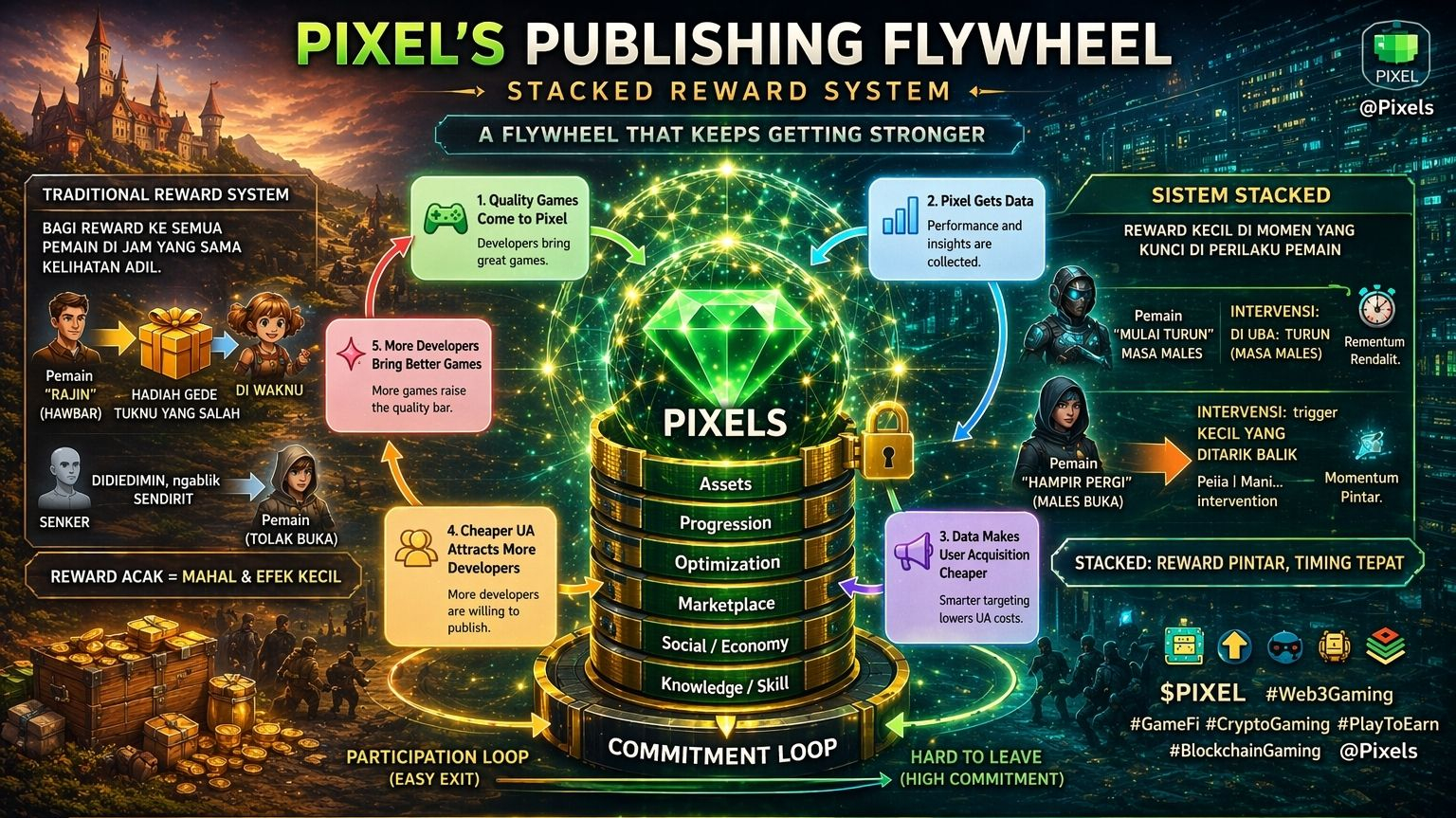
If I were to reduce the question “can Pixels build a commitment loop” to its simplest form, it is no longer about gameplay or rewards, but something much more fundamental: can the system make users feel that leaving is a loss. This sounds similar to retention, but I believe commitment is different—not just about returning, but also about the reluctance to leave.
I see Pixels as a system that is trying to shift from a “participation loop” to a “commitment loop”. It is no longer about “joining for incentives”, but “staying because there is something embedded in the system”. Interestingly, when we start looking at it from this angle, many design decisions in Pixels make much more sense.
Commitment, if simplified, can be seen as an accumulation of sunk costs—not just time, but also assets, positions, and understanding of the system. And Pixels seems to be trying to 'stack' all that. You don't just have assets, but also progress tied to those assets, optimizations linked with progress, and social aspects and marketplaces integrated into the overall process. Each layer might not be strong enough on its own, but when stacked, resilience (holding power) starts to emerge.
This is no longer just a game, but a system where leaving means abandoning the structure built over time.
However, the problem is not all forms of accumulation create real commitment. If what you gather can be easily exchanged and withdrawn, then that commitment can be 'liquidated.' You're not really tethered to the system; you just happen to not want to leave yet.
This is where I see tension in Pixels. On one hand, they want to create an open economy where players have ownership and can exit anytime. On the other hand, to build a commitment loop, some kind of 'friction' for exiting is needed—or at least a sense that exiting is a less optimal choice.
Compared to Web2 games, commitment there often comes from things that can't be converted: accounts, progress, social relationships. You can stop playing, but you can’t 'withdraw' its value. This creates a form of commitment that is quite strong, even if it’s never explicitly stated.
In Pixels, when everything can be valued and transferred, commitment becomes more fragile. You can have lots of assets and progress, but if everything can be converted into numbers and withdrawn, then the decision to hold or exit becomes purely an economic one.
The difference is here: Web2 'locks' you into the system, while Pixels has to 'convince' you to stay through value. But the underlying logic remains the same: if users don’t feel a loss when they leave, then the commitment loop doesn’t truly exist.
Interestingly, Pixels seems to be trying to solve this by creating layers whose value doesn’t solely derive from liquidity. For example, efficiency in gameplay, position in the marketplace, or even understanding how to optimize the system. These aspects are harder to withdraw, and therefore can create a form of 'soft commitment.'
It's not just about owning assets, but about understanding how to use those assets better than others—and this knowledge isn't easily convertible into cash.
But then the question arises: is this form of 'soft commitment' strong enough when faced with market volatility? When incentives drop and prices fall, is efficiency and knowledge enough to keep players hanging on?
The real challenge is building a commitment loop without compromising the system's openness. If too much is locked up, the on-chain strength is lost. If it's too open, the system's resilience weakens.
This brings me back to one thought: commitment is not something that can be designed directly, but rather something that emerges from the interaction between layers in the system. We can facilitate it, but we can't force it.
I don’t think Pixels has fully established a strong commitment loop yet, but I feel they're heading in that direction by 'stacking' various forms of accumulation—from assets, progress, to knowledge. This doesn't guarantee players will stick around, but at least makes the decision to exit more 'thought-out.'
Perhaps the ultimate question is no longer 'does Pixels have a commitment loop?', but 'where is the balance point between liquidity and commitment?'. Because if commitment is too weak, the system just becomes a value extraction site. But if it’s too strong, it loses the openness that made it stand out in the first place.
I'm not sure Pixels will fully solve this issue, but that’s precisely why this project is worth following—because it’s trying to build something that hasn’t been successfully done by previous systems: keeping users engaged without having to lock them in.